

Late nights with a spreadsheet open, VAT work pushed to the edge, and a finance controller handing in notice just before year end. That's when most founders finally stop treating accounting and outsourcing as a tidy efficiency project and start seeing it for what it is, a control issue. If the finance team is stretched, the cost isn't just fees, it's missed deadlines, weak visibility and management time burned on avoidable rework.
UK businesses have already made that call in large numbers. The British Chambers of Commerce said in 2024 that 59% of firms were using some form of outsourcing, and 41% had increased it in the previous 12 months. In the same period, NHS England was still spending about £10 billion a year on private providers for services including elective care, diagnostics and community services, which shows how normal large-scale outsourcing has become when capacity matters and the work has to keep moving. UK outsourcing and accounting adoption data
For finance leaders, the useful question isn't whether outsourcing is fashionable. It's whether the current finance function is protecting cash, keeping reporting clean and giving leadership enough time to make decisions. In most growing SMEs, the answer is no, and that's exactly why accounting and outsourcing belongs in the boardroom, not in the back office.
Why UK SMEs Are Rethinking Accounting and Outsourcing in 2026
A typical SME finance story is brutally familiar. The books are behind, the VAT return is due, the month-end pack is half-built, and the person who knew where everything lived has just left. The founder is now checking receipts at 9pm, not because the business has failed, but because the finance function was built for a smaller company and never reset for growth.
That pressure is not a one-off staffing problem. UK professional and business services contributed around £300 billion in gross value added and employed more than 5.8 million people in 2023, so finance sits inside a huge, busy labour market rather than a neat little niche. Yet the labour market is still tight. The ONS reported that in late 2024 around 70% of businesses in finance and insurance expected recruitment difficulties, and 41% of all UK businesses reported labour shortages in the previous month. UK finance and accounting outsourcing trends
Practical rule: if the finance function keeps breaking whenever one person is absent, it's undersized, not “lean”.
That is why outsourcing has shifted from a temporary patch to a commercial decision. Research on outsourcing drivers found that understaffing is the primary reason firms outsource, with cost savings second. That matters because it cuts through the fantasy that outsourcing is mainly about shaving a few pounds off payroll. For UK SMEs, it's about capacity, continuity and keeping statutory work on the rails when the internal team is already at full stretch. Outsourcing drivers research
The inflection point comes when management starts asking whether finance is helping the business run or merely reacting to it. Once that question is on the table, accounting and outsourcing stops being a procurement choice and becomes a finance design choice.
What You Can Actually Outsource in a Finance Function
A finance function is easier to manage when it's treated like a building. The base is the transactional work, the middle holds compliance, the next layer is management reporting, and the roof is strategic finance. Not every business needs the same mix, but every business needs to know which floors it wants to own and which it can safely hand out.
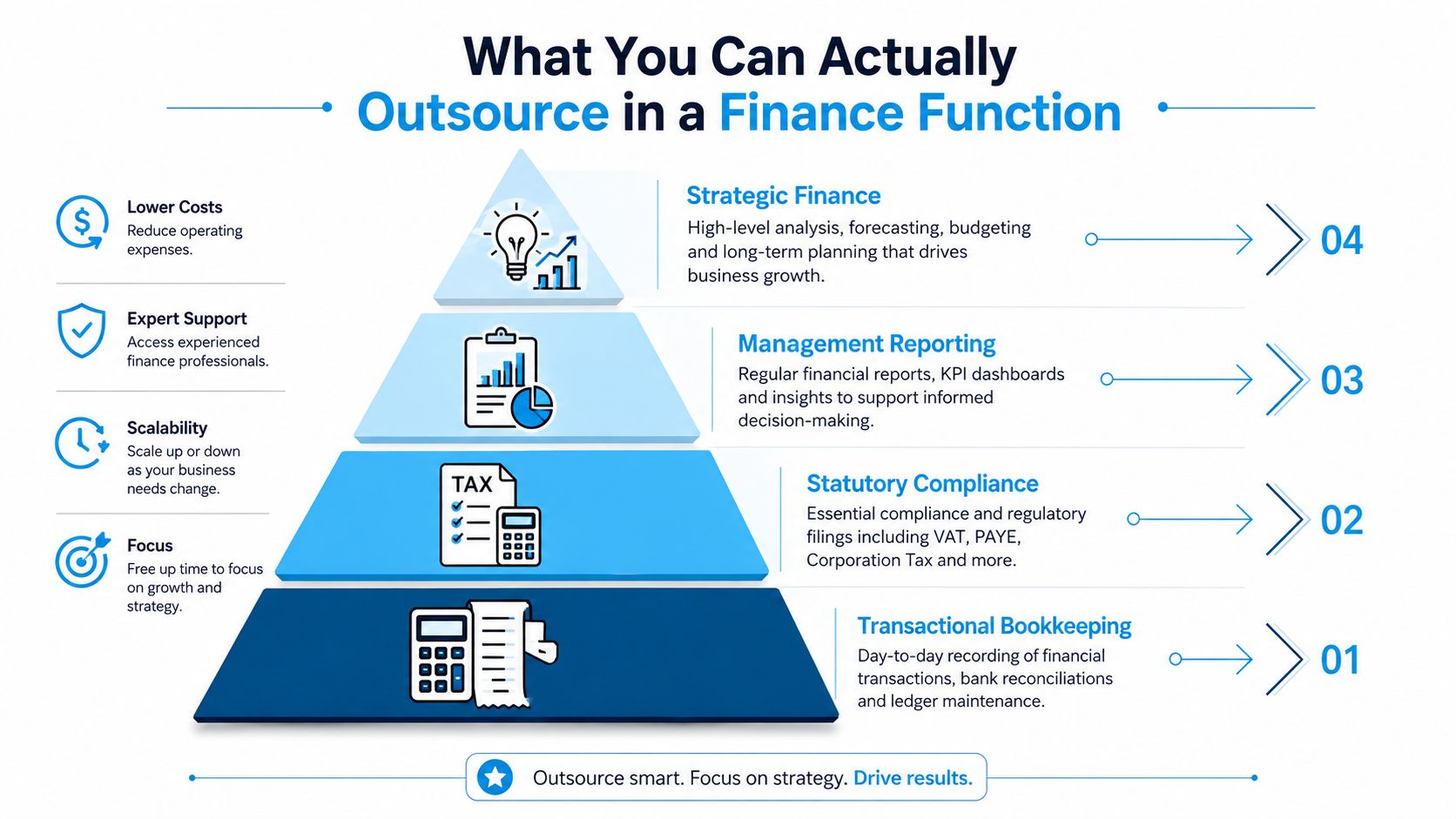
Start with transactional bookkeeping
This is the bottom layer, the receipts, bank feeds, reconciliations and ledger coding that keep the books alive. It's the least strategic work, but it still has to be accurate, fast and properly supervised. A clean monthly bookkeeping process can be outsourced without giving up control, as long as the client keeps approval rights, review points and access to the underlying records.
For teams running cloud accounting and repeatable month-end tasks, a useful starting point is monthly accounting and quarterly bookkeeping. That kind of support fits the businesses that need reliable data flowing in, not a full internal finance team sitting on payroll.
Move upward to statutory compliance
This middle layer covers VAT, PAYE, Corporation Tax support and the preparation of Statutory Accounts. It's the point where weak process becomes expensive, because mistakes here create HMRC problems, slow sign-off and distract directors from trading. Outsourcing works here when the provider understands deadlines, controls and the records needed to defend the numbers later.
Outsource the process, not the responsibility. Directors still own the filing risk.
Use management reporting where it changes decisions
This layer is where outsourcing becomes valuable. A provider that prepares management accounts, cashflow views and board packs can improve visibility far more than a team that only clears transactions. The study in the verified data found that outsourcing essential accounting functions, including mandatory financial statements, improved financial reporting quality, while outsourcing additional functions such as payroll processing did not improve quality. Financial reporting quality and outsourced accounting
Keep strategic finance close to the business
At the top sits part-time or fractional FD support. That is where finance turns from record-keeping into commercial steering, with input on pricing, working capital, funding, and decision support. For growth companies, that's often the point where a fractional role beats hiring a full-time senior finance leader too early.
For an example of structured external finance leadership, AI agent for finance teams is worth a look as a category resource, because it shows how teams are rethinking routine work before they scale headcount.
The Four Outsourcing Models and How to Choose One
The wrong model creates false savings. A cheap setup that can't handle month-end, doesn't understand UK compliance, or leaves communication scattered across inboxes will end up costing more in rework than it saves in fees. The right model depends on how much control the business wants, how much capacity it needs and how much complexity sits inside the numbers.
Match the model to the business stage
A full-service UK accountancy firm suits owners who want one accountable provider across bookkeeping, compliance and reporting. It usually costs more, but communication is easier and the UK compliance fit is stronger.
A freelance bookkeeper using cloud software works when the job is narrow and the owner still wants to keep decisions close. The upside is flexibility. The weakness is coverage, because the model often stops at transaction processing and basic reconciliations.
An offshore business process outsourcer can suit process-heavy work where the business wants scale and lower labour cost. The trade-off is that communication, time zones and control standards need more management. It can work, but only if the business has strong internal oversight and clear service levels.
A fractional or outsourced Finance Director fits businesses that already have transactional support but lack strategic finance leadership. The external model is most obviously commercial in this scenario, because it can sharpen cash control and decision support without adding permanent senior headcount.
Use five criteria, not one
The model should be judged on cost, control, compliance, communication and capacity flexibility. Cost matters, but it should never outrank control in a finance function. If the reporting is late or the records are weak, the apparent saving is an illusion.
A UK buyer also needs to separate outsourcing from offshoring. Outsourcing is about handing work to a third party. Offshoring adds geography and governance complexity, which matters when UK GDPR, UK GAAP and HMRC readiness are essential.
For businesses comparing a more senior model, outsourced Finance Director services are usually the right benchmark when the issue is not bookkeeping capacity but commercial direction.
What Accounting and Outsourcing Really Costs in the UK
The lazy answer is “it depends”. That's not helpful for a finance director trying to budget properly. A better answer is to think in service blocks and test the quote against what's included, what's excluded and what internal time still gets consumed.
| Service | Indicative monthly fee | Typically included | Watch for add-ons |
|---|---|---|---|
| Bookkeeping and bank reconciliations | Varies by transaction volume | Posting, reconciliations, basic housekeeping | Software licences, historic clean-up |
| Management accounts | Varies by reporting depth | Month-end pack, commentary, review call | Consolidations, board reporting, rush turnaround |
| VAT returns | Varies by complexity | Return preparation, filing support | Partial exemption, corrections, HMRC queries |
| Payroll | Varies by headcount and pay frequency | Routine payroll processing, payslips, filings | Auto-enrolment complexity, leavers and starters volume |
| Year-end statutory accounts | Varies by entity complexity | Statutory accounts preparation | Group structures, dormant entities, advisory work |
| Fractional FD support | Varies by scope and cadence | Finance leadership, cash review, planning | Funding work, deeper modelling, project spikes |
The issue is total cost of ownership. A quote that looks lean on paper can still become expensive if it triggers parallel-running, extra software costs, or repeated partner time to fix avoidable errors. That's why the cheapest monthly fee is often the most expensive engagement.
For directors comparing senior support, how much fractional executives cost is a useful external benchmark for understanding why strategic finance should be priced as an outcome role, not just an hourly admin function.
One further point: some work should almost always be priced separately. R&D claim support, multi-entity consolidation, HMRC investigations and unusual year-end work are not basic bookkeeping, and they should not be buried inside a vague retainer.
Choosing an Outsourcing Partner Without Losing Control
The provider's sales pitch is irrelevant if the control framework is weak. The right checklist is blunt: accreditation, contract terms, security and operational proof. If a shortlisted provider can't answer those points cleanly, it's not ready for finance work.
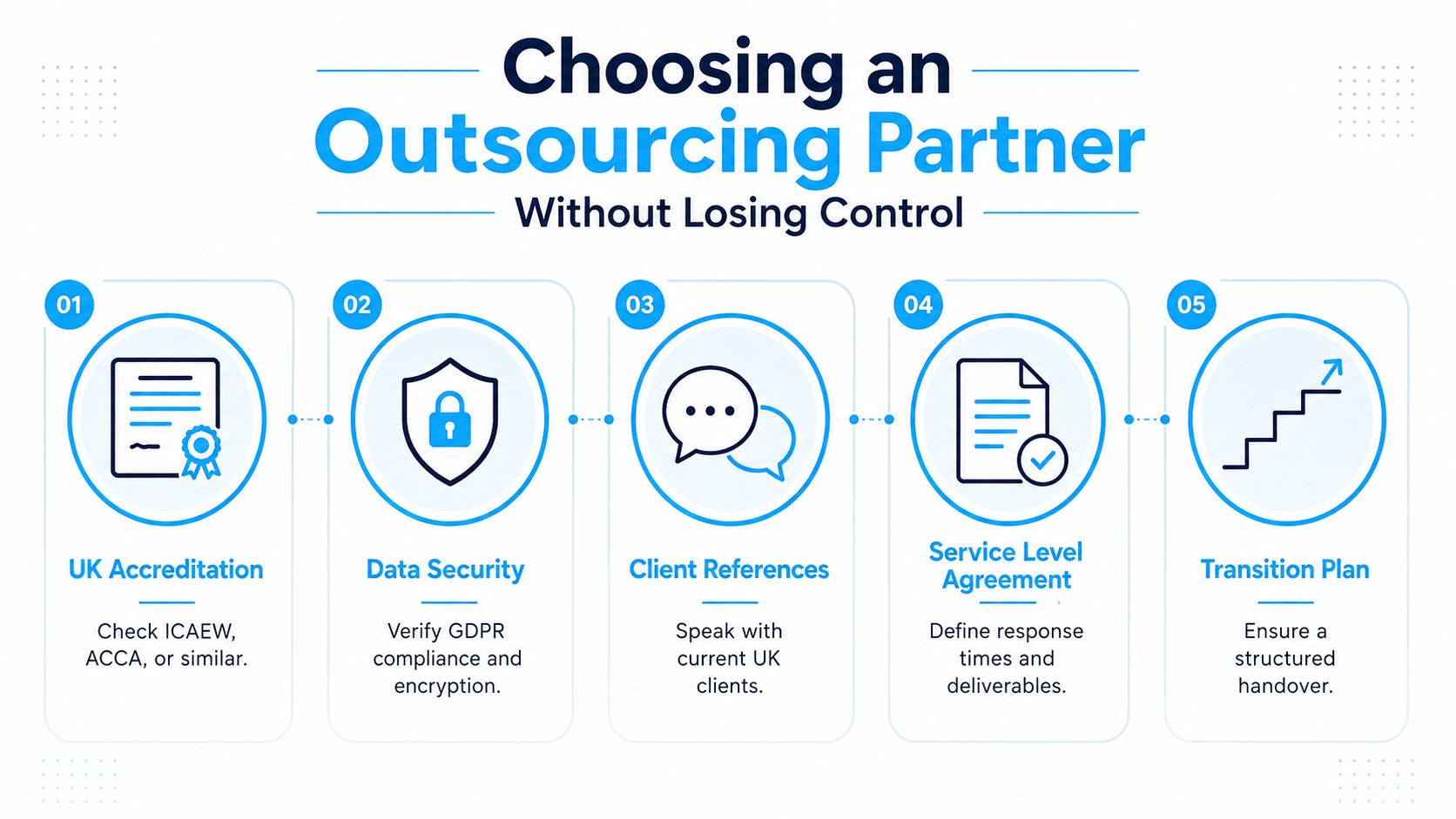
Check the credentials first
A serious provider should show ICAEW or ACCA registration where relevant and carry professional indemnity cover. That does not guarantee quality, but it does show the business sits inside a proper professional framework.
Demand the contract terms in writing
A compliant setup should evidence GDPR controller and processor terms, an Article 28-style data processing agreement, a transfer mechanism where data leaves the UK, access controls, logging and an incident-response SLA before any scale-up. Those are not legal niceties. They are the basic controls that protect payroll, VAT records and management accounts from becoming an operational mess. The practical procurement test is simple, where is the data processed, where is it backed up and which legal entity signs the transfer agreement? Secure and compliant accounting outsourcing guide
Test the operating discipline
The provider should be able to show MFA coverage, patching SLAs and restore-testing evidence. If that sounds tedious, good. Finance data is tedious, and that's precisely why the controls have to be boring and documented.
A strong shortlist usually includes providers that can explain data location, escalation paths and the handover plan without drifting into jargon. The monthly accounting and quarterly bookkeeping offer from striveX Ltd fits here when the business wants recurring support with a defined reporting rhythm, but the same standards should be applied to any provider under consideration.
Three questions should end every pitch: where is the data processed, who signs the transfer agreement and what is the restore-time objective?
Measuring Whether the Engagement Is Actually Working
Most outsourcing relationships sound fine in the first month. The truth shows up after the first cycle of rework, the first payment exception and the first close that should have been quicker. That is why the scorecard needs to be process-based, not sales-based.
Use four KPIs that finance leaders actually care about
Days Sales Outstanding shows how quickly cash is coming in. If DSO falls after outsourcing, and invoice cycle time shortens at the same time, the provider is improving order-to-cash discipline rather than just moving work off payroll.
Invoice cycle time measures how long it takes to raise and process invoices. That matters because it affects billing speed, dispute handling and working-capital control.
Payment error rate shows whether the provider is creating exceptions. Industry guidance for outsourced accounting sets a benchmark of keeping error rates below 1% and delivering finance outputs in under 48 hours. Those are sensible operating checks because they tie quality to speed rather than to vague satisfaction. Outsourced accounting KPI guidance
Cost per invoice is the cleanest way to compare throughput over time. If that number rises while quality falls, the business is paying for rework and complexity, not efficiency.
Read the signal, not just the number
A lower error rate with shorter close times usually means the handover worked. A rising error rate means the business is absorbing hidden costs, even if the supplier's fee looks stable. That's why a monthly review pack should be short, hard and numerical.
For businesses wanting a formal reporting rhythm, KPI tracking and reporting keeps the conversation anchored in the metrics that matter instead of in anecdotes.
If the supplier can't explain the movement in DSO and invoice cycle time, it probably doesn't understand the process well enough.
Change Management That Stops Outsourcing Going Wrong
The biggest failures are rarely about accounting skill. They come from sloppy handover. Parallel-running lasts too long, historical data isn't cleaned properly, the RACI between the in-house team and provider is vague, and nobody has agreed how to exit if the arrangement breaks.
The fix is disciplined and unglamorous. Start with a proper assessment of current systems and controls. Then secure access, clean the data, run a short pilot and only then scale the work. That sequence keeps the business from handing over a broken process and then paying someone else to debug it.
Four failure patterns to kill early
- Parallel-running for too long: it creates confusion about ownership and lets errors survive in both systems.
- Weak historical data cleansing: bad opening balances and messy ledgers contaminate every report that follows.
- Unclear RACI: when nobody knows who approves, posts or reviews, month-end drifts.
- No exit plan: if the contract ends badly, the business needs data portability and a clean handover route.
Outsourcing is a finance-function redesign, not a procurement exercise. That means leadership involvement stays essential, because only leadership can decide what stays inside, what moves out and what control points must never be diluted.
FAQs and Next Steps for Outsourced Finance
How much does outsourced accounting cost in the UK?
It varies by scope, entity complexity and reporting cadence. Transactional bookkeeping, VAT, payroll, year-end accounts and fractional FD support are usually priced separately or bundled by scope. The cheapest headline fee rarely reflects the full cost once software, onboarding and rework are included.
How long does it take to onboard an outsourced finance provider?
A clean onboarding should be measured in phases, not guesses. The practical sequence is assess, secure access, cleanse data, pilot and scale. If a provider tries to skip the pilot, control often suffers later.
What should stay in-house when accounting is outsourced?
Approval of payments, commercial decisions, supplier relationships and board-level judgement should stay close to the business. Outsourcing should remove processing load, not strip directors of control.
Can VAT and Corporation Tax be outsourced safely?
Yes, if the provider has the right controls, the records are clean and responsibility is clearly assigned. The business still owns the filing risk, so compliance work must be reviewed, documented and traceable.
striveX Ltd supports UK businesses that want outsourced finance without losing visibility, control or commercial grip. The firm handles bookkeeping, reporting, tax and finance leadership for growing companies, so the finance function works as a decision tool rather than a daily distraction. To talk through the right model for your business, visit striveX Ltd and book a conversation that fits your current finance setup.
This article is for informational purposes only and does not constitute professional advice. Tax rules apply as of April 2026. Consult a qualified accountant for your specific circumstances.
