

A director opens the 60-page PDF at 9pm, searches for cash, skips past three versions of the KPI tables and reaches the forecast without knowing which decisions the board needs to make. The meeting starts with questions about missing context, not choices about hiring, pricing, borrowing or investment.
For a UK company turning over £1 million to £15 million, the problem usually isn't a lack of information. It's a poorly assembled board pack. The useful version is shorter, decision-led and honest about exceptions. It protects cash, surfaces risks early and gives the board room to discuss strategy rather than reconstruct last month.
The practical standard is simple: lead with decisions required, then show performance, risks and cash. The structure below turns monthly management information into board reporting that directors, non executive directors, investors and lenders can use.
The Monthly Board Meeting Most UK SMEs Already Know
The familiar meeting begins with a pack that grew by attachment. Management accounts sit beside a sales report, which sits beside a project update, which sits beside a risk register nobody has reconciled. Each paper may be reasonable alone. Together, they force directors to assemble the story themselves.
That wastes expensive board time. Directors need to know whether margins are deteriorating, whether cash headroom is tightening, whether the forecast remains credible and what management wants approved. A report that makes them hunt for those answers has failed, even when every number is technically correct.
A useful board pack creates a common starting point. Its opening page identifies the decision, recommendation, financial effect, principal risk and accountable owner. The following pages provide enough evidence to challenge the recommendation, not a full archive of every operational detail.
The same discipline applies when investors or lenders attend. They want a clear view of performance, assumptions and control, rather than a larger PDF. Teams preparing recurring investor materials may find this guide to SaaS board deck metrics investors want useful when deciding which commercial measures deserve prominence.
The board meeting itself still matters. A clear approach to board meetings keeps discussion focused, but the pack must do the preparatory work first. It should tell directors what changed, why it changed and what action is required.
Why Most Board Packs Fail to Drive Decisions
Most weak packs fail in three predictable ways.
First, they are data dumps. The preparer includes every available report because removing information feels risky. In practice, excess detail can hide the few issues that need challenge.
Second, papers have no clear owner. A board sees a variance, but nobody is accountable for explaining it or correcting it. Third, the pack doesn't state the decision required. Directors discuss the number, then leave the meeting without a recorded intervention.
UK governance guidance says board papers should be relevant, concise, reliable and structured to support debate, challenge and decisions. It also warns against collecting information that isn't used. That principle should govern every recurring page in a growing company's pack. (UK government corporate governance guidance)
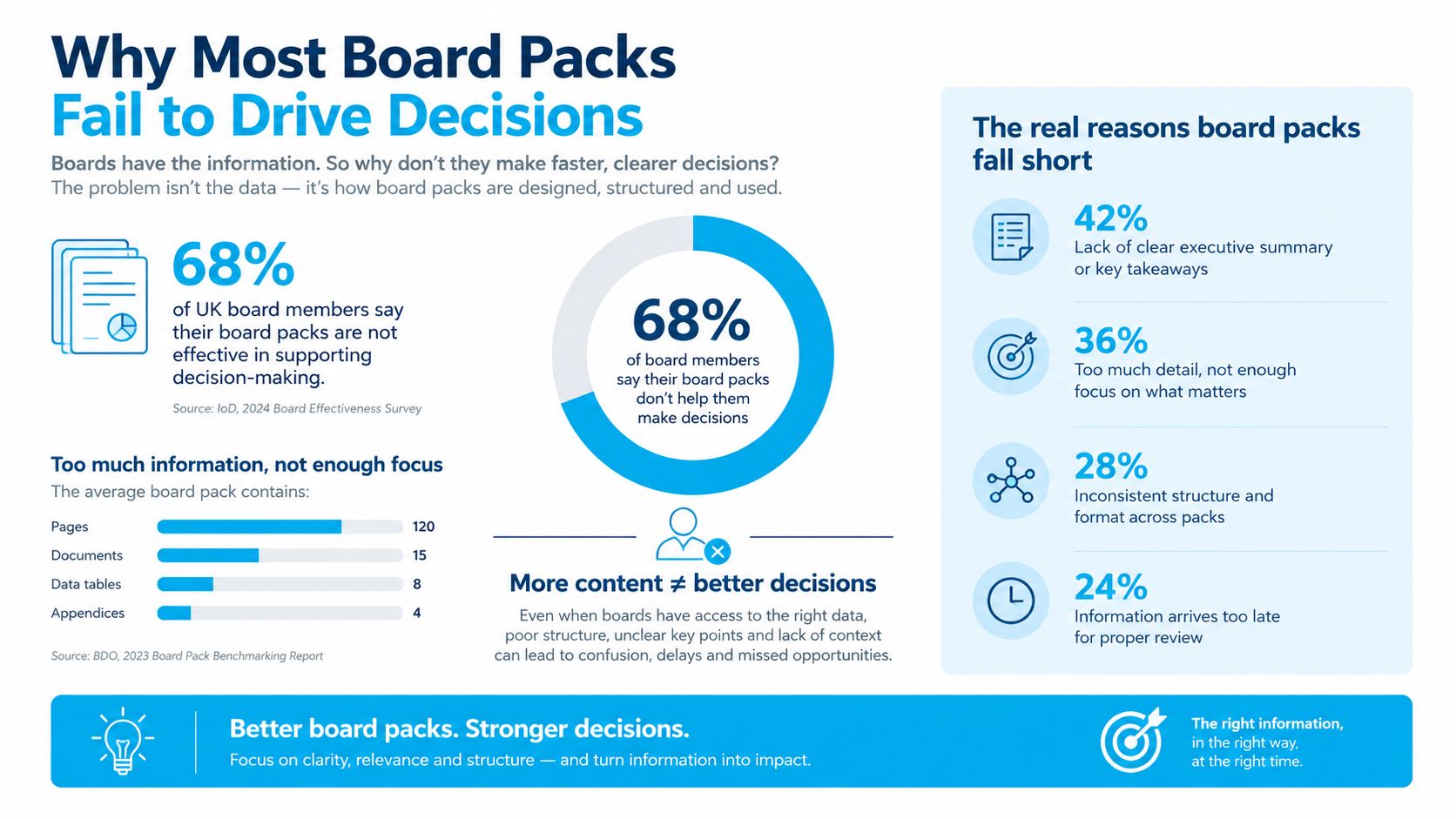
The scale of the problem is clear. Research covering more than 1,000 organisations found that 68% rated their board materials as weak or poor, while only 1% rated them excellent. In 2024, just 36% of directors said their board packs added value, down from 48% in 2023. (Board Intelligence research)
Practical rule: More transparency isn't automatically better governance. If directors can't see what matters, added information reduces control.
The answer is a fixed page budget and four purposes for content: approval, assurance, escalation and monitoring. Anything that serves none of these purposes belongs in a dashboard, data room or appendix. The board pack should be a decision-control system, not a monthly storage facility.
What Belongs in a Board Pack for a Growing UK Business
The first page should be a one-page decision summary. Each item needs a plain-English description of the decision, management's recommendation, the financial impact, the main risk and a named owner. If no decision is required, the paper should say whether it is for discussion, assurance or monitoring.
The remaining content should answer four questions.
What changed? Headline KPIs should show actual performance, budget, prior period and forecast, with a short explanation of material movements.
Can the business fund its plan? Show cash, working capital, borrowing headroom and the forward forecast. The board needs early warning of pressure, not a historic cash balance alone.
What could alter the outcome? Include principal risks and opportunities, with probability, potential effect, mitigation and owner. AI, cyber and supplier dependencies deserve evidence, not vague labels.
Did the business do what the board agreed? Carry forward actions with status, owner, deadline and outcome. A decision without follow-up is only an intention.
For a company in the £1 million to £15 million turnover range, a useful minimum dashboard normally combines monthly turnover and gross margin, operating profit, cash runway, aged receivables, covenant or borrowing headroom, forecast-versus-actual variance and sector-specific operating drivers. Remove any metric that doesn't change a decision.
| Section | Board purpose | Minimum data | Decision triggered |
|---|---|---|---|
| Decision summary | Approval or escalation | Recommendation, impact, risk, owner | Approve, reject or request more evidence |
| KPI dashboard | Monitoring | Actual, budget, prior period, forecast | Investigate or change operating action |
| Cash and forecast | Assurance | Cash position, runway, headroom, scenarios | Protect liquidity or revise spending |
| Risks and opportunities | Escalation | Exposure, mitigation, owner, movement | Accept, mitigate or invest |
| Action log | Follow-up | Decision, owner, deadline, status | Escalate delay or close action |
Management accounts remain essential, but they need interpretation. A concise guide to management accounts helps separate the accounting record from the board narrative. The board pack should explain what the numbers mean commercially.
A Simple Board Pack Layout You Can Use This Month
A practical layout moves from decisions to evidence, then from risk to accountability.
Cover sheet. List the meeting date, papers, owner and classification: for decision, for discussion or for assurance.
One-page decision summary. Put requested approvals and escalations first. State the recommendation and consequence of delay.
Headline KPI dashboard. Use a consistent hierarchy. Add exception commentary beside the measure, not on a distant page.
Cash position and rolling forecast. Show current cash, expected inflows and outflows, borrowing headroom and the assumptions most likely to move the result.
Risk register. Include movement since the previous meeting, mitigation and accountable owner. Add material cyber, AI, privacy and supplier exposures where relevant.
Opportunities register. Describe the commercial upside, required investment, dependencies and decision date.
Carried-forward actions log. Record the original decision, owner, deadline, current status and outcome.
Appendix. Place detailed management accounts, reconciliations and supporting schedules here unless a director needs them for a decision.
The appendix isn't a dumping ground. It should contain evidence that supports the main papers, while the main pack carries the narrative and action. Directors can request detail when a variance, risk or proposal warrants deeper examination.
The FRC expects board papers to be accurate, clear, complete and up to date, with a summary of contents and a clear explanation of what directors are expected to do. (FRC corporate governance guidance) That makes the order above more than a formatting preference. It helps directors reach the right question faster.
Cadence and Timing That Protect Decision Quality
A board pack delivered late becomes a presentation pack. Directors skim it, management explains it aloud and the meeting spends time discovering information that should have been read beforehand.
The Chartered Governance Institute recommends that packs are usually supplied five working days before a meeting. NHS board-reporting guidance recommends no less than seven days, except in exceptional circumstances. (CGI specimen report cover sheet guidance)
A workable monthly timetable is:
Working day 8: monthly accounts finalised and reviewed.
Working day 10: board papers drafted, with commentary and recommendations.
Working day 12: director or senior management challenge completed.
At least five working days before the meeting: final pack distributed.
Monthly reporting suits a company where cash, hiring, customer concentration or delivery commitments can change quickly. Quarterly meetings may suit a stable business, but a quarterly strategic review plus a monthly KPI exception report is often more useful than a quarterly data dump. A business scaling past £5 million turnover should usually test whether quarterly oversight still catches problems early enough.
Timing also affects commentary quality. Each paper should separate actual results, forecast, prior period and budget, then explain the operational cause, direction and duration of any material variance.
The next pack must show whether last month's decisions worked. A recruitment approval should have an implementation status. A working-capital intervention should show the effect on receivables or cash. This closes the control loop and gives the board evidence about outcomes, not just resolutions.
Sector Examples for SaaS, Construction and Manufacturing
The framework stays consistent, but the signals change by sector.
A SaaS board pack should focus on recurring turnover, net revenue retention, gross margin, cash runway and burn multiple. The decisions usually concern pricing, hiring pace, product investment and capital allocation. A metric belongs in the pack only when it changes one of those choices or exposes a risk to the plan.
Construction requires a different cash lens. Contract margin, retentions, aged receivables and application-for-payment timing reveal whether reported work is converting into cash. Subcontractor terms, bond exposure and disputed variations may deserve escalation even where turnover appears strong. Businesses operating in this environment can use specialist guidance from construction accountants.
Manufacturing boards should look at throughput, material cost variance, stock turn and borrowing headroom. These measures connect operational performance to pricing, capacity investment and covenant compliance. A margin issue caused by material costs needs a different decision from one caused by downtime or poor production mix.
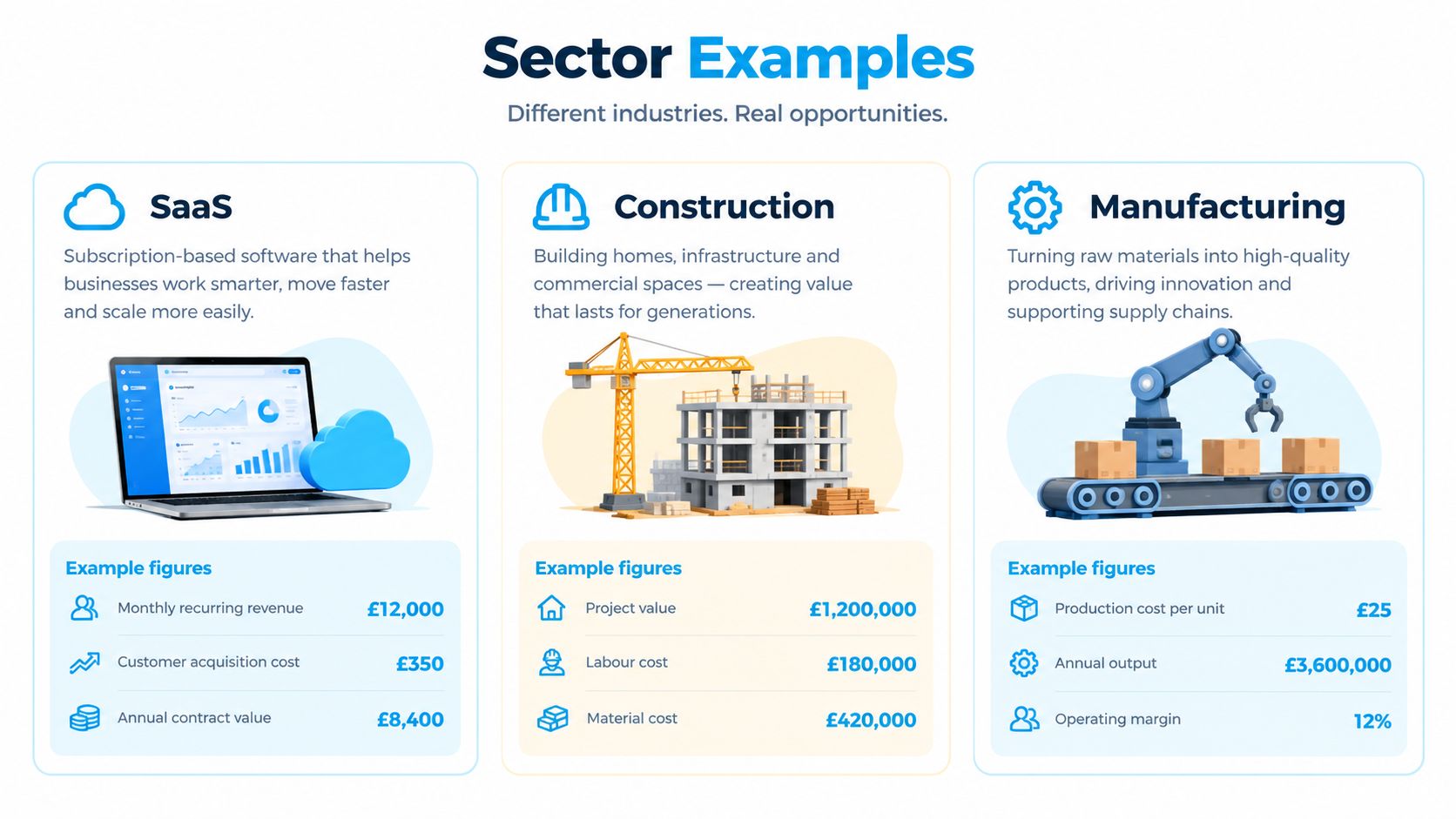
Anonymised client patterns are useful here. A growing software company may need a hiring decision because its forecast assumes delivery capacity that hasn't been funded. A contractor may need a cash intervention because certified work isn't being collected. A manufacturer may need pricing action because material variance has eroded contribution. In each case, the KPI is valuable because it points to an owner and a decision.
Putting It Together and Frequently Asked Questions
The first week of improvement doesn't need a new system. Set a page budget, build the one-page decision summary, fix the close timetable and retire one redundant report from this month's pack. A finance director can design and run that process alongside the existing team. For companies that need additional capacity, striveX Ltd provides outsourced finance function support for fast-growth UK businesses, including board-style management packs.
How does a board pack differ from management accounts?
Management accounts record and explain financial performance for management. A board pack includes selected management information plus decisions, risks, cash, forecasts, actions and context required for director oversight. Statutory Accounts serve a separate compliance purpose and don't replace current internal reporting. (Companies House annual accounts guidance)
How long should a board pack be?
There is no useful universal page count. The pack should fit a defined page budget and move detailed schedules into an appendix. UK evidence shows that large packs can become difficult to use. The right test is whether directors can identify decisions, risks, cash pressures and owners before the meeting.
Who prepares a board pack?
The finance director or CFO usually owns financial content, while a company secretary, finance manager or executive assistant may coordinate the full pack. Each paper needs a named operational owner. The board chair should challenge whether the pack supports the agenda and gives directors enough time to prepare.
What should non executive directors look for?
Non executive directors should look for unexplained variances, weak assumptions, cash pressure, conflicts, concentration risk, overdue actions and decisions without owners. They should ask whether the forecast reflects operational reality and whether management has disclosed bad news clearly. Directors' duties under sections 171–177 of the Companies Act 2006 include independent judgement and reasonable care, skill and diligence. (CGI summary of directors' general duties)
What is a board pack?
A board pack is a structured set of papers sent before a board meeting. It normally combines a decision summary, financial and operational KPIs, cash and forecast information, risks, opportunities and actions. Its purpose is to help directors challenge management and make informed decisions, not to reproduce every report produced inside the company.
This article is for informational purposes only and does not constitute professional advice. Tax rules apply as of April 2026. Consult a qualified accountant for your specific circumstances.
