

A heads of terms lands on the MD's desk, the unit looks right, the fit-out budget is moving, and someone says the magic words, “We'll just sort the VAT later.” That is usually how a commercial property deal starts to leak cash. The VAT treatment can change who funds the transaction, who recovers input tax, and whether the project protects margin or destroys it.
For a UK business turning over £1 million to £15 million, VAT on commercial property is not a technical sideshow. It affects purchase price, rent, legal fees, refurbishment spend, and the cash tied up in the deal itself. In the UK, the commercial property sector was estimated to generate around £3.9 billion in net VAT payments in 2009–2010, roughly 4.1% of total VAT paid in the UK economy, according to an IPF and Oxford Economics analysis (IPF and Oxford Economics analysis).
That matters because VAT on property is rarely just a compliance issue. It is a working-capital decision, and often a negotiation point. Get it wrong, and the business can end up financing VAT it never expected to fund, while also losing recovery on related costs.
Why VAT on Commercial Property Deserves a Second Look
A finance director signs a warehouse deal, then finds the seller has opted to tax. The purchase price still looks workable, but the legal bill is climbing and the fit-out contractor is already pricing materials. The question is how much VAT the business will have to fund upfront, and whether any of it can be recovered.
For a UK business turning over £1 million to £15 million, that question changes the deal economics fast. VAT on commercial property affects the headline price, but it also hits legal fees, professional costs, and refurbishment spend. If the structure is wrong, the company ends up holding a useful asset with avoidable tax drag attached to it.
Practical rule: treat property VAT as part of the transaction price, not as an afterthought. If the VAT position is unclear, the deal is not ready to sign.
The wider UK VAT system shows how large and concentrated the field is. In 2024–2025, total VAT receipts reached £171 billion, up from £168 billion in 2023–2024, and the VAT population stood at 2,330,400 traders, with 234,000 new registrations and 218,000 de-registrations in-year (HMRC VAT annual statistics). Within that population, Real Estate Activities accounted for 112,800 traders. Businesses with turnover above £10 million paid 75% of total net Home VAT liability, which tells you where HMRC's money sits and why property decisions get attention fast.
That scale matters because property VAT sits inside a system where timing, classification, and cash recovery all bite. For an MD, the issue is simple. Get the VAT treatment right, and you protect working capital. Get it wrong, and the business funds tax it did not need to fund, while losing recovery on linked costs.
The Default VAT Position for Commercial Property
Start with the exemption rule
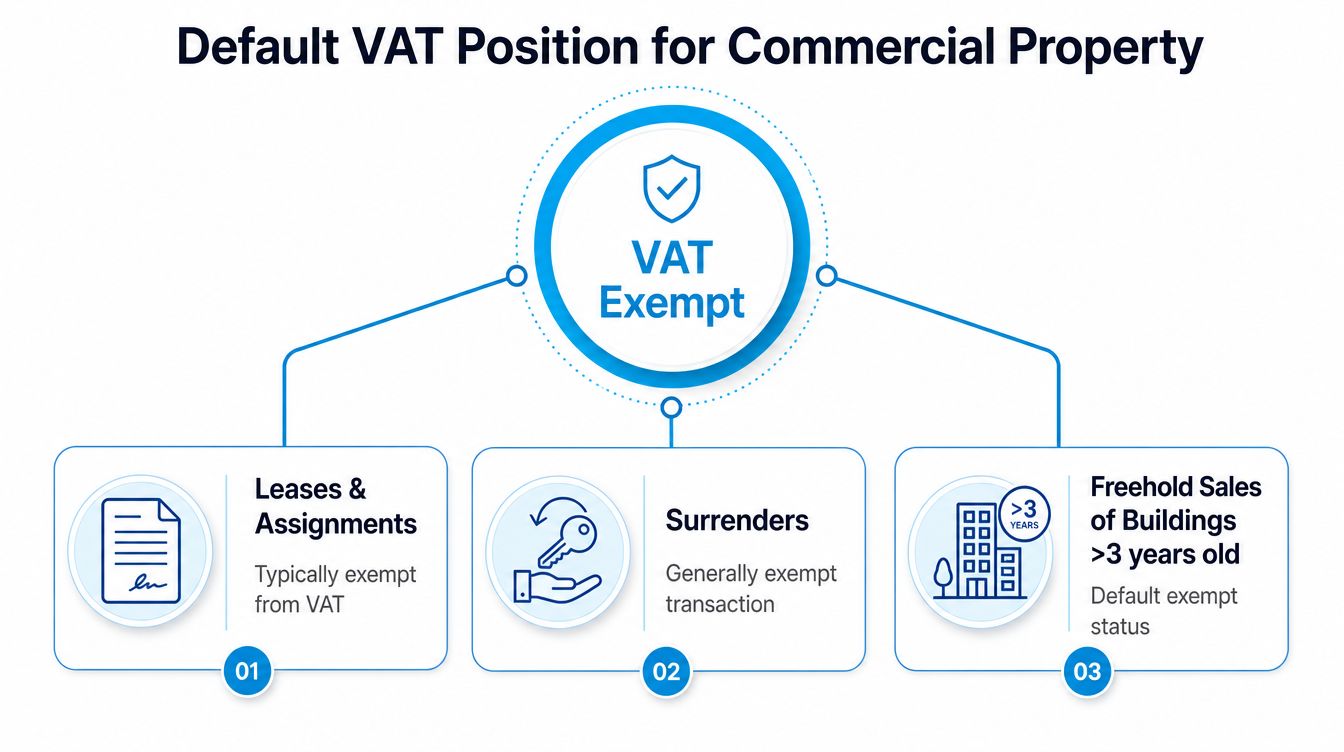
HMRC's default position is exemption for commercial property. Leases, assignments, surrenders, and sales of freehold buildings more than three years old are generally outside VAT (HMRC guidance). For an MD, the point is straightforward. The tenant or buyer usually does not see VAT on the property invoice, but the business behind the deal often loses recovery on the costs tied to that asset.
That is where the cash-flow hit shows up. If a landlord sells or lets exempt property, VAT on solicitors, agents, refurbishments, repairs, and professional fees is often trapped in the cost base. The business funds it, but cannot normally reclaim it in the same way as input tax on taxable supplies. For a property-heavy company, that turns a cheap-looking transaction into an expensive one once the linked spend is added up.
Use the three-year rule as the test
The cleanest dividing line is the three-year rule. A commercial building completed within the last three years is typically standard-rated at 20% VAT on sale, even without an option to tax, while older buildings usually sit in the exempt bucket (Price Bailey). That difference changes the amount of cash the business has to put up front and whether input VAT can be recovered.
A new-build unit and a ten-year-old warehouse can look similar operationally, but the VAT outcome is not the same. On the new-build, VAT may be charged on the sale price. On the older warehouse, the deal is more likely to be exempt unless an option to tax has been made. The commercial question is simple. Which structure lets the business recover input VAT and avoid funding tax it should not be carrying?
Bottom line: exempt property usually looks cheaper on the invoice, but it can be more expensive once lost recovery is included. Taxable property usually brings VAT onto the face of the deal, but it often gives better input tax recovery.
| Commercial property transactions at a glance | Default VAT treatment | When standard-rated |
|---|---|---|
| Lease | Generally exempt | If the property is opted to tax |
| Assignment or surrender | Generally exempt | If the property is opted to tax |
| Sale of freehold building more than three years old | Generally exempt | If the property is opted to tax |
| Sale of a building within three years of completion | Usually outside the exempt default | Typically standard-rated |
The point is not to memorise the table. The point is to know that exemption is the default, and that the option to tax exists to override it when the cash-flow case justifies the move. If you need the VAT treatment joined up with the accounting entries, VAT accounting support for property transactions should be part of the planning before contracts are finalised.
How the Option to Tax Works in Practice

What changes when a property is opted
An option to tax turns an otherwise exempt commercial property into a taxable one. In practice, that means VAT is charged on the sale or rent that sits inside the option, and the landlord or seller can usually recover VAT on costs tied to that property. For an owner spending serious money on a refurbishment or acquisition, that can change the cash position fast.
The process is formal, not casual. The landlord or seller must notify HMRC in writing within 30 days of the decision, and once the option is in force it usually stays with the property for at least 20 years (Price Bailey). That matters because this is a structural decision, not a short-term VAT tweak. Once the choice is made, it can affect later disposals, funding, and the way the asset is marketed for years.
Why the cash-flow effect matters
A £4 million turnover manufacturing business that opts to tax a new unit may recover VAT on a £250,000 fit-out. That is real cash, not a theory point. It changes how much the business has to fund upfront and how quickly the project starts paying back.
VAT still has to be managed properly. If the property and the supply sit within the taxable structure, the business can usually reclaim the related input tax. If the paperwork is late or the first supply is treated incorrectly, the cash-flow benefit disappears and the deal becomes more expensive than it needed to be.
The common mistakes are clear, and they are avoidable:
- Late notification: the decision is made, but HMRC is not told in time.
- Wrong first supply treatment: VAT is not charged correctly on the initial taxable supply.
- Future disposal risk: the business opts to tax now, then later finds the choice affects a sale it would rather have kept simple.
For transactional work, VAT should be checked alongside funding and legal sign-off. The VAT accounting support page is the point to use when the numbers need checking before the property structure is fixed. If valuation is part of the decision, Corinthian Surveyors valuation advice helps frame the asset value properly before the tax position is locked in.
If the deal depends on recovering VAT, the option to tax needs to be documented before the money starts moving.
Letting Versus Selling a Commercial Property
A lease and a sale on the same building can land very differently for VAT. Owners get caught by that all the time. The asset is unchanged, but the transaction is not. One route can keep cash free by staying outside VAT. The other can put VAT on the headline figure and force the buyer to fund more upfront.
If the letting or sale is exempt, the landlord or seller usually cannot recover VAT on the related cost base, such as legal fees, agents' fees, refurbishments, repairs, and professional advice. Once the property is opted to tax, the position shifts. Input tax on costs linked to that taxable property can usually be reclaimed, so the decision affects net margin as much as it affects the deal structure. For the wider treatment of exempt and taxable property supplies, see the section on the default VAT position for commercial property.
The same cash-flow logic applies to assignments and surrenders. A lease ending early may look like a legal tidy-up, but the VAT position can still decide who carries the cost. If the transaction sits in the exempt bucket, recovery stops. If the property is opted, VAT starts to matter again, and that changes the numbers the finance team has to sign off.
Here is the decision lens that matters before heads of terms harden into a deal.
| Decision point | What changes for the money |
|---|---|
| Granting a lease | If the property is opted to tax, VAT usually lands on the rent. That pushes the tenant's funding need up unless the tenant can recover it. |
| Selling a freehold commercial building | If VAT is in play, the buyer needs to fund the tax at completion unless recovery is available. That can widen the equity gap and change whether the price still works. |
| Assigning a lease | The VAT position affects the cost of the transfer and whether the assignee is looking at a VAT-inclusive or VAT-free deal. |
| Surrendering a lease | VAT can affect the amount paid to end the lease and the net cost of getting the space back. |
The buyer's recovery position is the key pressure point. If the buyer is fully taxable, VAT on the price may be a timing issue rather than a deal-breaker. If the buyer cannot recover all of it, the tax becomes a permanent cost and the headline price is no longer the effective price. That is why valuation and VAT have to be checked together before anyone locks in a figure. Corinthian Surveyors valuation advice is worth using at that stage, because the value you agree and the VAT treatment you apply need to point in the same direction.
For development work, fit-outs, and refurbishment-heavy transactions, the VAT profile needs to be checked alongside the construction plan. Use this guide to VAT and construction property work when the deal depends on how building costs will be treated.
The VAT Reverse Charge on Construction Services
Who accounts for the VAT
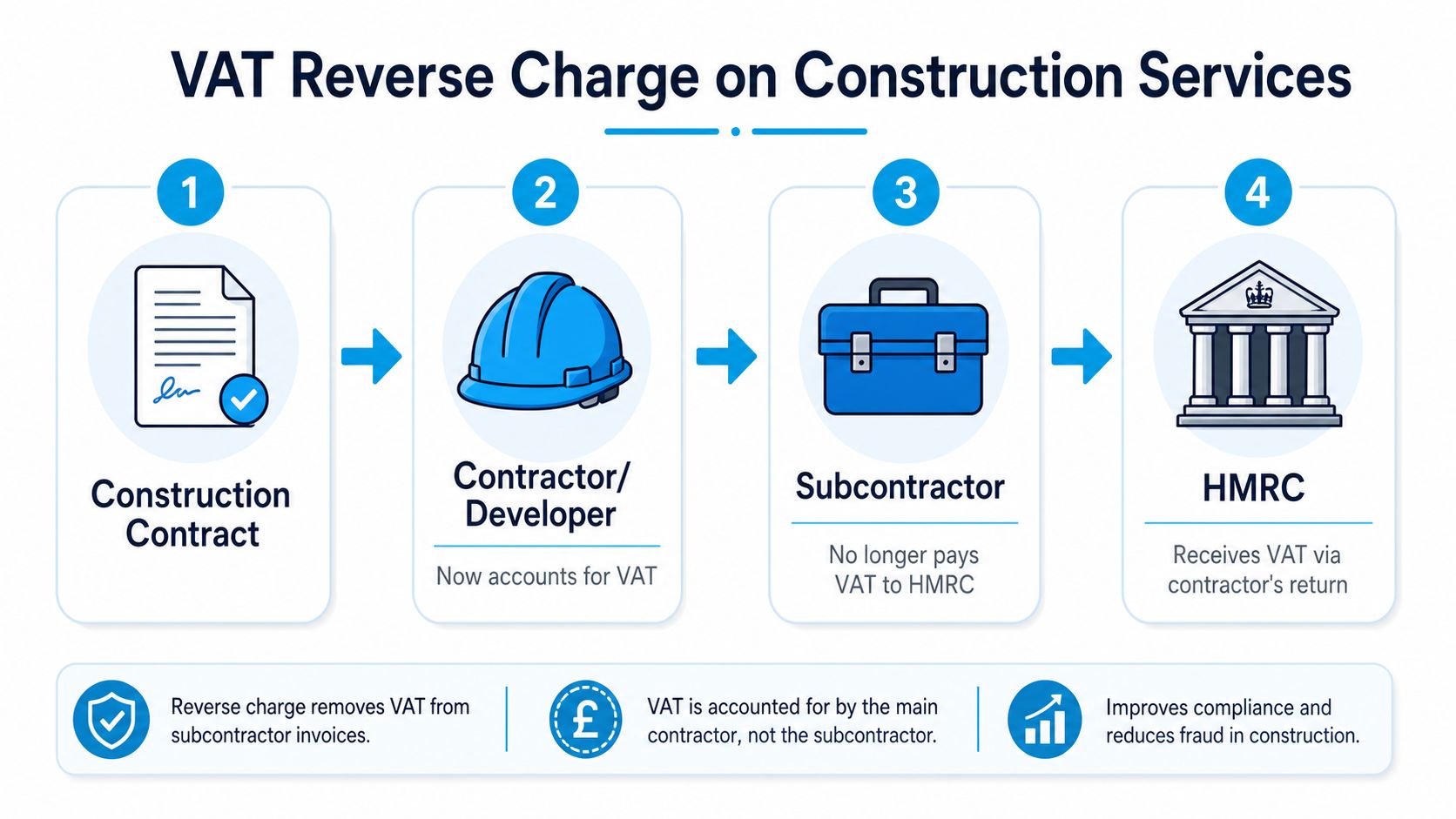
The reverse charge changes who hands over the VAT cash. On qualifying construction services, the supplier does not collect the VAT in the normal way. Instead, the VAT-registered customer accounts for it on its own return, provided the supplies are standard-rated and used for the customer's own VATable activity.
That is the key cash-flow point. The contractor does not sit on VAT money that should go to HMRC, and the customer does not pay a VAT-inclusive invoice in the usual way. The tax is dealt with in the return. For property owners, landlords, and developers, that changes the working capital profile of a fit-out or refurbishment.
What to check on incoming bills
A construction invoice under the reverse charge should show zero VAT and include reverse-charge wording. That is not a clerical detail. It tells the finance team that VAT is being self-accounted for rather than paid over to the supplier. Internal controls should flag this before payment, because a wrong invoice can distort both cash flow and VAT returns.
A straightforward example makes it plain. On a £120,000 refurbishment, the contractor invoices zero VAT under the reverse charge. The customer then accounts for £24,000 of VAT on its own return. That does not create a free lunch. It moves the reporting responsibility and prevents VAT leakage through the chain of supply.
The construction bidding guidance is a useful reference when commercial teams are pricing work and need to understand how VAT treatment affects bid comparisons.
For businesses managing property works, construction property advice should sit in the same conversation as the build programme. If the finance team does not know whether a bill falls inside the reverse charge, the cash forecast is already wrong.
Practical check: every fit-out invoice should be matched to the contract, the VAT registration status of the recipient, and the intended use of the property before payment is approved.
Refurbishments, Repairs and Input Tax Recovery
A refurbishment can either protect margin or destroy it. For an owner-manager, the central question is blunt. Does the VAT on fit-out work, repairs, and professional fees come back through input tax recovery, or does it sit on the P&L as a dead cost? The answer turns on the VAT status of the property, and the timing of the decision. Get that wrong, and the tax bill automatically becomes part of the project cost.
If a property is opted to tax and the supplies are taxable, VAT on the related spend can usually be recovered, which changes the cash-flow case for the whole project. Legal fees, design work, repair invoices, and refurbishment bills all need the same treatment check. If the property is exempt, those costs are often trapped. If it is taxable, the business can usually recover them, provided the paperwork lines up and the invoices match the intended use of the building. For a fuller technical overview, use the PropertyKiln guide alongside the transaction file, not as a substitute for it.
Keep the records that HMRC will ask for
A future review focuses on evidence, not excuses. Keep the opt-to-tax decision and notification evidence, the invoices showing the correct VAT treatment, the contracts that match the property use and supply type, and a clear record of when works started and when the VAT position changed. If the file is incomplete, the claim is weak, however good the commercial logic looked at the start.
A property decision made too late can trap cash fast. VAT on a £45,000 structural repair is recoverable if the option was notified before the invoice date. VAT on a £12,000 agent fee incurred before the option is trapped. That is the difference between a tax-neutral project and a cost that sits entirely with the business.
A Midlands-based manufacturer extending a unit before the tax position is settled can lose the recovery it expected. If the structure is exempt, the VAT on contractors and advisers becomes a cost. If the structure is opted in time, the same spend may sit in input tax instead. That is why the decision has to be made before works begin, not after the builder has already priced the job.
For tax planning that intersects with property spend, capital allowances advice should sit in the same review. It does a different job from VAT, but it can still change the after-tax cost of the project.
If the paper trail is weak, the recovery claim is weak.
A Worked Example for a £2.5m Turnover Business
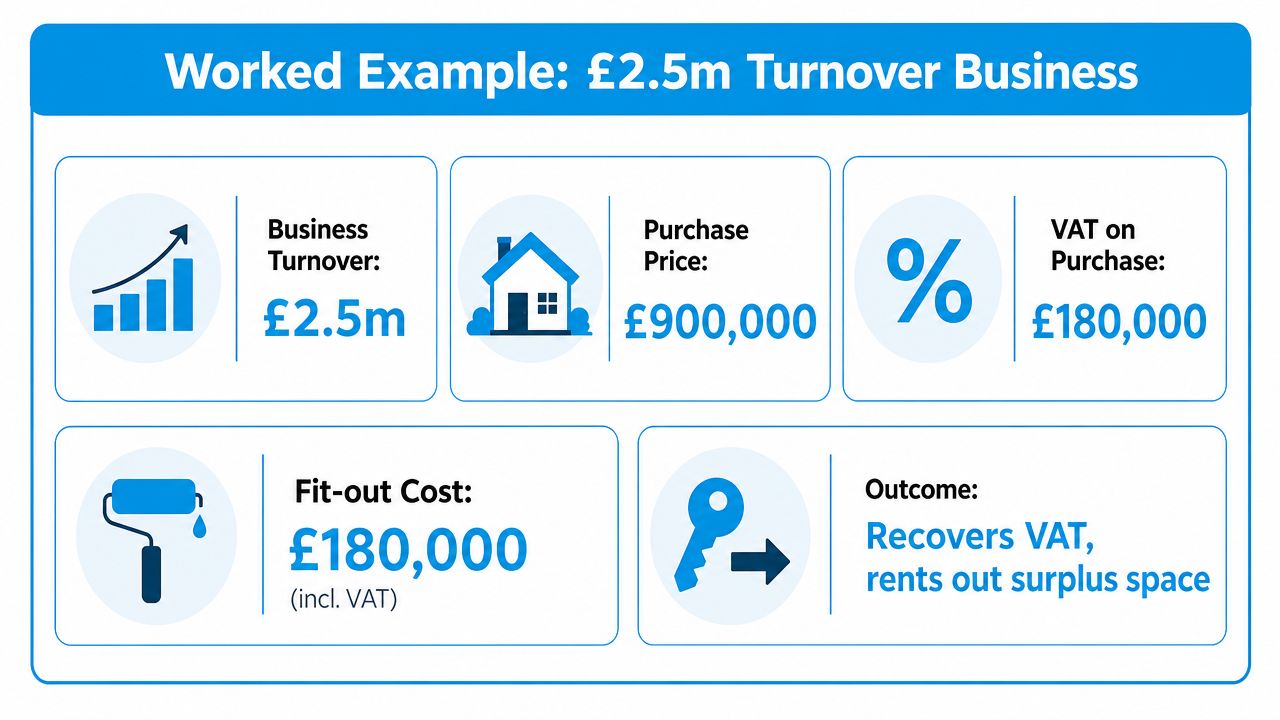
A £2.5 million turnover services company buys a freehold unit for £900,000 and opts to tax the property before completion. The business then spends £180,000 on the fit-out, VAT included in the contract price, and later lets a small surplus area to another tenant. That one decision changes the cash-flow profile from the start.
The purchase is no longer just a simple exempt buy. With the option to tax in place, the VAT position on the property lines up with the business's taxable activity, so the tax on the deal is easier to recover where the use supports recovery. The fit-out work may also fall within the construction reverse charge, which means the supplier does not charge VAT in the usual way and the business accounts for the tax itself. In practice, that keeps the VAT from being swallowed by the project cost, provided the invoices and intended use are correct.
The benefit shows up in the margin. A business that opts to tax at the right time protects itself from irrecoverable VAT on the purchase and on the spending that follows, rather than treating that tax as part of the building cost. The small surplus letting also sits inside the opted structure, so the rent follows the same tax treatment as the rest of the property position. If the business had not opted to tax, the VAT on the same fit-out and advisory costs would be far harder to recover, and the project would carry more dead cash into the balance sheet. A surveyor's fee of £12,000, for example, is the sort of cost that can either come back through input tax or sit as a pure overhead, depending on how the property was set up. That is the choice here, paying tax through the project or keeping it out of the cost base.
Frequently Asked Questions and Your Next Step
Do you charge VAT on commercial rent in the UK?
Usually, no. The default position for commercial property is exemption, so VAT only appears when the landlord or seller has opted to tax, or when another specific rule applies. For an MD, the question is simple. Can the tenant recover the VAT, or does it sit as a dead cost that makes the rent look better on paper than it does in cash-flow terms?
How do you revoke an option to tax on commercial property?
You do not treat it as an easy reset. Revocation normally requires a written application to HMRC, setting out the property concerned and the reasons why the option should be disapplied. HMRC will only consider revocation in limited circumstances, so the case has to be built properly and backed by the property history and the commercial facts. If you are trying to unwind an option because the deal has changed, get that application reviewed before you send it.
When does the VAT reverse charge apply on a fit-out?
It applies where the construction services fall within scope, the recipient is VAT-registered, and the work is being used for the recipient's own VATable activity. The supplier issues an invoice without VAT, and the customer accounts for the tax on its own return. Get the invoice wrong, or assume the wrong intended use, and the cash-flow hit lands in the wrong place. That is where projects start leaking margin.
Can VAT be reclaimed on a new commercial property purchase?
Often, yes, because a building completed within the last three years is typically standard-rated on sale, even without an option to tax. The point is not whether VAT is shown on the invoice. The point is whether the buyer's own VAT position lets that tax come back through input recovery. That needs checking before contracts are exchanged, because once the deal is signed, the cash has already started moving.
For a property transaction, a VAT review should happen before the heads of terms become binding. striveX Ltd supports UK businesses with VAT, property tax, and cash-flow focused advice, so a deal can be structured with the VAT cost understood upfront. Visit striveX Ltd to arrange a 30-minute review and get a clear answer on the VAT position within 24 hours.
This article is for informational purposes only and does not constitute professional advice. Tax rules apply as of April 2026. Consult a qualified accountant for your specific circumstances.
