

The month ends, the bank balance looks healthy, and the accounting system shows a profit. Then a large customer pays late, payroll is due, VAT needs funding, and the founder discovers that reported profit isn't the same as cash available. That gap is exactly why monthly management accounts matter for a UK business turning over £1 million–£15 million.
A useful pack helps directors decide whether to hire, raise prices, slow spending, chase debtors, renegotiate supplier terms or prepare for Corporation Tax. A weak pack confirms what happened after the opportunity to act has passed.
What a Monthly Management Accounts Pack Is For
The first question a pack should answer is simple: what decision does the board need to make this month? If the answer is unclear, the report probably contains too much accounting detail and not enough commercial direction.
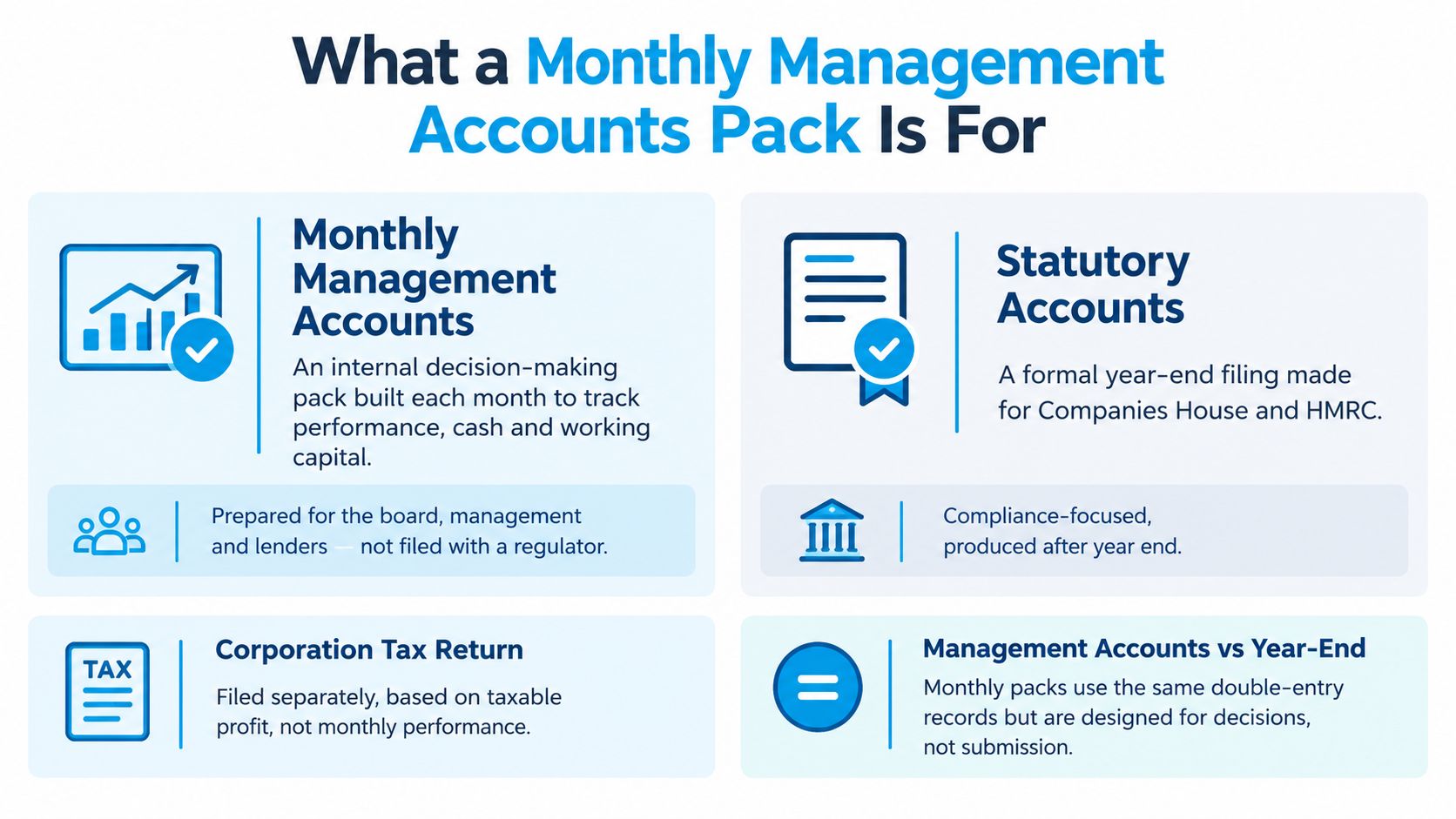
Management accounts are an internal control and decision-making practice. They aren't a statutory filing, a Corporation Tax return or a VAT submission. Annual Statutory Accounts are filed with Companies House, while tax returns and VAT submissions follow their own rules and deadlines. Monthly reporting sits between the ledger and management action.
ACCA research found that 40% of UK businesses had none of three assessed financial-capability elements: management reporting, formal business planning or documented financial processes. Management reporting alone was present in 16%, while 7% demonstrated all three elements. The figures show why regular reporting remains a competitive discipline rather than an administrative luxury. ACCA's research on the evolving finance function provides the wider context.
The pack is for decisions, not filing
A statutory set of accounts answers questions for external compliance. Monthly management accounts answer operational questions such as:
-
Is pricing still producing an acceptable gross margin?
-
Which customers are taking longer to pay?
-
Can the business fund planned recruitment?
-
Will cash cover PAYE, VAT and Corporation Tax commitments?
-
Does the business need borrowing before growth creates pressure?
A private company normally has nine months after its accounting reference period ends to file annual accounts with Companies House. Monthly packs don't replace that obligation, but regular balance-sheet reconciliations and documented adjustments can reduce the volume of year-end corrections. Government guidance on company accounts confirms the distinction between internal reporting and statutory filing.
The pack should be issued on a consistent timetable after period end. The exact deadline depends on transaction volume, system quality and the level of review required. A business that routinely waits until late in the following month has a historical report, not a management tool.
Practical rule: a report is only useful if the directors still have time to change the outcome it describes.
What belongs in the reporting cycle
A decision-ready pack normally contains:
-
Profit and loss statement, compared with budget and prior year.
-
Balance sheet, with working-capital movements explained.
-
Cash-flow summary, supported by a rolling forecast.
-
KPIs, limited to measures that influence action.
-
Management accounts commentary, with variances, risks and owners.
-
Controls evidence, including reconciliations, estimates and unusual journals.
The financial statements must connect. A profitable P&L with unexplained debtor growth is incomplete. A cash forecast that ignores payroll liabilities is unreliable. A KPI dashboard that doesn't reconcile to the ledger creates confidence without control.
The management accounts service model used by an outsourced finance provider may include monthly P&L, balance sheet reporting and a review meeting, with additional KPI and board-pack options where required. Businesses assessing their current process can also learn more about management accounts before deciding whether to redesign it internally.
For wider reporting design and analytics ideas, finance leaders can also browse reporting analytics solutions. The useful principle is consistent across providers: reporting should connect data to a decision, rather than present every available figure.
The Core Statements Every Pack Needs
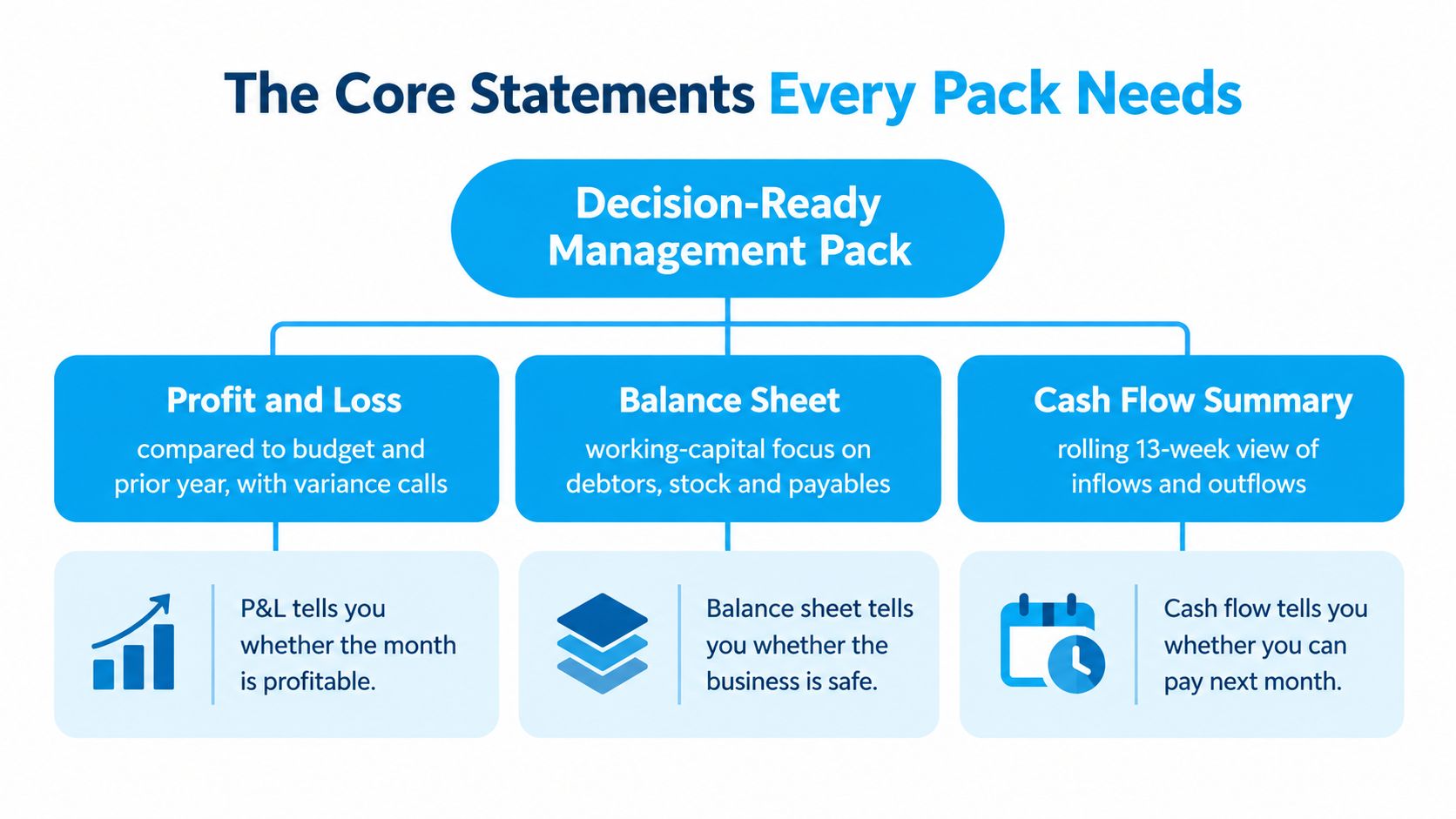
A monthly pack without a P&L, balance sheet and cash-flow view leaves directors looking at separate pieces of the same business. The three statements answer different questions, but they must reconcile to one commercial story.
P&L versus budget and prior year
The P&L answers whether the period generated profit and where that result came from. It should show turnover, direct costs, gross profit, overheads and operating profit, with comparisons against both budget and the prior year where the data is meaningful.
A total turnover figure is not enough. A business can grow while gross margin falls, overheads rise faster than sales or one contract distorts the result. The report should highlight material variances in pounds and explain the driver, not force directors to inspect every nominal-code movement.
The management accounts versus profit and loss statements comparison is useful for separating the statement itself from the wider reporting pack around it. A P&L is one component. Management accounts add context, forecasts, KPIs and actions.
Balance sheet and working capital
The balance sheet shows what the business owns, owes and retains at the reporting date. For a growing company, the most commercially important lines are often trade debtors, stock, work in progress, creditors, VAT, PAYE, borrowings and cash.
A balance sheet review should ask:
-
Debtors: Which invoices are overdue, and are a few customers responsible for most of the exposure?
-
Stock and work in progress: Has cash been committed to goods or projects that haven't converted into invoices?
-
Creditors: Are supplier terms being used deliberately, or are payments slipping because cash is tight?
-
Tax and payroll liabilities: What has accrued, and when must it be paid?
The balance sheet is where reported profit meets timing. A sale can increase profit before the customer pays. Inventory can absorb cash before it becomes a cost of sale. A balance-sheet schedule makes those movements visible.
Cash flow and cash position
The cash-flow summary should reconcile opening cash, operating inflows, operating outflows, financing movements and closing cash. It should be supported by a rolling 13-week cash forecast, particularly where the company has uneven collections, project-based billing, stock purchases or regular tax obligations.
The forecast isn't a second P&L. It shows when money is expected to enter and leave the bank. It should include known customer receipts, supplier payments, payroll, PAYE, VAT, Corporation Tax, loan payments and planned investment.
PAYE must be controlled separately. Employers paying PAYE monthly generally need to pay HM Revenue and Customs by the 22nd of the following tax month, or by the 19th if paying by post. Including the PAYE creditor and expected payment date in the pack helps distinguish accrued employment costs from cash already paid. HMRC's PAYE payment guidance sets out the payment timetable.
VAT also deserves a monthly control review, even where returns are quarterly. The normal deadline for a standard VAT return and payment is one month and seven days after the VAT period ends. A monthly review can identify missing purchase invoices, unreconciled VAT and unusual output-tax movements before the filing deadline. Business.gov.uk's tax guidance explains the underlying VAT records and deadlines.
The one-screen board sequence
A compact board view can follow this order:
-
P&L: What happened to turnover, gross margin and operating profit?
-
Balance sheet: Which assets and liabilities changed, and why?
-
Cash flow: What cash is available, what is committed and what is expected next?
-
Action summary: Which decision requires an owner before the next meeting?
If any statement doesn't reconcile or a movement lacks an explanation, the pack isn't ready for board distribution.
KPIs Worth Tracking in a Monthly Pack
A KPI dashboard shouldn't be a wall of numbers. Four sector-neutral measures usually give a £1 million–£15 million business more useful direction than a long list of vanity metrics: gross margin, debtor days, cash runway and revenue per head.
Turnover still matters, but it doesn't show whether new work is profitable, collectible or efficient to deliver. A business can report strong sales and still weaken its cash position.
Gross margin
Gross margin is calculated as gross profit divided by turnover. The calculation should use a consistent definition of direct costs, including relevant labour, materials, subcontractors or delivery costs for the business model.
The decision is more important than the formula. If gross margin falls, management should investigate pricing, discounts, supplier costs, delivery efficiency and contract scope. A falling margin can make additional turnover less valuable, particularly when the work also creates debtor or stock pressure.
Debtor days
Debtor days estimate how long customers take to pay. The calculation normally compares trade debtors with credit turnover, using a consistent period and basis.
The KPI should sit alongside an aged receivables report. An average can hide concentration risk. Ten customers paying promptly and one large customer paying late can produce a tolerable average while creating an immediate cash problem.
Useful supporting measures include:
-
Overdue value: How much is past agreed terms?
-
Concentration: Which customers represent the largest overdue balances?
-
Collection owner: Who is responsible for each material account?
-
Promised date: When is the cash expected?
Cash runway
Cash runway estimates how long available cash can support expected net outflows under the chosen forecast assumptions. It's more useful when it reflects committed payroll, tax, debt service and essential suppliers rather than a simple bank balance.
The forecast should include a base case and clearly labelled downside assumptions. A founder doesn't need false precision. The value comes from seeing which event causes pressure and how early action could change the result.
Revenue per head
Revenue per head divides turnover by the relevant average headcount. It can highlight changes in capacity, utilisation and organisational efficiency, but it must be interpreted alongside gross margin and service quality.
A higher figure isn't automatically better. It may reflect under-resourcing, delayed hiring or a temporary mix of high-value work. A lower figure may be deliberate if the business is building capability. The KPI should prompt a question, not become a target detached from commercial reality.
A focused KPI tracking and reporting service can help turn these measures into a consistent dashboard. The key recommendation is to track fewer indicators and assign each one to a decision. If nobody changes behaviour when a KPI moves, it probably doesn't belong in the pack.
Why Cash Visibility Beats Accounting Profit
A profitable month can still put a business under pressure. That usually happens when customers pay late, stock is bought before it turns into sales, projects need labour before billing catches up, or supplier terms are shorter than customer terms. Profit can look fine on the P&L while the bank balance says the opposite.
Take a business with £3 million turnover. The P&L can show a healthy profit while the bank account stays thin because invoices are outstanding and costs have already been paid. That is the reporting gap that catches founders out as a business scales from owner-managed to properly controlled.
A monthly pack should deal with that gap directly. It needs three connected views:
-
Aged receivables, showing which invoices are overdue and the expected receipt date.
-
Supplier terms, showing which payments fall due before customer cash lands.
-
A rolling 13-week forecast, showing the week in which cash tightens and which assumption causes the pressure.
The late-payment exposure
Late payment is not a side issue. It is one of the main reasons accounting profit fails to convert into usable cash.
According to The Credit Connect report on late payment, 60% of businesses said customers were taking longer to pay than a year earlier, with average outstanding invoices of £72,000. For mid-sized businesses, the average was £143,000. In a business doing £1 million to £15 million of revenue, that is enough to distort hiring plans, supplier payments, tax timing and appetite for new work.
This is why debtor reporting belongs in the main pack, not buried in credit control. Directors need to see which customers, contracts or billing decisions are tying up cash, how concentrated that exposure is, and when the money is expected in. If the expected date slips, the pack should show the consequence immediately, not after the bank account is already tight.
Profit isn't cash available for obligations
Accounting profit includes sales that have not been collected. It does not tell you what is available for the next payroll, VAT payment or supplier run. Cash available to trade is narrower. It has to cover payroll, PAYE, VAT, Corporation Tax, suppliers, debt repayments and planned investment from actual liquidity, not booked income.
Growth makes this worse, not better. A new contract can improve profit while pushing up work in progress and debtor days. A stock purchase can support future sales while reducing cash today. A low-margin contract can fill the team's time and still leave the business short of cash.
Board question: “Which customers, contracts or decisions are absorbing cash, and when will it return?”
A useful monthly pack answers that before the pressure shows up in the bank. My rule is simple. If the pack cannot explain the bridge from accounting profit to cash available, it is incomplete.
Commentary That Explains the Numbers
Numbers describe the month. Commentary explains what management should do about it.
A useful commentary page reads like a short briefing, not a list of excuses. It identifies the variance, quantifies it in pounds, names the underlying driver and assigns an owner with a date.
Start with the result
A strong opening might state that operating profit was below budget because gross margin fell on a particular contract and recruitment costs started earlier than planned. It should then separate the temporary issue from the recurring one.
The commentary shouldn't merely say “costs were higher than expected”. It should explain whether the increase came from an invoice received late, an accrual, a headcount decision, supplier pricing or a coding error. The reader needs to know whether the result requires action, correction or no further attention.
Connect all three statements
Suppose the P&L shows strong turnover, while the balance sheet shows a rise in trade debtors and the cash forecast shows a weaker receipt profile. The commentary should connect those facts:
-
P&L movement: turnover increased, but the gross margin was below budget.
-
Balance-sheet movement: debtor balances rose because several invoices passed their expected payment dates.
-
Cash impact: the forecast shows pressure around payroll and tax commitments.
-
Action: the commercial lead contacts named customers by a stated date, while finance updates the receipt assumptions.
That is management accounts commentary. It converts separate lines into a decision.
Give every action an owner
Every material risk should have:
-
A named owner, not “the team”.
-
A deadline, not “as soon as possible”.
-
A next step, such as a customer call, pricing review or supplier negotiation.
-
A follow-up slot, so the next pack confirms whether the action worked.
The discipline matters because cash-flow pressure can block growth before the P&L visibly deteriorates. Commentary gives directors a place to record the pressure early, while the business still has options.
A concise pack might include a short executive summary, several quantified variance notes and an action list. It shouldn't reproduce the ledger. Directors need the exceptions, decisions and risks that require attention.
AI and Automation in the Monthly Close
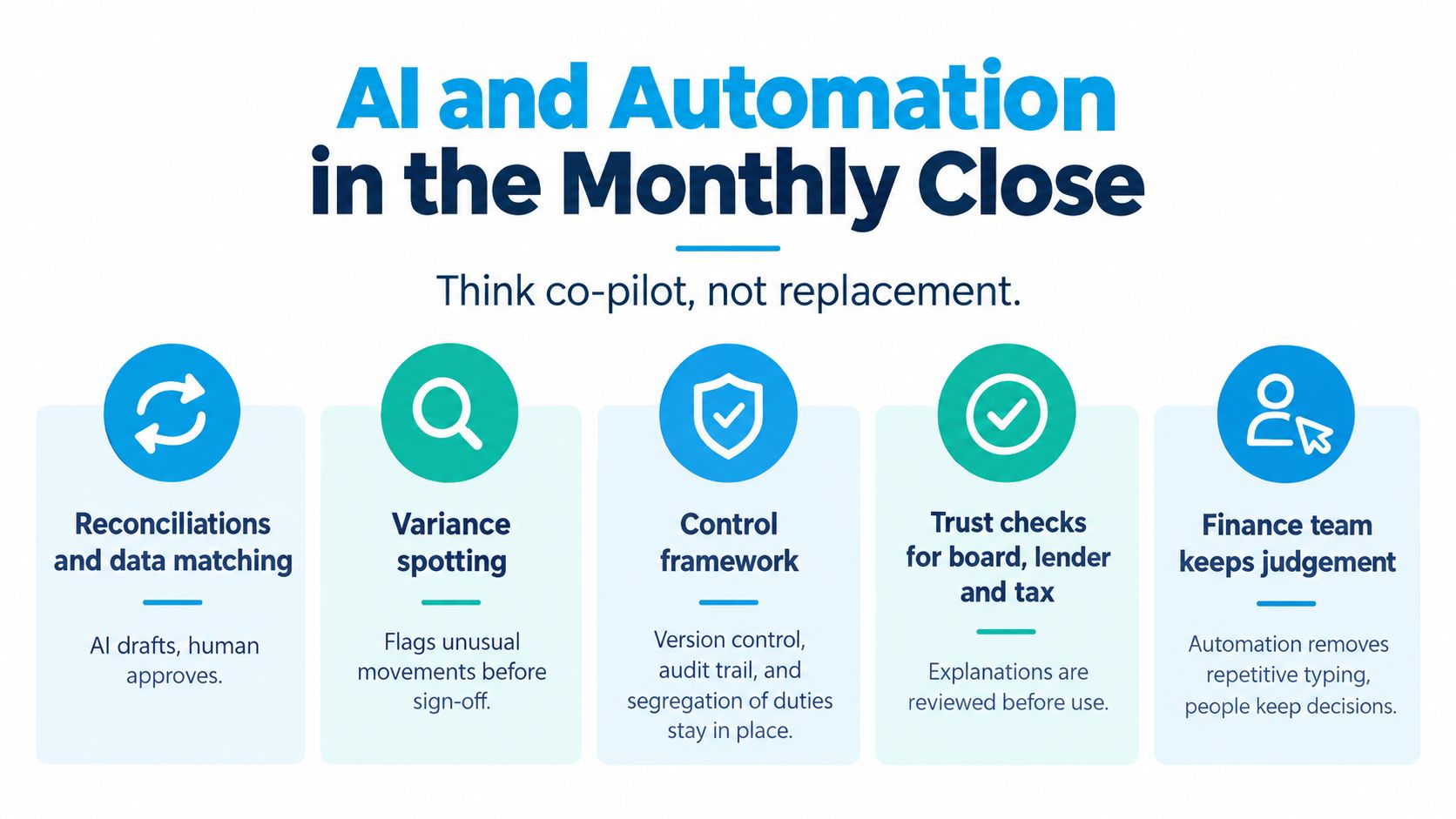
Automation can make monthly reporting faster, but speed doesn't make inaccurate data reliable. AI should support reconciliation, anomaly detection, commentary drafting and scenario modelling. It shouldn't approve its own output or replace finance judgement.
The British Business Bank's 2026 SME Finance Survey reports that 32% of SMEs were already using AI or planned to use it within two years. The survey report shows the direction of adoption, not proof that AI-generated management information is ready for a board or lender.
Where automated numbers need review
Automated processes remain vulnerable around:
-
Cut-off: Transactions may be recorded in the wrong period.
-
Accrued costs: Costs incurred but not yet invoiced may be missing.
-
Deferred turnover: Cash received may not represent earned turnover.
-
Work in progress: Projects may be valued or released incorrectly.
-
Intercompany balances: Related balances may not agree.
-
Payroll liabilities: Accruals and payments may be out of step.
-
Unusual journals: A rare or high-value entry needs human explanation.
The finance team must understand what the system can infer and what requires evidence. A machine-generated variance explanation can sound plausible while missing a contract change, customer dispute or operational event.
The close control framework
A trustworthy automated close needs visible controls:
-
System owners: Each source and report has a responsible person.
-
Locked reporting dates: The close period is defined before review begins.
-
Reconciled accounts: Bank, receivables, payables and control accounts are checked.
-
Documented estimates: Material accruals, provisions and allocations have support.
-
Reviewed commentary: A finance lead confirms the explanation and implication.
-
Retained audit trail: AI-assisted coding and commentary can be traced to source data and approval.
A useful automated bookkeeping and reporting guide can help finance teams think about efficiency without treating automation as a control framework.
The best use of AI is practical. It removes repetitive typing, highlights unusual movements and prepares a first draft. Directors and finance professionals retain accountability for the numbers and the decisions based on them.
In-House vs Outsourced Monthly Accounts
The choice isn't whether the company has a bookkeeper. The question is whether the current finance function produces a timely, reconciled pack that directors trust and use.
An in-house bookkeeper may handle transaction processing efficiently, but management accounts also require review of estimates, working capital, KPIs, commentary and forecast assumptions. A part-time finance resource can be economical while the business is straightforward. The arrangement becomes fragile when reporting depends on one person, spreadsheets and late approvals.
When in-house works
An internal model can work where:
-
Ownership is clear: Someone is accountable for the close and pack.
-
The ledger is current: Bookkeeping isn't being reconstructed at month end.
-
Review capacity exists: A qualified finance lead challenges the numbers.
-
Commercial data is available: Operations can explain margin, utilisation and debtor movements.
-
The board uses the pack: Reporting leads to decisions rather than filing.
The business should document the timetable, reconciliations, approval points and commentary expectations. Otherwise, the process remains dependent on personal knowledge.
When outsourcing makes commercial sense
Outsourcing becomes more compelling when the business repeatedly experiences:
-
Late close dates, so the pack arrives after decisions are made.
-
Missing commentary, leaving directors to interpret variances themselves.
-
No forecast view, despite uneven collections or significant commitments.
-
Increasing PAYE and VAT complexity, particularly across departments or sites.
-
Lender or investor reporting pressure, where consistency and evidence matter.
The comparison should include more than the visible fee. It should consider director time, missed collection opportunities, weak pricing decisions, late tax visibility and the cost of correcting year-end records.
Businesses reviewing possible automation can also explore curated AI tools by use case, provided each tool is assessed against data ownership, security, review and audit requirements.
For clarity on responsibilities, who prepares management accounts depends on the company's systems, people and control environment. An outsourced provider should not remove management accountability. It should give directors a repeatable process, clear outputs and access to finance judgement.
What the first handover should achieve
The first month should establish the chart-of-accounts logic, reporting dates, balance-sheet reconciliations, KPI definitions, forecast assumptions and action owners. It should also identify what the existing pack gets wrong or omits.
The recommendation is direct: outsource when the internal process is late, incomplete or too dependent on one person, not merely because the business has reached a particular turnover. A specialist should make the pack more consistent and more decision-ready, while management retains ownership of the decisions.
FAQs and Next Steps for Your Monthly Pack
What is the difference between management accounts and statutory accounts?
Management accounts are internal reports prepared during the year for directors, managers and sometimes lenders. Statutory Accounts are formal annual accounts filed with Companies House and prepared for compliance purposes. Monthly reports can support the year-end process through regular reconciliations, but they don't replace Statutory Accounts, Corporation Tax returns or VAT submissions.
How often should we produce monthly management accounts?
A monthly cycle suits most businesses in the £1 million–£15 million turnover range because it shows performance, working capital and cash movement regularly. The pack should follow a consistent close timetable and arrive early enough to influence pricing, hiring, collections and spending decisions. Quarterly reporting may be insufficient where cash pressure or operational complexity changes quickly.
Who should receive monthly management accounts?
The board and senior management should receive the core pack. The finance team needs the supporting schedules, while operational leaders may need relevant segment or KPI pages. Lenders or investors should receive information suited to their needs where required. Distribution should follow responsibility and confidentiality, not an automatic email list.
How long should a management accounts pack be?
There isn't a fixed correct length. The board version should be concise enough to read before a meeting and detailed enough to support decisions. A typical structure includes an executive summary, P&L, balance sheet, cash flow, KPIs, commentary and action log. Supporting reconciliations and schedules can sit behind the main pack.
Can management accounts be outsourced?
Yes. An outsourced finance provider can prepare the reporting pack, reconciliations, forecasts and commentary, depending on the agreed scope. Directors still need to review and challenge the output because they remain responsible for business decisions. Before appointing a provider, confirm the close timetable, data controls, deliverables, review meeting and responsibility for forecasts.
The practical test is whether the current pack explains profit, cash and working capital in the same conversation. If directors can't see which customers are delaying cash, which costs are changing margin or which commitments threaten liquidity, the pack needs redesigning.
striveX Ltd provides monthly management accounts, KPI reporting, cash-flow insight and review support for growing UK businesses.
This article is for informational purposes only and does not constitute professional advice. Tax rules apply as of April 2026. Consult a qualified accountant for your specific circumstances.
The current draft already includes all planned sections through the final call to action and disclaimer. There is no remaining section to continue without repeating existing content.
The current article already contains the final section, call to action and disclaimer. There is no remaining content to add without repeating material.
