

A £4 million turnover business can look profitable on its monthly management accounts while running out of usable cash. Payroll is due, VAT is approaching, a supplier run is fixed, and a major customer has pushed payment beyond the agreed terms. The problem isn't necessarily margin. It is timing.
A 13 week cash flow forecast maps expected weekly cash in and cash out for one quarter, then updates every week. It gives directors enough warning to delay spending, accelerate collections, renegotiate terms or arrange funding before a shortfall becomes an emergency. The forecast is most valuable when it changes a decision, not when it produces another attractive spreadsheet.
What a 13 Week Cash Flow Forecast Does for a Growing Business
A finance team may already have an annual budget, a profit forecast and a 12-month cash flow projection. Those tools answer different questions. The budget tests the expected commercial result, the profit forecast shows accounting performance, and the longer cash flow projection supports planning. A 13-week model asks a narrower operational question: what cash should be available in each of the next 13 weeks?
That distinction matters during growth. A business can invoice more quickly than it collects, buy stock before a project starts, recruit ahead of delivery and pay VAT before customers settle their invoices. Management accounts may show healthy gross profit while the bank account reaches a difficult week.
A rolling cash flow forecast earns its place when timing is uncertain or decisions are moving quickly:
Rapid growth: New contracts can consume working capital before customer receipts arrive.
Seasonal trading: A profitable year can still contain tight operating weeks.
Lender or covenant pressure: Weekly evidence is more useful than an annual estimate when liquidity is being monitored.
Restructuring: Directors need to identify essential payments and funding gaps quickly.
Major investment: Recruitment, equipment and mobilisation costs need to be tested against actual bank capacity.
A useful explanation of why cash gets trapped despite profit reinforces the point. Profit is recorded when income is earned and costs are recognised. Cash is available only when money has cleared the bank and remains uncommitted.
Practical rule: If the forecast never changes anyone's mind about a payment, hire or contract, it is reporting theatre rather than financial control.
The discipline also belongs within wider financial strategy. A growing business needs both the long view and a weekly view that tests whether the strategy is affordable now.
Inputs You Need Before You Build the Forecast
The model needs three reliable building blocks: opening cash, expected receipts and committed payments. Weak inputs produce false confidence, however neat the formulas look.
Opening cash
Start with cleared bank balances, separated by account where necessary. Exclude restricted cash, uncleared receipts and money already reserved for a specific obligation. Record the opening balance for Week 1, then make each later opening balance equal to the previous week's closing balance.
Expected receipts
List customer receipts by the week cash is realistically expected to arrive, not by invoice date or contractual due date. Use the aged debtor ledger, customer payment history, known disputes, promised dates and concentration risk. The UK Government found that only 52% of surveyed businesses said customers paid in line with contractual terms, while 36% said customers paid later and 12% earlier. The same research recorded a mean late-payment proportion of 17%, so agreed terms alone are not a dependable cash assumption. Government payment research supports using observed behaviour instead.
Committed payments
Build payments from payroll, PAYE, VAT, supplier runs, loan repayments, subscriptions, equipment, recruitment and other one-off commitments. Corporation Tax must be dated as a cash event. For companies with taxable profits up to £1.5 million, payment is normally due nine months and one day after the accounting period ends, before the Company Tax Return deadline. The business tax timetable explains why the accounting Year End alone isn't enough.
Companies above £1.5 million of taxable profits normally use Quarterly Instalment Payments, so the next instalment must be entered in the relevant forecast week and later instalments kept visible beyond it. HMRC's instalment guidance sets out the timing structure.
The owner of each assumption should be named. The finance lead may own payroll and tax dates, the credit controller may own receipts, and the MD may own uncertain commercial payments.
Building the Forecast Step by Step in Excel or Google Sheets
A functional 13 week cash flow template doesn't need elaborate design. It needs transparent assumptions, visible ownership and formulas that another person can check.
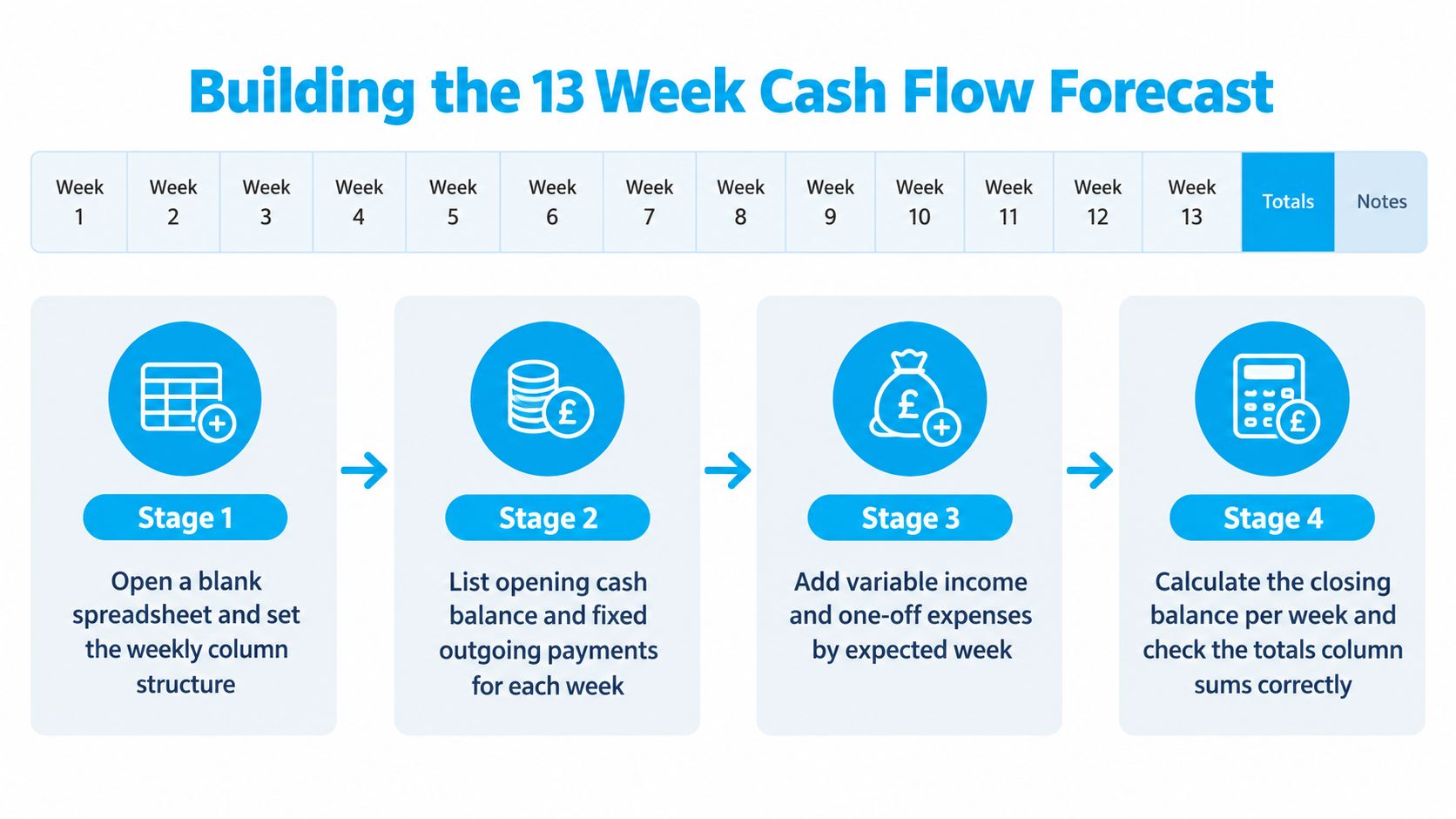
Set the columns across the sheet first:
Create the horizon. Add Week 1 through Week 13, followed by a totals column and a notes column. Use actual calendar dates in each weekly heading.
Enter opening cash. Add the cleared starting balance and fixed cash outflows, including payroll, PAYE, VAT, Corporation Tax, suppliers and debt repayments.
Add receipts and variable costs. Show customer or channel receipts separately, then add stock, equipment, recruitment, project mobilisation and other one-off payments in the week they should clear.
Calculate closing cash. Closing cash equals opening cash plus receipts less payments. The following week's opening cash should link to that closing figure.
Add a minimum cash buffer as a separate input. A simple conditional-formatting rule can highlight any closing balance below that buffer. Keep the notes column practical, such as “customer promised payment”, “VAT payment date confirmed” or “director approval required”.
A cloud accounting export should feed the source data wherever possible. Manual re-keying creates avoidable errors and makes weekly refreshes harder. The Jumpstart Partners cash flow template can provide a useful structural reference, while guidance on building a financial forecast helps connect the sheet to wider planning.
The sheet's own title can say "practical guide", but it isn't a downloadable template. Any lead magnet needs to be built, tested and refined before it is offered to clients or prospects.
Turning the Aged Debtor Ledger into Weekly Cash
The aged debtor ledger should become an action list, not a passive report. Sort invoices by customer, value, due date, dispute status and historic payment behaviour. Then move each expected receipt into the week when cash is likely to clear.
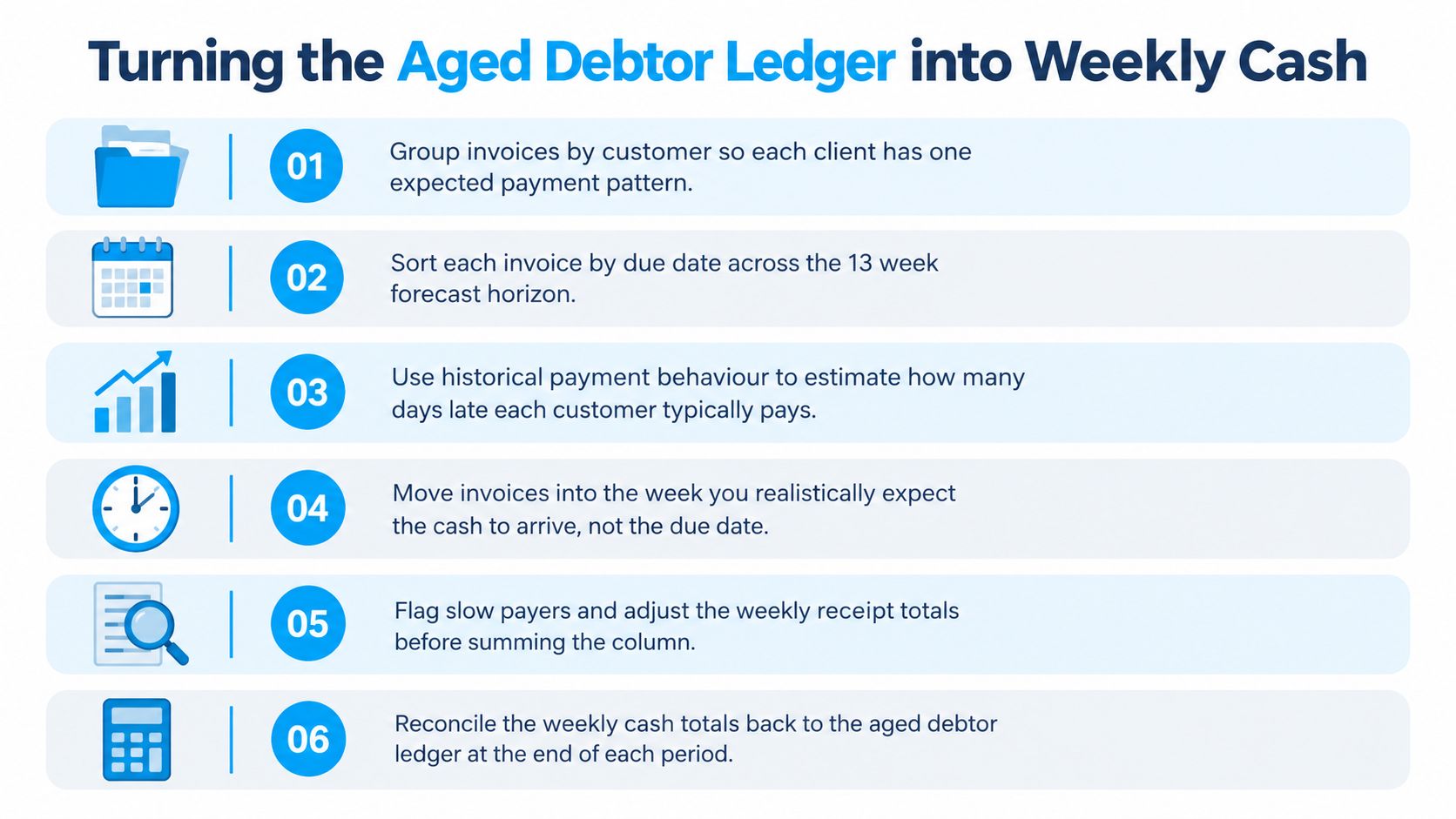
A practical classification might include:
Reliable customers: Model receipts close to the agreed date where payment history supports it.
Slow-paying customers: Move receipts into a later week based on the customer's established pattern.
Disputed invoices: Use a cautious receipt assumption and assign an owner to resolve the dispute.
Concentrated exposure: Flag any customer whose delayed payment would breach the minimum cash buffer.
For the base case, use expected collection dates rather than invoice dates. Then test delayed-30-day and delayed-60-day cases for customers most likely to slip. Those cases aren't generic contingency percentages. They show which week becomes difficult and which customer conversation needs to happen first.
The UK Government estimates that more than 1.5 million UK businesses, or 28% of all businesses, are affected by late payments each year, with around £26 billion in overdue invoices at any given time. It also estimates an average exposure of £17,000 for each affected business and almost £11 billion of annual economic cost. The late-payment research explains why debtor timing belongs inside the core forecast.
Every week, reconcile forecast receipts with actual receipts, record the percentage of invoices paid late and measure the absolute forecast error. The credit-control list should show contact dates, promised dates, escalation points and the cash impact of failure.
Running the Forecast Weekly Without It Taking Over Your Life
The forecast becomes useful when it is treated as a rolling operating routine. Each week, the closed week becomes actual, the remaining weeks move forward, and a new Week 13 is added at the end.
A disciplined review can remain short if the model is prepared properly. The finance lead should refresh bank balances and cleared transactions before the meeting, then the MD and relevant owners should focus on material changes.
A workable weekly rhythm
Reconcile the closed week: Compare forecast receipts and payments with actual cleared cash.
Explain variances: Separate timing differences from permanent changes, such as a lost customer, cancelled order or higher supplier cost.
Refresh the opening balance: Use the actual closing bank position, not last week's estimate.
Roll the window: Move Weeks 2 to 13 forward and add a new week.
Update ownership: Record who will chase a debtor, approve a payment or confirm a tax date.
Check the buffer: Identify the first week where available cash falls below the agreed minimum.
The review should concentrate on variance, not variance theatre. A small discrepancy that repeats may reveal a broken assumption. A larger one-off difference may matter less if the cause is understood and won't recur.
Keep scenarios simple and live
The base case should represent the most likely outcome. The downside should show a realistic difficult period, such as a major customer paying late while a cost overruns. The upside can model a faster-paying quarter, but it shouldn't be used to justify spending before evidence appears.
Useful scenario triggers include:
| Scenario | Trigger | Decision it informs |
|---|---|---|
| Base | Expected collections and committed costs remain stable | Normal spending and hiring |
| Downside | A major customer slips or a material cost increases | Spending pause, collection escalation or funding |
| Upside | Receipts arrive earlier and margins hold | Stock, recruitment or investment timing |
A customer-loss case and a cost-inflation case can be added when they are commercially plausible. Each scenario needs a named trigger, an owner and a decision. Otherwise the team is maintaining a model rather than using scenario analysis.
The forecast should also reconcile with monthly management accounts. Management accounts explain performance and trends. The weekly model explains liquidity. If the two views tell different stories, the finance lead should identify whether the difference comes from accruals, VAT, tax, stock, debtor timing or an input error. A well-integrated cloud process can reduce repeated data entry, and automated bookkeeping and reporting can support that connection.
Cash Actions the Forecast Should Trigger
A forecast is only valuable if a warning produces a proportionate action. The response should match both the size and the timing of the gap.
A large debtor slipping into a weak week may justify earlier credit-control escalation or invoice finance. A new contract that consumes cash before delivery may need staged billing, a deposit or revised mobilisation terms. A margin squeeze may call for supplier negotiation, deferred non-essential spending or a review of pricing.
Director loans or equity can provide support, but they should generally follow cheaper operational measures rather than replace them. A business shouldn't fund avoidable collection delays with expensive capital if a documented customer commitment or staged invoice could improve timing.
Profit also needs to be separated from usable cash. VAT, Corporation Tax, stock purchases and project mobilisation can absorb cash without appearing as a matching reduction in the current month's profit. A short written trigger memo agreed by the MD and finance lead should state what happens when the buffer is breached, a customer slips or a tax obligation approaches.
That turns the model into a decision system. It tells the team not only that cash is tight, but who must act, by when and with which lever.
Common Mistakes That Make a Forecast Useless
The most common failure is optimism disguised as professionalism. A forecast filled with invoice values and contractual due dates can look precise while overstating the money that will arrive.
Stop treating invoices as cash
Invoice value isn't cleared cash. The government research found that 49% of small businesses reported that business customers took longer to pay than their typical agreed terms, compared with 36% across businesses overall. The published sector and size analysis supports customer-specific payment assumptions rather than a blanket contingency.
Stop ignoring tax dates and clearing time
Corporation Tax payment dates, VAT quarter dates, PAYE and payroll need to be entered as actual cash events. The bank-clearing date matters too. HMRC states that Corporation Tax must reach it by the deadline, and payment methods can require advance processing time. A forecast that shows cash on the legal deadline but ignores clearing can overstate what the business can spend. HMRC payment guidance covers the practical timing issue.
Stop leaving the model ownerless
Someone must own each input and the weekly close. Without an accountable owner, missed receipts remain unexplained, supplier changes arrive late and no one updates assumptions when reality moves.
Stop making it an annual exercise
A 13-week cash flow forecast isn't a budget produced once for a board pack. It needs a weekly roll-forward, actual-versus-forecast review and a fresh final week. If it takes excessive effort, simplify the categories and automate the source data rather than abandoning the discipline.
Stop hiding concentration risk
One large customer can dominate a week's receipts. The closing balance may look positive until that customer slips, at which point the business discovers that the apparent headroom was conditional rather than available.
Know when external help pays
Outside support becomes useful when the forecast is being used for a lending conversation, sale process, restructure or significant growth decision. A capable finance partner should provide template rigour, tax-date discipline, scenario stress-testing and an independent challenge to the management story.
Specialist cash flow forecasts support can also connect the weekly model to management accounts, debtor actions and board decisions. For a focused review, a business can book a cash flow forecasting consultation and have the next quarter's commitments pressure-tested rather than reformatted.
This article is for informational purposes only and does not constitute professional advice. Tax rules apply as of April 2026. Consult a qualified accountant for your specific circumstances.
Frequently asked questions
Is 13 weeks the right horizon?
For near-term liquidity, usually. It covers roughly one quarter and gives enough time to see payroll, tax, supplier and debtor timing. It shouldn't replace a longer budget or cash flow projection. Businesses with unusually long contract cycles may need additional forward planning beyond the 13-week view.
What is the difference from a 12 month forecast?
A 13-week model focuses on weekly bank movements and operational decisions. A 12-month forecast supports broader planning, including profitability, investment and funding requirements. The shorter model uses more detailed timing assumptions, while the longer model necessarily relies on more aggregated estimates.
How often should a 13 week cash flow forecast be updated?
It should be updated every week. The closed week becomes actual, the forecast window rolls forward and assumptions change when receipts, costs or commitments move. Monthly updating leaves too much time for a missed payment or tax event to become urgent.
Do I need a 13 week cash flow template?
A template can speed up the first build, but it won't correct poor assumptions. The essential features are weekly columns, opening and closing balances, receipts, payments, notes, variance tracking and a visible minimum cash buffer. The template should be simple enough to maintain consistently.
Who should own the forecast?
A finance lead should own the model and weekly reconciliation, while the MD or CFO should own decisions arising from it. Credit control, payroll, operations and tax owners need responsibility for their respective inputs. One person must remain accountable for the final version.
striveX Ltd helps growing UK businesses build rolling 13-week cash flow forecasts linked to receipts, payroll, VAT, Corporation Tax, loan repayments and management reporting.
