

A monthly management accounts fee depends on transaction volume, number of entities, reporting frequency, data quality and how much advisory time is included. There is no reliable UK market rate without defining those factors, so the right comparison is between two properly scoped quotes, not two headline prices.
An MD can ask two firms for management accounts services and receive figures that look thousands of pounds apart. That doesn't automatically mean one firm is expensive or the other is cutting corners. One quote may include bookkeeping corrections, consolidated reporting and board support, while the other covers a standard profit and loss report built from clean records.
For a company turning over £1 million to £15 million, monthly reporting should support decisions about cash, margins, hiring, borrowing and investment. The UK Government's Longitudinal Small Business Survey 2023, based on 7,799 SME employers with one to 249 employees, found that 73% used some form of external finance, up 10 percentage points on the pre-pandemic level recorded in 2019 (UK SME finance survey). A reliable pack gives directors evidence before a lender, supplier or cash position forces a decision.
The practical answer is to understand what changes the work, then ask for a quote that names every inclusion and exclusion. A useful explanation of the reporting itself appears in this guide to what management accounts include.
What a Management Accounts Quote Actually Covers
Management accounts services are priced on scope, not on a universal market rate. The provider is pricing the work needed to close the books, check the numbers, build the reports and help management interpret them.
Five variables usually move the fee:
Transaction volume: More sales, purchases, payroll entries, bank movements and journals create more processing and review work.
Entity count: A single company is simpler than a group requiring intercompany reconciliations and consolidation.
Reporting frequency: Monthly reporting requires a recurring close. Quarterly reporting creates fewer reporting cycles, but each close may involve more catch-up work.
Bookkeeping quality: Clean, reconciled records reduce correction time. Missing invoices, uncategorised transactions and unreconciled bank accounts add remedial work.
Advisory time: Variance analysis, forecasting, scenario modelling, lender support and board meetings require senior input beyond report production.
The pack itself can also vary. One provider may deliver a standard profit and loss, balance sheet and cash summary. Another may include customer profitability, debtor ageing, operational KPIs and a review meeting.
Practical rule: A low fee is only good value when it supports the decisions the board actually needs to make.
The scope matters because external finance is material for many growing businesses. It also means the reporting has to explain more than whether the company made an accounting profit. It should show whether turnover is converting into cash, whether margins are holding and whether planned growth can be funded.
The Five Cost Drivers Behind Any Quote
The biggest pricing differences usually come from the time a management accountant must spend before the report can be signed off.
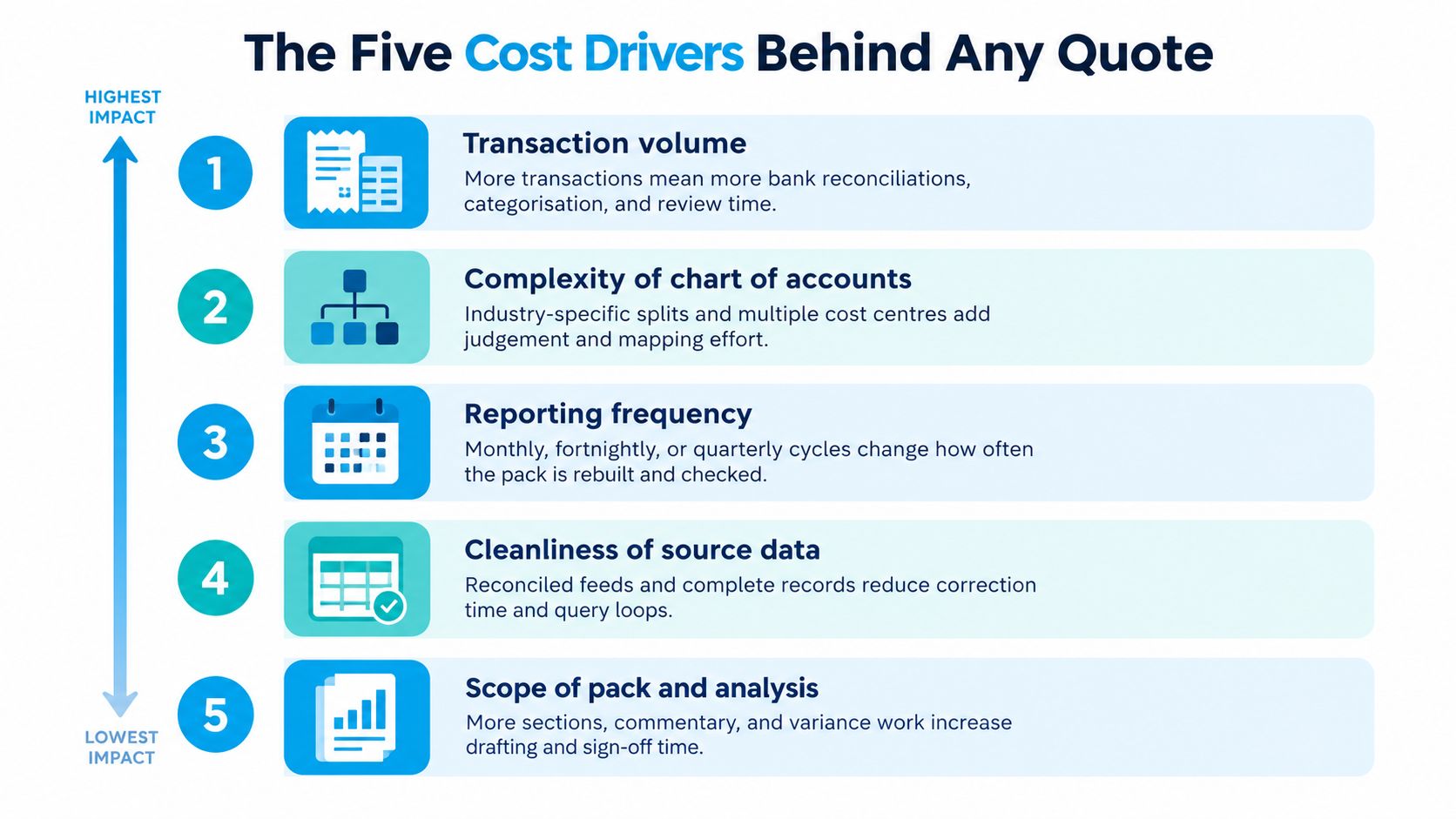
Transaction volume
A trading company processing a high number of invoices and bank movements needs more reconciliation, categorisation and review than a professional services business with fewer monthly entries. Transaction volume also affects query handling and the likelihood of corrections.
Entities and currencies
A group structure introduces company-to-company balances, consolidation journals and separate reporting views. Foreign currencies add translation, exchange-rate checks and another layer of reconciliation. Even when turnover is similar, the finance work can be materially different.
Reporting frequency
Quarterly reporting creates fewer formal close cycles than monthly reporting. Monthly reporting costs more because the team repeatedly posts adjustments, reviews the balance sheet and prepares commentary against a tighter timetable.
Bookkeeping quality
Unreconciled bank feeds, incomplete purchase records and inconsistent coding force the management accountant to investigate before producing useful information. A clean bookkeeping handover keeps the fee focused on insight rather than repair.
Advisory and board support
A standard pack is not the same service as a finance partner who models hiring decisions, tests debt capacity, explains margin movement or attends board meetings. A business that wants lender-ready reporting and scenario analysis should expect the quote to reflect that senior time.
The Bank of England's 2023 survey of 2,885 UK small and medium-sized enterprises found that around 70% preferred slower growth to taking on debt, while approximately half used only internal funds to finance investment (UK SME finance survey). That makes the advisory element commercially important. Directors need to know not only what happened, but whether the next investment can be funded safely.
Typical Service Tiers and What Each One Includes
Most providers can structure management accounts services around three practical levels. The right choice depends on the decisions the reports need to support, not on selecting the largest package.
| Tier | Typical deliverables | Best fit |
|---|---|---|
| Core reporting | Monthly or quarterly profit and loss, balance sheet, cash summary and budget variance | Businesses that need a dependable financial close |
| Insight reporting | Management commentary, KPI dashboard, debtor and creditor ageing, and rolling cash forecast | Growing companies managing working capital and performance |
| Board support | Scenario modelling, lender-ready packs, segment reporting and board meeting attendance | Companies making funding, hiring, restructuring or investment decisions |
The core tier works when the finance team can interpret the numbers internally. It becomes less suitable when the MD needs an explanation of why gross margin changed, which customers are consuming cash or whether a planned hire should proceed.
The middle tier adds the bridge between accounting and management action. A rolling forecast can expose a future cash squeeze, while debtor ageing can show that strong turnover is being funded by delayed collections.
The top tier is an outsourced finance function rather than a report delivery service. It suits a company that needs recurring senior judgement without employing a full-time senior finance team. Businesses can compare the reporting emphasis with the approach described in monthly and quarterly business reviews.
In-House Versus Outsourced Management Accounts
An in-house management accountant offers immediate access and close familiarity with the business. That can work well where transaction volume is substantial and the role is full enough to occupy a capable senior person throughout the working week.
The trade-off is broader than salary. Recruitment, training, holiday cover, software, professional development and retention all sit with the company. A single employee may also lack the tax, forecasting, systems and board experience needed as the business becomes more complex.
Outsourced management accounting gives a growing company access to a wider finance function. The provider can often bring bookkeeping, management reporting, forecasting and advisory capability into one engagement, then increase or reduce support as the business moves through seasonal demand, funding discussions or a restructure.
The decision test
Outsourcing tends to fit when the company needs breadth and senior judgement without a full-time cost. In-house hiring tends to fit when recurring volume is high enough to keep a senior finance professional fully occupied and the company values constant internal availability above flexibility.
The comparison resembles the wider question of choosing an external operating model. For a useful explanation of how businesses weigh different outsourced arrangements, see how Benely weighs ASO versus PEO.
Control doesn't disappear with outsourcing, but it must be designed. The engagement should identify who approves journals, who owns deadlines, who reviews the pack and how the company receives its records if the relationship ends. A provider's explanation of who prepares management accounts can help directors assess the level of responsibility being offered.
What a Clean Quote Should Include and Questions to Ask
A clean quote lets another provider price the same work from the same information. It should specify reporting frequency, delivery timetable, entities, currencies, systems, and the exact contents of the management pack. Without those details, two quotes can differ by thousands while both remain reasonable.
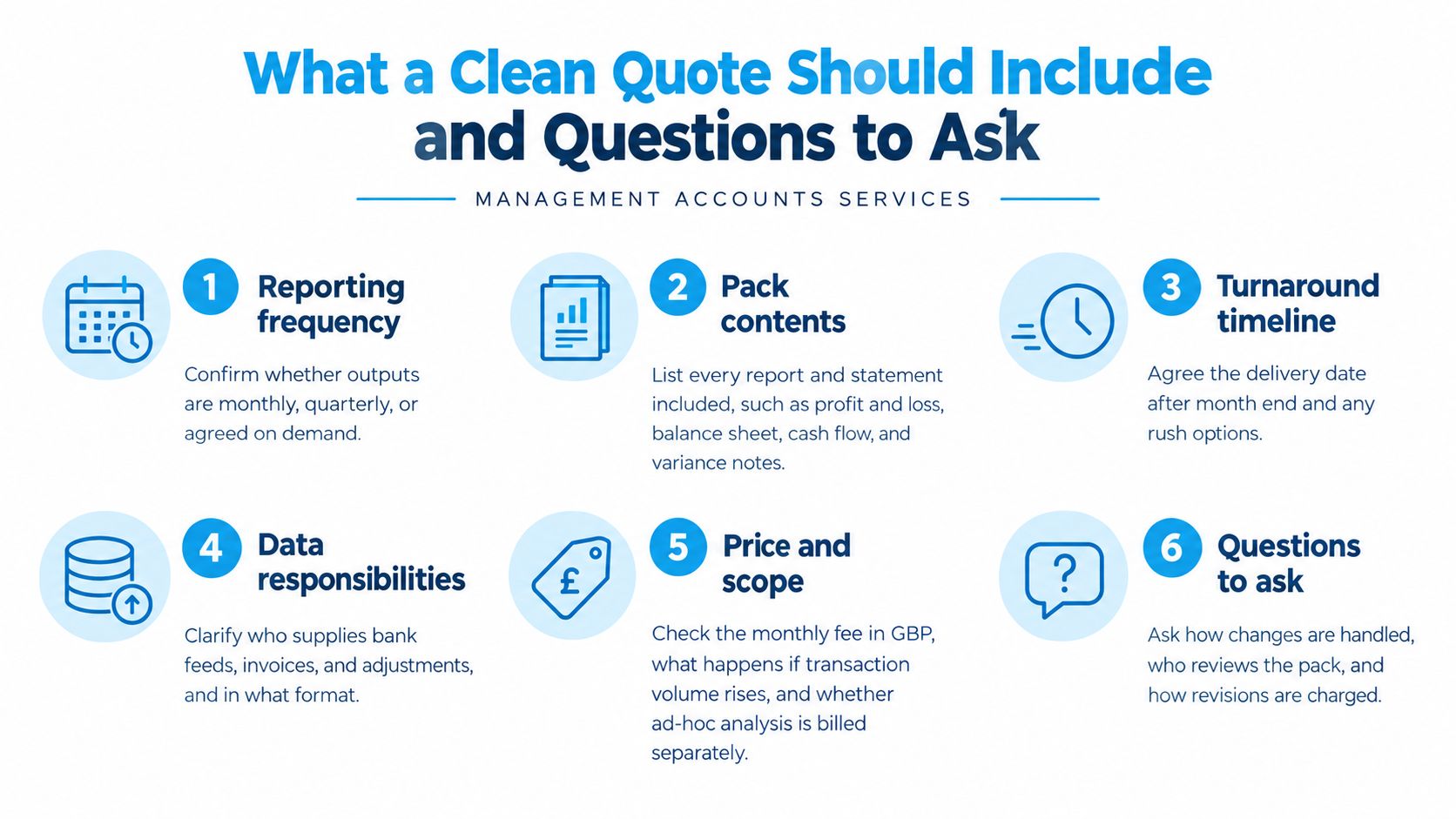
The proposal should confirm whether the provider works in the company's existing cloud accounting platform and what access they need. It should also name who supplies invoices, bank information, payroll journals, and other adjustments. Those hand-offs affect both the monthly fee and the delivery date.
Before signing, directors should ask:
What happens if transaction volume doubles? The answer should set out the review point and any fee adjustment.
When is the pack delivered after month end? A late report cannot guide the next decision.
Are advisory calls included? Reporting without interpretation leaves management to do the most valuable analysis themselves.
What does onboarding involve? The provider should identify opening balances, reconciliations, access permissions, and outstanding records.
How is data returned at the end? The company should retain access to its ledger, reports, working papers, and supporting information.
The fee basis must be explicit. It may be fixed for a defined scope, reviewed when activity changes, or split between recurring reporting and ad hoc analysis. Ask what triggers a price change, what the monthly fee excludes, and how extra work is approved.
How to Keep the Monthly Fee Down Without Cutting Quality
A meaningful part of the cost sits with the client's own processes. Clean data lets the management accountant spend time explaining performance instead of rebuilding the ledger.
Three controls make the largest practical difference:
Reconcile before the close: Bank feeds, control accounts, payroll balances and supplier records should be checked before the reporting deadline.
Set fixed cut-off dates: Agree when invoices, receipts, payroll information and adjustments must arrive. Late inputs create chasing, rework and delayed review.
Use one source of truth: Sales, purchases, payroll and banking should feed a consistent cloud accounting process with an agreed chart of accounts.
Late payment deserves special attention. Government research found that 40% of surveyed businesses identified customers being paid late as a driver of late payment, while the mean proportion of invoices paid late was 17% (UK Government late-payment research). A management pack should therefore show aged receivables and overdue customer balances, not just reported turnover.
The same principle applies to reporting automation. Businesses assessing how ERP exports become board packs should still confirm that the underlying ledger is complete, reconciled and mapped consistently. Automation can accelerate a sound close, but it can't correct weak source data by itself.
How StriveX Scopes a Management Accounts Engagement
StriveX starts with a free 30-minute review of the current finance function. The discussion should establish the company's reporting needs, existing bookkeeping process, cloud accounting system, entity structure and the decisions the board needs the pack to support.
The next step is a written proposal covering the reporting pack, frequency, systems included and fee basis. The engagement is led by a qualified management accountant and delivered in the client's cloud accounting system. Advisory time can be built into the monthly fee where the company needs more than report preparation.
The proposal should make the boundary between routine reporting and additional work clear. That protects the company from unexpected charges and gives the provider enough information to resource the close properly.
A company considering management accounts services can book a review through the contact page. The stated expectation is a free 30-minute conversation, with a response within 24 hours.
Frequently Asked Questions on Management Accounts Pricing
Is outsourcing cheaper than hiring?
It can be, particularly where the company needs a mix of bookkeeping, reporting and senior advisory input but doesn't have enough recurring work for a full-time senior finance professional. The comparison should include recruitment, cover, systems and training, not salary alone.
What is included in a monthly fee?
A fee may include a profit and loss, balance sheet, cash summary, variance commentary and review meeting. Enhanced scopes can add KPIs, forecasting, debtor analysis, scenario modelling and board support. The quote must list inclusions clearly.
Is there a minimum contract?
Some providers require a minimum term, while others agree a rolling arrangement. The proposal should state notice periods, onboarding commitments and how outstanding work is handled if the engagement ends.
How quickly can reporting start?
The start date depends on data quality, system access, opening reconciliations and the availability of prior-period information. A realistic provider will confirm the onboarding steps before promising a first pack.
Do you need cloud accounting?
Cloud accounting helps teams share live records and maintain a repeatable close, but the required system depends on the provider and business. The company should ask whether its existing platform is supported and what data must be supplied.
striveX Ltd provides management accounts services for growing UK companies, combining recurring reporting with bookkeeping, forecasting and advisory support where the scope requires it.
This article is for informational purposes only and does not constitute professional advice. Tax rules apply as of April 2026. Consult a qualified accountant for your specific circumstances.