

The fashionable answer to rolling forecast vs annual budget is that the annual budget is obsolete and rolling budgets are the modern replacement. That advice is too simplistic for a UK business turning over £1 million to £15 million. A fixed budget still gives directors a clear target, while a rolling forecast gives them a current view of where the business is heading.
The core decision is commercial. If turnover, margins, customer demand and cash timing move quickly, an annual plan can become stale before the financial year is half finished. If income is stable and predictable, the cost of monthly reforecasting may outweigh the benefit. The strongest model for many scaling firms is therefore not either-or. It is an annual budget for governance, combined with a rolling forecast for decisions.
The Short Answer Most Guides Avoid
An annual budget sets the target. A rolling forecast updates the expected landing position. Neither should pretend to be the other.
An annual budget fixes expected income and expenditure for a financial year. A rolling forecast keeps a constant look ahead, replacing the period that has closed with a new future period. The budget answers, “What did the board approve?” The forecast answers, “What does the latest information suggest will happen?”
The evidence supports a more balanced view than most comparison articles offer. A UK and Australia survey of 380 firms found that only 29.3% prepared rolling budgets, while more than 95% agreed that rolling budgets improve predictions for future periods. That gap suggests many finance leaders see the value but haven't yet built the process. The Oxford research also indicates that annual and rolling budgets can work together.
The likely scenario for a scaling SME is familiar. The annual plan looked sensible when approved, but by month four, a major customer has delayed an order, recruitment has accelerated, supplier costs have moved and the cash position no longer matches the original expectation. The budget hasn't failed. It has become a historical benchmark rather than a reliable current outlook.
The practical verdict depends on revenue volatility, customer concentration, seasonality, gross-margin stability and cash runway. A business with contracted income and strong visibility may need a disciplined annual budget with monthly variance analysis. A project-led firm with uncertain delivery dates may need a monthly rolling forecast alongside it. The decision framework below helps directors make that call without adopting rolling budgets merely because they sound more advanced.
How an Annual Budget Actually Works for a Scaling SME
An annual budget is a detailed statement of expected income and expenditure over a defined financial year. For an established business, the sensible starting point is the previous year's actual trading, adjusted for inflation and planned changes such as growth. That makes the budget a structured commercial commitment, not a guess pulled from a spreadsheet.
For a £1 million to £15 million turnover company, the budget usually sets expectations for turnover, gross margin, labour, overheads, capital expenditure, financing and cash. It gives the board a reference point for decisions and creates a common set of assumptions for department heads. A well-built budget also makes budgeting variance useful, because directors can distinguish between poor execution and assumptions that no longer hold.
Where the annual budget earns its place
The annual budget remains valuable because it creates a fixed baseline for:
-
Board governance: Directors can approve a defined plan and monitor performance against it.
-
Funding conversations: Lenders and investors can see the assumptions behind planned borrowing, investment and repayment.
-
Remuneration guardrails: Variable remuneration can be linked to an agreed target rather than a number that changes every month.
-
Spending authority: Managers can work within approved limits for recruitment, equipment, stock and discretionary costs.
-
Variance analysis: Finance can explain the difference between actual results and the original plan.
The budgeting process can be laborious. Deloitte research involving more than 500 senior finance professionals found that budgeting took eight weeks or more in 80% of organisations, while only about one-quarter used rolling forecasts. Deloitte's integrated performance management research shows why the annual cycle often feels disproportionate for a lean finance team.
Where the fixed plan starts to hurt
The weakness appears after trading moves away from the original assumptions. An annual budget doesn't automatically reflect a lost contract, a delayed project, a change in customer payment behaviour or a sudden hiring requirement. If the management team continues treating the old budget as the current outlook, directors can make decisions using numbers that no longer describe the business.
That doesn't make annual budgets outdated. It means the budget should remain the agreed target and be paired with a separate working forecast. Businesses that need a stronger initial planning process can explore business budgeting support to build a clearer baseline before adding rolling budgets.
How a Rolling Forecast Works in Practice
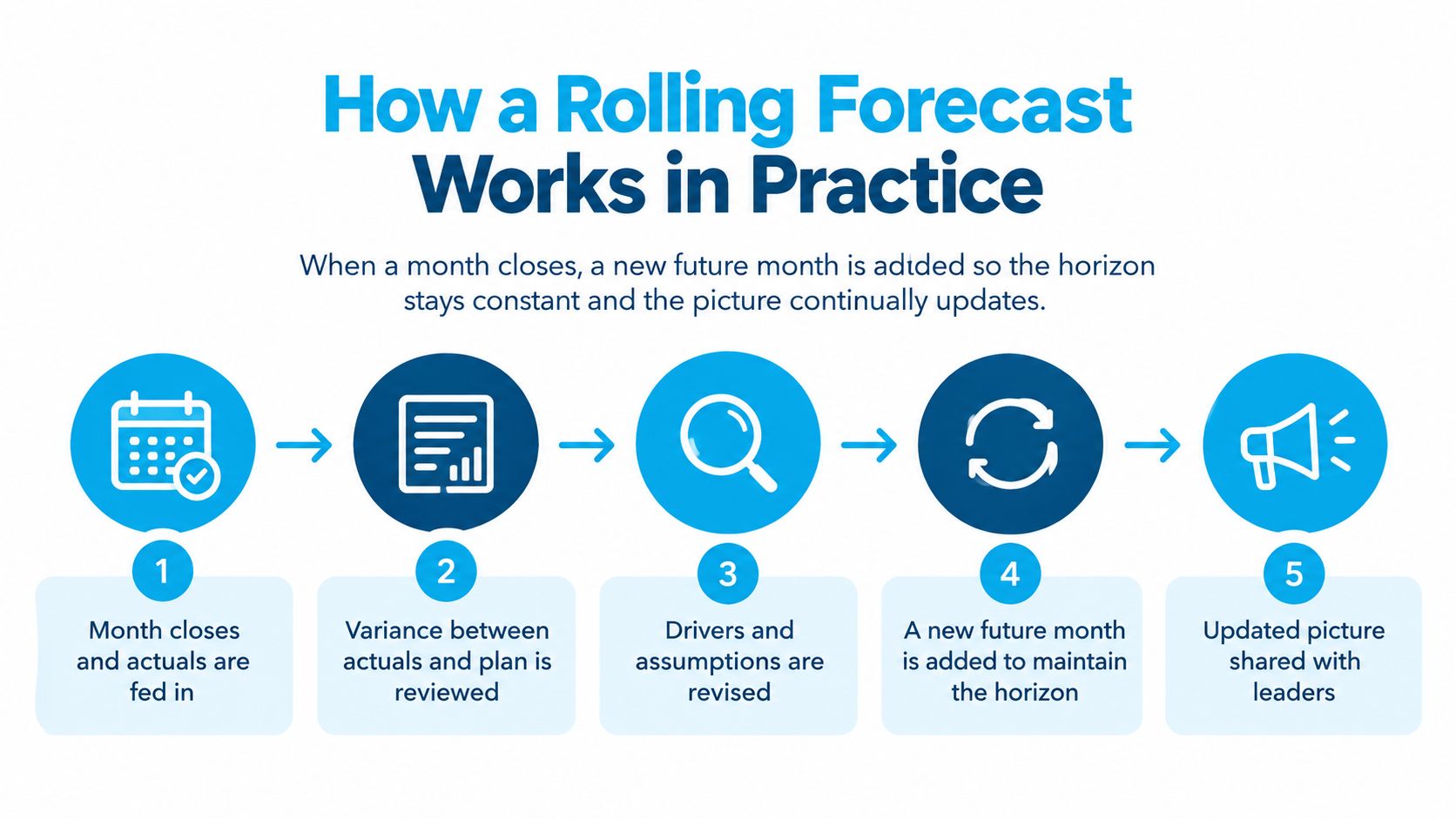
A rolling forecast is a current estimate that keeps extending the planning horizon. Once a month closes, actual results replace that month's estimate, and a new future month is added. The business keeps a consistent forward view without reopening the annual budget each time conditions change.
Use a 12-month minimum horizon for most SMEs. Businesses with longer production, delivery or financing cycles may choose an 18-month view, but the horizon should match the decisions directors need to make. Monthly updates suit businesses facing regular changes in demand, pricing or costs. Quarterly updates can work when order books, margins and cash movements remain stable.
The mechanics behind the model
A useful rolling forecast is not an annual budget with extra tabs. It is a driver-based model connected to the operational activity that produces financial results. For a practical build process, use our guide to how to build a great financial forecast.
The model should include:
-
Driver-based turnover: Orders, utilisation, headcount, pricing, conversion or contracted work should explain the forecast.
-
Monthly actualisation: Closed periods use actual results rather than outdated estimates.
-
Named ownership: Specific people own turnover, payroll, working capital, tax and capital expenditure assumptions.
-
Scenario planning: Base, upside and downside cases show how decisions change under different conditions.
-
An assumption register: Each material assumption has an owner, date, rationale and review status.
Connect the profit and loss view to working capital and cash. A business can report a healthy accounting profit while late customer payments, stock purchases or tax bills reduce the bank balance. A rolling cash flow forecast should show when money enters and leaves the bank account, not only when invoices are raised.
A funding application will normally require a business cash-flow forecast covering the next 12 months, including income, materials, rent, utilities, tax, wages, advertising and the monthly running balance. UK government funding guidance explains the practical difference between invoice dates and bank movements.
What the forecast gives directors
A rolling forecast gives directors earlier visibility of cash requirements, sales shortfalls, margin pressure and hiring capacity. It also gives the MD a current landing position without reopening the debate over whether last December's assumptions were reasonable.
The forecast is the best current estimate, not a new target for managers to chase. The annual budget remains the agreed benchmark. Keeping those roles separate protects accountability and stops every revision becoming a negotiation about performance._monthly reforecasting only earns its keep when revenue volatility and decision speed justify the finance time. Cash runway, customer concentration and seasonality should determine the update rhythm, not a blanket preference for one method.
Side by Side Comparison Without the Fluff
A comparison only helps if it connects to decisions. The following differences matter more than the labels.
Annual budget
-
Horizon: Usually covers the financial year and remains fixed after approval.
-
Update frequency: Typically built through one concentrated planning cycle, with actual performance reviewed during the year.
-
Primary use: Sets targets for turnover, costs, investment, funding and management accountability.
-
Governance role: Strong. It supports board approval, remuneration guardrails, lender discussions and spending authority.
-
Cash visibility: Useful for planned cash requirements, but weak when payment timing or trading assumptions change.
-
Time cost: Can consume substantial finance capacity before the year begins.
-
Best fit: Businesses with stable demand, predictable margins and reliable forward visibility.
Rolling forecast
-
Horizon: Maintains a constant forward view, normally at least 12 months.
-
Update frequency: Usually monthly or quarterly, depending on volatility and decision speed.
-
Primary use: Updates the expected landing position using actual results and revised assumptions.
-
Governance role: Complementary. It informs decisions but shouldn't replace the approved target.
-
Cash visibility: Stronger when linked to debtor timing, stock, tax, payroll and financing.
-
Time cost: Requires an operating rhythm, clear ownership and disciplined data preparation.
-
Best fit: Businesses exposed to customer concentration, project timing, seasonality, margin movement or short cash runway.
PwC UK describes rolling forecasts as continually replacing the period just completed while extending the horizon, but it also notes that they aren't a universal solution for businesses with stable, predictable income. PwC's budgeting discussion supports the central conclusion.
The annual budget wins on governance. The rolling forecast wins on speed and current visibility. Both fail when nobody owns the assumptions.
Which Method Fits Your Business Stage and Sector
The decision should start with how the business behaves, not with finance fashion.
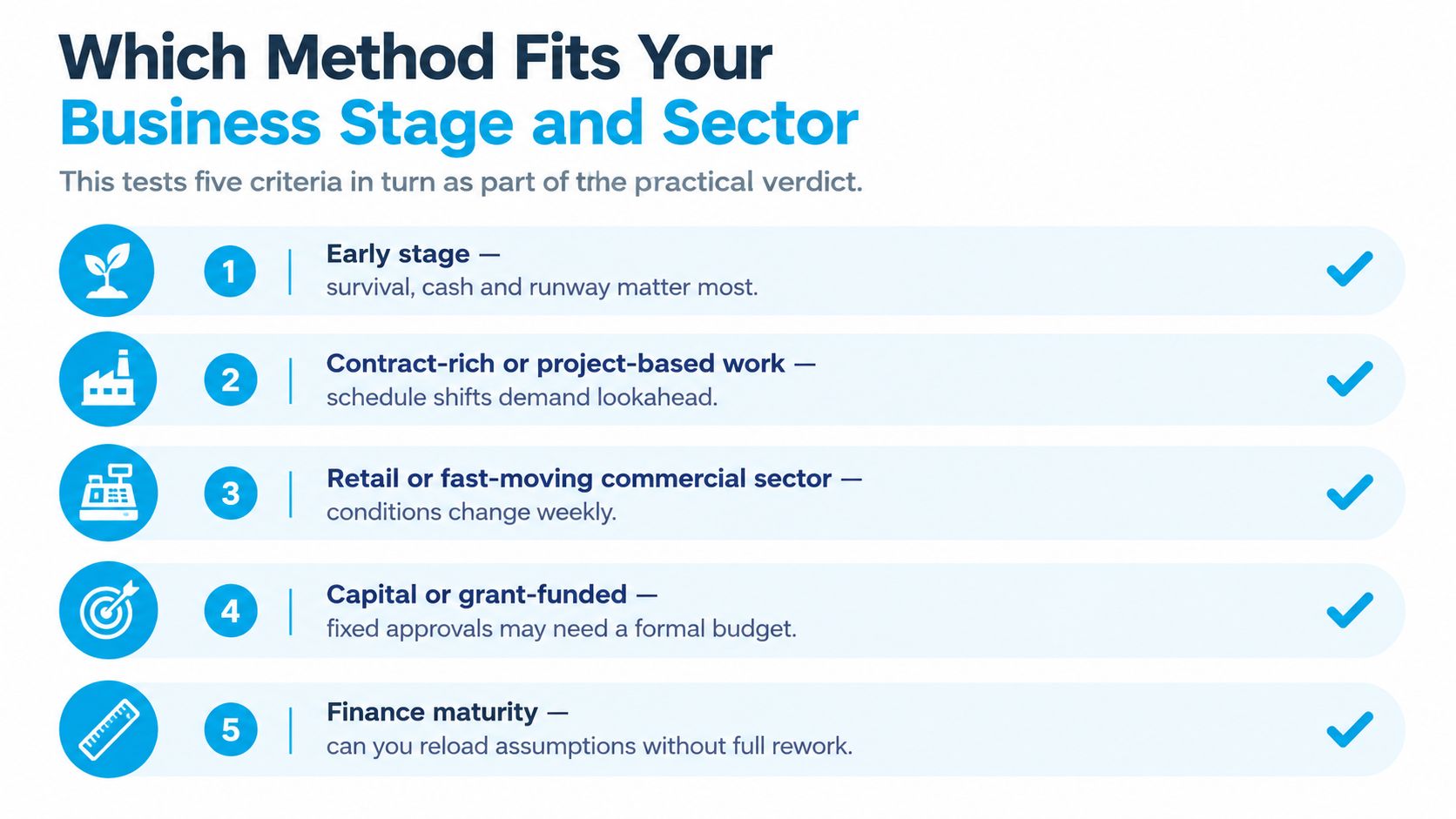
Revenue volatility is the first test. If orders, project starts or customer usage move sharply, an annual budget will lose relevance quickly. If turnover comes from repeat contracts with dependable renewal patterns, an annual budget plus monthly variance review may be entirely adequate.
Customer concentration changes the risk. A business dependent on a small number of customers needs to model renewal, delay and loss scenarios. One delayed contract can alter payroll capacity, working capital and borrowing needs. A diversified customer base with consistent purchasing patterns creates less need for frequent reforecasting.
Seasonality determines the value of a constant horizon. Retail, tourism, events and certain distribution businesses need to see the next trading peak well before it arrives. Seasonal movements affect stock, labour, marketing and cash, so the forecast should add a new future period whenever the current month closes.
Gross-margin stability matters more than turnover alone. A company can hit its turnover target and still miss its cash and profit expectations if supplier pricing, labour mix or project scope changes. Manufacturing and construction businesses often need driver-based forecasts because delivery schedules and input costs influence the result. Professional services firms should connect forecasts to billable capacity, utilisation and people costs. Subscription businesses may have clearer forward visibility, although churn, pricing and expansion still deserve monitoring.
Cash runway is the decisive test. If the business has limited headroom, a rolling forecast is normally worth the effort because directors need early warning of a funding gap. UK evidence reported that 47% of small and medium-sized businesses were experiencing cash-flow challenges, while 51% cited financial or resource-management problems as barriers to growth. The Accountancy Age report reinforces why cash literacy should come before software selection.
Tools, People and Time Needed to Run Both
A small finance team can run an annual budget and rolling forecast, but only if the process is deliberately simple. The minimum setup is a reliable source of actual results, a structured forecasting model and a calendar that tells each owner when information is due.
The model can be a disciplined spreadsheet or a dedicated planning layer. The choice matters less than version control, transparent assumptions, reconciled actuals and an output that the MD can understand quickly. The finance lead should be able to trace each material movement back to a business driver.
Ownership beats sophistication
A finance manager or part-qualified accountant can coordinate the cycle, but finance can't invent every assumption. Named owners should provide input for:
-
Turnover and pipeline
-
Payroll and recruitment
-
Debtors, creditors and working capital
-
VAT, PAYE and Corporation Tax
-
Capital expenditure and financing
The MD should attend a short monthly review focused on decisions, not a long meeting where every line is read aloud. The forecast should highlight material movements, cash risks and actions required.
The model should also pair the rolling profit and loss forecast with a short-term cash view. That view must include VAT, PAYE, Corporation Tax, payroll, debtor receipts, supplier payments and borrowing headroom. Monthly or quarterly business reviews can provide the operating rhythm needed to turn numbers into action.
Running rolling budgets well isn't free. It consumes management attention, and poor data can make monthly updates more frustrating than useful. However, KPMG evidence reports that organisations adopting more focused budgeting and rolling forecasts reduced the time required to produce planning information by more than 60%. KPMG's planning, budgeting and forecasting paper shows why process design matters as much as the model itself.
Moving from Budget Only to Budget Plus Rolling Forecast
The safest route is to keep the annual budget and add the rolling forecast around it. That avoids confusing accountability with prediction.
-
Review the existing budget. Identify which assumptions have already failed, including pricing, customer timing, staffing, supplier costs and payment behaviour. Separate errors in execution from assumptions that changed.
-
Create an assumption register. Record the owner, source, date and review trigger for every material assumption. Include cash timing, tax payments and financing, not just turnover and operating costs.
-
Build the driver-based model. Start with the few business activities that explain most of the movement. Use actual results for closed months and add base, upside and downside cases for the periods ahead.
-
Run the first complete cycle. Reconcile the model to the accounts, review actual-versus-forecast variance and identify missing drivers. Don't aim for perfect detail before the first review. Aim for a credible decision tool.
-
Explain the roles to managers and lenders. The annual budget remains the formal target. The rolling forecast is the latest estimate and shouldn't be used to move performance expectations after the fact. Lenders generally value a clear, reconciled outlook, particularly when it explains movements against the original budget.
-
Set the forecast calendar. Define the close date, data owners, review meeting, scenario refresh and board reporting date. Once the profit and loss cycle works, add more detailed balance sheet and cash forecasting where the decisions justify it.
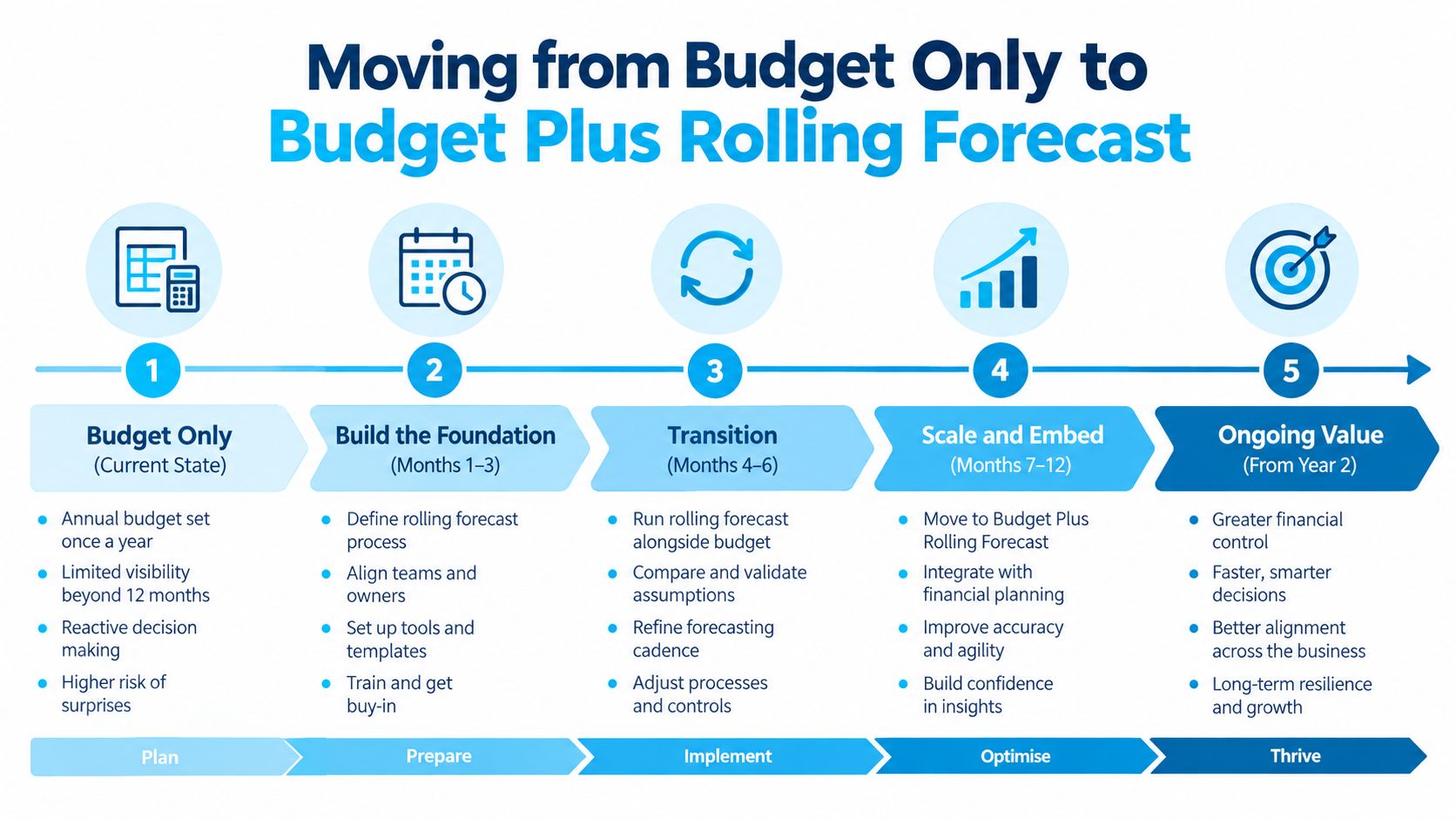
The first credible cycle usually takes sustained implementation effort rather than a single afternoon. The important point is to establish ownership and a repeatable review process before adding unnecessary complexity.
Common Pitfalls and How to Spot Them Early
The most expensive forecasting mistakes are usually process failures, not spreadsheet errors.
Treating the forecast as a moving target
A forecast is an estimate of what management currently expects to happen. It isn't a revised budget and shouldn't become a softer target whenever performance slips. If managers believe the forecast will be judged like the budget, they may understate likely results to make the landing position easier to defend.
Diagnostic cue: The forecast changes after every difficult conversation, but the underlying assumptions aren't recorded.
Correction: Keep the approved annual budget fixed. Label the rolling forecast clearly as the latest estimate and retain each cycle so directors can see how expectations changed.
Ignoring cash timing
Profit doesn't pay suppliers. Bank receipts do. A forecast that records invoiced turnover without modelling collection dates can give directors false comfort, particularly where customers pay slowly or tax liabilities fall in concentrated periods.
A cash-flow forecast is cumulative. Each closing bank balance becomes the next opening balance, and a negative closing balance signals that action is required. UK cash-flow guidance sets out this basic mechanics clearly.
Diagnostic cue: The profit forecast looks healthy while the bank balance repeatedly surprises the board.
Correction: Include debtor timing, supplier demands, payroll, VAT, PAYE, Corporation Tax, financing and a minimum cash threshold. Use the threshold to trigger action before committing to recruitment, equipment or stock.
Giving finance ownership of every assumption
Finance should coordinate the model, not carry responsibility for every operational input. Sales owns pipeline and conversion assumptions. Operations owns delivery and capacity. The people responsible for hiring should own headcount timing.
Diagnostic cue: Finance produces the forecast, but department heads can't explain why their numbers changed.
Correction: Assign named owners and require short commentary for material variances. A forecast becomes useful when operational managers recognise their decisions in the numbers.
Modelling at the wrong level of detail
Too little detail hides the drivers. Too much detail creates maintenance work without improving decisions. A £5 million business doesn't need every minor cost line forecast independently if a small number of operational drivers explain the movement.
Diagnostic cue: The model takes longer to update than the management team has available for discussion.
Correction: Forecast by meaningful customer groups, service lines, locations, projects or cost categories. Add granularity only where it changes a decision.
Failing to reconcile the forecast to the budget
A budget-versus-forecast bridge shows what changed since approval. It should separate volume, price, mix, timing, cost and one-off movements. Without that bridge, directors see two numbers but not the commercial explanation.
Diagnostic cue: The board asks why the forecast differs from the budget and receives a list of unexplained spreadsheet movements.
Correction: Report actual versus budget, actual versus forecast and forecast versus budget. Track recurring bias, not just individual variances. Persistent optimism in turnover or underestimation of labour costs points to an assumption problem rather than bad luck.
UK cash-flow guidance recommends updating forecasts regularly for changes in customer payment patterns, supplier demands, staff costs, legislation, interest rates and tax. It also recommends warning signals and a contingency plan. South Tyneside's cash-flow guidance provides a practical reference for those controls.
The habit that separates a useful rolling forecast from an expensive ritual is simple: every material variance must lead to an explanation, an owner and an action.
Frequently asked questions
Is a rolling forecast the same as a budget?
No. An annual budget fixes the agreed income and expenditure target for a financial year. A rolling forecast updates the expected outcome as actual results and assumptions change. The budget supports accountability and governance, while the forecast supports operational decisions. Keep both when the business needs a fixed benchmark and a current view.
How far ahead should a rolling forecast look?
A scaling SME should normally maintain at least a 12-month horizon, especially when the forecast supports funding, hiring or investment decisions. Businesses with longer production, project or financing cycles may need a longer view. The horizon should match the lead time of the decisions directors need to make, not a fashionable template.
How often should a rolling forecast be updated?
Monthly updating is the sensible default where turnover, margin or cash movements change regularly. Quarterly updating may suit a stable business with reliable forward visibility. The model should also be refreshed when a material assumption changes, such as a major customer delay, recruitment decision, financing event or significant tax liability.
Do lenders accept a rolling forecast?
Lenders can use a rolling forecast when it is reconciled to actual accounts, clearly explains assumptions and shows cash timing. It shouldn't replace an annual budget where the lender asks for an approved plan. The strongest funding pack normally presents the annual budget as the agreed baseline and the rolling forecast as the latest outlook.
Can a small finance team run a rolling forecast?
Yes, provided the model remains focused and ownership is shared with operational managers. One finance lead can coordinate the process, but sales, payroll, working capital, tax and capital expenditure owners must supply timely assumptions. Start with a driver-based profit and loss forecast plus a cash view, then add complexity only when it improves a real decision.
This article is for informational purposes only and does not constitute professional advice. Tax rules apply as of April 2026. Consult a qualified accountant for your specific circumstances.
striveX Ltd helps UK businesses turning over £1 million to £15 million combine annual budgets with driver-based rolling forecasts, cash-flow planning and practical variance reporting.