

A business turning over between £1 million and £15 million can reach an awkward point quickly. The founder still signs off the management pack, the bank wants covenant reporting, and an investor or acquirer expects reliable forecasts. The accounts may be technically complete, but nobody is turning them into confident commercial decisions.
That's where the choice between a fractional finance director and a financial controller matters. A controller protects the quality of the numbers. An FD decides what those numbers mean for investment, funding, margins and growth. Hiring the wrong role first leaves the reporting wall intact.
The Short Answer for Scaling UK SMEs
A financial controller runs the accounting function and reporting accuracy. A finance director sets financial strategy, forecasting and funding. A fractional FD gives a growing company the second capability on a part-time basis.
The right first hire depends on the constraint:
Hire a controller first when management accounts are late, reconciliations are unreliable, controls are weak or the finance team can't complete a disciplined month-end close.
Hire an FD first when the numbers are broadly trustworthy but the business needs funding, investment preparation, covenant reporting, acquisition modelling, margin decisions or board-level challenge.
Hire both, in sequence, when the business has accurate data problems and strategic decisions waiting behind them.
A founder shouldn't appoint an FD to compensate for broken bookkeeping. Equally, a controller shouldn't be expected to lead a funding round because they're the most senior person in finance.
The rest of the decision comes down to one question: is the business struggling to produce reliable information, or struggling to act on it? The first problem points to financial controllership. The second points to an FD.
What a Financial Controller Actually Does
A financial controller owns the operating rhythm of finance. The role turns transactions into reliable management information and ensures the underlying records can withstand scrutiny from directors, lenders, auditors and tax advisers.
The controller's four core responsibilities
Month-end close comes first. A competent controller sets a timetable for bank reconciliations, journals, accruals, prepayments, stock, fixed assets, payroll and intercompany balances. The result is management accounts issued consistently enough for leaders to act while the information is still useful.
Controls are the second responsibility. The controller should define who can raise suppliers, approve payments, amend customer records and post journals. They should also investigate unusual movements rather than allowing unexplained balances to roll forward.
Reporting accuracy is more than exporting a profit and loss statement. The controller should explain variances, check whether margins are recorded in the right period and challenge estimates around provisions, debtor recoverability and revenue recognition under the applicable accounting framework.
Team leadership completes the role. That may include bookkeepers, finance assistants, payroll providers and external clerks. The controller sets standards, allocates work and makes sure no critical process depends on one person's memory.
A senior bookkeeper may process transactions well. A controller adds judgement, review discipline and ownership of the finance process. That distinction becomes important when management accounts support borrowing, dividends, hiring or an acquisition.
For a practical breakdown of how this support works in a growing business, see what a virtual financial controller can do for your business.
Practical rule: If the finance team can't explain why last month's numbers changed, the business needs stronger controllership before it needs more strategy.
A controller isn't normally the person responsible for the funding narrative, acquisition model, pricing strategy or board-level capital allocation decision. Those responsibilities belong with the FD.
What a Finance Director Actually Does
A finance director takes the numbers beyond accuracy and into choice. The role connects financial information with the decisions that determine whether growth creates cash or consumes it.
Four commercial jobs define the FD role
Financial strategy means deciding where the business should invest, which activities deserve protection and which costs need changing. The FD may test whether a new sales hire can generate enough contribution, whether a product line deserves more capital or whether expansion should be delayed.
Forecasting gives the leadership team a forward view. That includes a rolling 13-week cash forecast, an annual budget and scenario plans for different trading outcomes. A proper forecast doesn't stretch last month into the future. It tests the effect of slower collections, increased stock, higher labour costs, recruitment or weaker margins.
Funding is where the difference between finance director vs financial controller becomes obvious. An FD prepares lender or investor information, models borrowing capacity, compares funding options and monitors covenants. The UK Government's Longitudinal Small Business Survey 2024 found that 72% of SME employers used some form of external finance, while 15% sought external finance in the previous 12 months. The average amount sought by applicants was £513,000, with results varying by business size, according to the Longitudinal Small Business Survey 2024.
Board work turns financial reporting into accountability. The FD challenges assumptions, explains the commercial meaning of variances and puts decisions into a clear financial narrative. A board shouldn't receive a pack that merely describes what happened. It should show what needs deciding next.
For a broader explanation of how these decisions fit together, businesses can review financial strategy for growing companies.
The FD doesn't replace a sound accounting function. The role uses that function to answer harder questions: can the company fund expansion, absorb a margin squeeze, complete an acquisition or meet lender expectations without putting liquidity at risk?
Where the Two Roles Overlap
The overlap is real, which is why businesses often appoint the wrong person. Both roles may contribute to monthly management accounts, cash reporting, KPI dashboards, basic covenant monitoring, year-end preparation and audit liaison.
The difference lies in ownership and depth. A controller may prepare the cash report and identify overdue balances. An FD decides whether customer concentration requires tighter credit limits, whether supplier terms need renegotiating or whether additional working-capital funding should be arranged.
Two failure patterns appear regularly:
Accurate but inactive: management accounts arrive on time, yet nobody uses them to change pricing, hiring, stock or investment decisions. The business has controllership but lacks financial leadership.
Strategic but unstable: an FD spends time building forecasts while reconciliations remain incomplete and the management pack changes after every review. The business has strategic input without a dependable control base.
A strong operator can cover both roles for a period, particularly when the finance function is modest and the reporting demands are manageable. That person must be able to close the books, challenge estimates, produce useful management information and then lead a funding or investment discussion without confusing those responsibilities.
The test isn't whether one person can perform both jobs. It's whether the business can still close accurately while that person is dealing with lenders, investors or strategic decisions.
What a Fractional FD Adds at Part-Time Cost
A fractional finance director, also described as a part time finance director, virtual finance director or outsourced finance director, gives a business access to senior judgement without a full-time appointment. The engagement should have a defined purpose, such as board reporting, cash forecasting, lender communication, fundraising preparation or commercial planning.
The arrangement might involve a limited number of days each month under a fixed scope or retainer. The exact shape should follow the decisions the FD must own, not an arbitrary label. A business preparing for funding needs a different rhythm from one that only requires quarterly board challenge.
A fractional FD can:
Build and review the rolling cash forecast.
Improve board reporting and KPI interpretation.
Prepare lender and investor information.
Test investment, hiring and pricing decisions.
Monitor funding headroom and covenant requirements.
Challenge the founder's assumptions without being involved in every transaction.
The model doesn't make the external FD a statutory director. Company directors remain legally responsible for filing annual accounts and Company Tax Returns, paying Corporation Tax, keeping records and reporting relevant changes, even where an accountant or external adviser is appointed, as set out in GOV.UK guidance on running a limited company. The engagement must therefore produce an evidence trail, documented controls and a clear handover, not just informal advice.
HMRC research published in 2025 surveyed 2,001 small businesses. It found that 67% used an accountant or tax agent for at least some finance work, while 50% performed some finance work internally and outsourced the remainder, and 18% outsourced all finance work. The HMRC research on finance activity shows that fractional finance leadership extends an established outsourcing pattern.
Businesses considering the model can also review business advisory services in Stirling for a wider perspective on part-time senior finance support.
| Scenario | Financial controller | Finance director | Fractional FD |
|---|---|---|---|
| Month-end close | Owns the process and accuracy | Reviews whether reporting supports decisions | Reviews the pack and focuses attention on key risks |
| Cash visibility | Produces cash reports and reconciles balances | Builds scenarios and funding plans | Provides senior cash review without daily attendance |
| Funding | Supplies reliable underlying data | Leads funding preparation and lender discussions | Leads defined funding work on a retained basis |
| Board reporting | Produces core information | Shapes the narrative and challenges assumptions | Brings board-level judgement part time |
| Finance team | Manages daily workflow | Sets capability and structure | Advises on the team and operating model |
The Five Triggers That Decide Which Role You Need
Five situations usually reveal the correct hiring decision faster than turnover does.
Preparing for investment. An investment process requires a coherent financial story, defensible forecasts and clear use of funds. If the underlying accounts are unreliable, appoint a controller first. If the information is sound but no one can model scenarios or lead funder discussions, appoint an FD.
Lender covenant pressure. Quarterly covenant reporting is not a formatting exercise. It requires accurate management information, forward cash visibility and early escalation when headroom narrows. A controller fixes the data. An FD owns the lender conversation and tests the actions needed to protect liquidity.
An upcoming acquisition. An acquisition needs valuation analysis, funding capacity, integration planning and downside modelling. That is an FD-led project. A controller should prepare clean schedules and validate the data, but shouldn't be left to decide whether the transaction is affordable.
A margin squeeze. A manufacturer facing raw-material inflation, or a distributor facing supplier cost increases, needs more than a historical gross margin report. The FD should model pricing, customer profitability, purchasing and hiring choices. If the margin report itself can't be trusted, controllership comes first.
A board demanding proper reporting. If directors receive late packs, unexplained variances or inconsistent KPIs, the immediate need is a controller. If the pack is reliable but the board wants scenario analysis, accountability and capital allocation advice, the FD is the correct first appointment.
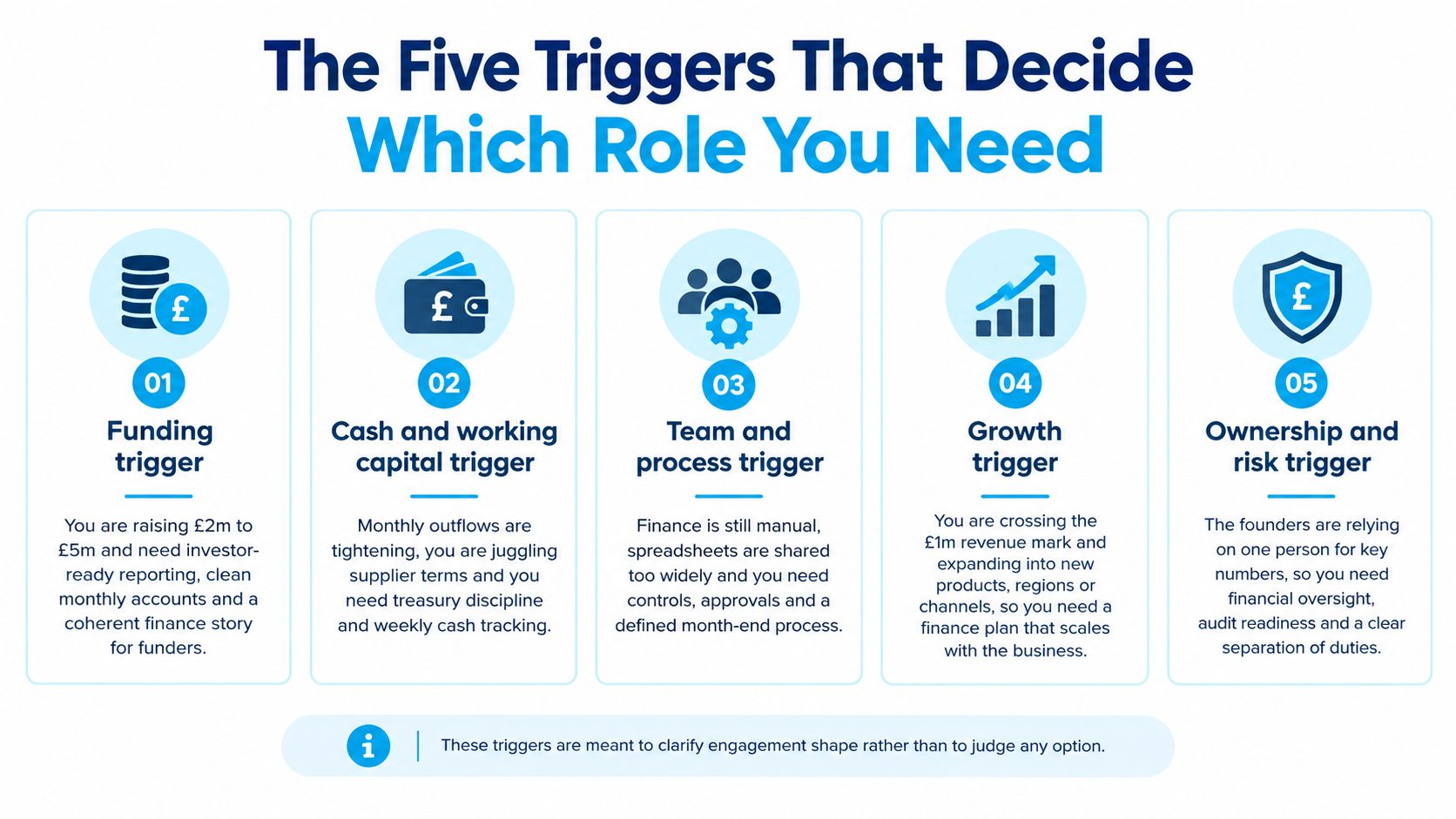
The funding case is particularly strong. External finance remains common among UK SMEs, and the survey cited above records an average amount sought of £513,000 among businesses that applied. Senior finance input should begin before a permanent FD feels affordable, because weak forecasts can restrict funding choices.
Fractional FD Versus Full-Time, Interim and Outsourced Options
A permanent FD offers deep integration, daily availability and continuity. That suits a business with complex funding, a substantial finance team, frequent board decisions or a sustained need for executive-level finance leadership. The trade-off is a fixed senior cost and a longer hiring process.
An interim finance director is usually brought in for a defined transition, turnaround, transaction or absence. This works when urgency matters more than long-term continuity. The business should decide at the outset what knowledge must transfer before the interim engagement ends.
A fractional or virtual finance director suits a business that needs senior judgement regularly but not every day. The arrangement can expand around a funding process or acquisition and reduce when the immediate project ends. It offers flexibility, but the FD won't have the same day-to-day presence as a permanent executive.
An outsourced finance function can combine bookkeeping, controllership, management reporting and senior oversight. That may be efficient where the business needs a broader team rather than one individual. Seniority varies, so the engagement must identify who owns commercial decisions, lender reporting and board support.

Cost should be assessed by scope, availability, continuity and the value of decisions made, not by day rate alone. A fractional FD isn't automatically cheaper once the required work is fully defined, and an outsourced package isn't automatically strategic. Businesses comparing structures can explore finance consultancy services before selecting an operating model.
When the Fractional Model Becomes the Wrong Answer
Fractional support becomes a risk when the business depends on the external FD for knowledge it has never absorbed. The founder may not own the financial narrative, lender relationships may sit outside the company and key controls may exist in an adviser's inbox. If the business can't function when the FD is unavailable, the model has gone too far.
The warning signs are practical:
Management reporting takes longer to produce.
Forecast accuracy is falling.
Control failures are recurring.
The finance team can't sustain its workload.
Funding arrangements are becoming more complex.
The founder relies on the FD for everyday decisions.
Investors, lenders or an acquirer expect daily finance ownership.
The answer is a planned transition, not an abrupt cancellation. A useful 90-day handover should document the rolling 13-week cash forecast, transfer lender and investor relationships, internalise the board pack, build a finance team that owns the close and record the FD's final recommendations.
The permanent hire should receive more than files. They need the assumptions behind the forecast, the history of funding decisions, customer or supplier risks, reporting definitions and the timetable for statutory obligations. Directors retain responsibility even when advisers are appointed, so the handover must preserve evidence and control ownership.
A fractional FD is best understood as a temporary operating system and succession mechanism, not a permanent substitute for every finance capability. Use it to establish disciplined reporting, make important decisions and prepare the business for the next stage. Move to a permanent FD, controller or wider finance team when the workload and risk justify internal ownership. Businesses comparing broader models can read about outsourced finance function support for fast-growth UK businesses.
Frequently Asked Questions
Is an FD more senior than a financial controller?
Usually, yes. A financial controller owns accounting operations, controls and reporting accuracy. An FD operates at a broader commercial level, leading strategy, forecasting, funding and board decision support. A strong controller may cover some FD responsibilities, but the two roles have different primary accountabilities.
What does a fractional FD cost?
There is no responsible universal figure. Cost depends on the scope, complexity, seniority, number of days required and whether the engagement covers a defined project or ongoing board support. Businesses should compare the cost with the financial risk of late reporting, weak forecasts, poor funding preparation and delayed decisions.
Do I need a full-time FD at £5m turnover?
Turnover alone doesn't decide it. A business at that level may need a full-time FD if it has complex funding, acquisition activity, a large finance team or constant board-level decisions. Another company may need a controller plus fractional FD support. Reporting latency, forecast quality and decision complexity are better tests.
What is the difference between a CFO and an FD?
An FD usually leads the finance function, management reporting, forecasting, funding support and board finance work. A CFO often operates at a broader executive level, with greater emphasis on capital structure, investor relationships and corporate development. The titles overlap, so the required responsibilities should be written into the engagement.
Can an outsourced team replace both?
An outsourced team can cover bookkeeping, controllership and senior finance leadership if the scope and accountability are explicit. The business should confirm who owns the close, cash forecast, board pack, funding discussions and statutory evidence. Outsourcing can provide capability, but directors still retain their legal responsibilities.
This article is for informational purposes only and does not constitute professional advice. Tax rules apply as of April 2026. Consult a qualified accountant for your specific circumstances.
striveX Ltd provides outsourced CFO, virtual finance director and outsourced FD services for UK businesses turning over £1 million–£15 million.