


That brown envelope lands on your desk. HMRC logo. Your stomach drops a little. We’ve seen it happen countless times.
But a letter about an HMRC tax check isn’t an accusation. It’s usually a routine request to make sure your tax return is accurate. Think of it less like a police raid and more like a car’s annual MOT—a standard procedure to check everything is in order.
For a commercially sharp Finance Director or MD, understanding this process isn’t just about compliance; it’s about managing risk and protecting your bottom line.
What Is an HMRC Tax Check and Should You Be Worried?
For most growing companies, an HMRC tax check isn’t a sign you’ve done something wrong. It’s a formal request to clarify figures in your return, whether for Corporation Tax, VAT, or PAYE. It only escalates if significant—or deliberate—errors come to light during the review.
These checks are becoming more common, especially for businesses with a turnover between £1 million and £15 million. HMRC now uses powerful data-matching software to spot tiny inconsistencies between your Statutory Accounts and other financial data, flagging them for a closer look.
A tax check is usually a data-driven query, not a personal attack. The fastest way to resolve it is to respond professionally and transparently, so you can get back to running your business.
Why Panic Is Commercially Damaging
That initial jolt of fear when you see an HMRC-headed envelope is natural, but panic is your enemy. A calm, structured response shows you’re in control and can significantly reduce the commercial impact.
Here’s why a measured approach is always better:
- Checks are rarely random: HMRC enquiries usually focus on a specific area, like a large R&D Tax Credit claim or an unusual spike in expenses. Knowing this helps you gather the right information without wasting time and professional fees.
- Cooperation is your best tool: HMRC’s penalty system takes your behaviour into account. If a mistake is found, being prompt, cooperative, and honest could significantly reduce any potential penalties.
- It’s a manageable project: With the right advice, a tax check becomes a clear, step-by-step process. An experienced accountant can handle the communication, pull together the exact documents needed, and ensure you don’t over-share information.
Framing the tax check as a procedural task, not a crisis, is the key. The goal is to prove your numbers are solid, correct any honest mistakes, and move on as quickly and painlessly as possible.

Common Triggers That Flag a Business for a Tax Check
It’s a common myth that getting a letter from HMRC is just down to bad luck. The truth is, most tax checks are anything but random. They are triggered by data.
HMRC’s sophisticated ‘Connect’ system is the driving force here. Think of it as a hugely powerful computer that spends its days cross-referencing your tax returns against billions of data points – from your bank accounts and VAT returns to Land Registry records and even sales data from online marketplaces.
Its job is simple: to spot inconsistencies. And for Finance Directors, it means small discrepancies that might have been missed in the past are now flagged by an algorithm.
Financial Red Flags for Growing Businesses
For businesses in the £1 million to £15 million turnover bracket, the risk is often higher. This is usually a period of rapid growth, where financial systems can struggle to keep pace with operations, leaving the door open for errors.
While every business is different, we see the same patterns crop up time and again.
Key triggers include:
- Rapid turnover growth, but flat profits: If your turnover has doubled but your profit margin hasn’t budged, Connect will flag it. Without a clear reason, like a major investment, it suggests costs might be inflated or income under-reported.
- Large or unusual expense claims: A sudden jump in ‘miscellaneous’ costs or director expenses that seem out of proportion with your business activity is a classic red flag.
- VAT returns not matching company accounts: This is one of the easiest checks for HMRC to make. Their system will compare the sales you declared on your quarterly VAT returns with the annual turnover in your Statutory Accounts. If they don’t line up, expect a query.
- Big swings in your payroll: A sharp drop in your PAYE bill while turnover is steady or growing could point to a shift towards using off-payroll workers. This often prompts HMRC to check if your employment status (IR35) rules are being applied correctly.
The key takeaway is that most checks are not random. Your numbers are being constantly compared against your own filing history, industry benchmarks, and third-party data.
In fact, it’s estimated that just seven per cent of HMRC investigations are random. The other 93 per cent are triggered by a specific discrepancy or piece of information.
This isn’t about being unlucky. It’s about understanding that your accounts are sending signals. By learning to look at your own numbers through an inspector’s eyes, you can spot and fix inconsistencies before they ever become a problem.
The Different Types of HMRC Compliance Checks
That brown envelope from HMRC can make any Finance Director’s heart sink. But before you panic, it’s crucial to understand what you’re actually dealing with.
Not all enquiries are created equal. The type of check dictates the seriousness and potential disruption. Knowing what HMRC is asking for helps you and your adviser gauge the situation and respond in the right way from the very start.
Aspect Queries
The most common and least worrying type of check is an Aspect Query. This isn’t a full-blown investigation; it’s a targeted question about one specific part of your tax return.
Think of it as HMRC simply asking for a receipt. They’ve spotted a particular figure and just want to understand it a bit better. Common triggers include:
- A large or unusual expense claim.
- A significant jump in a director’s remuneration.
- Questions about a specific box on your Corporation Tax return.
Most of the time, an Aspect Query is resolved quickly by providing a clear explanation and the right supporting documents. It’s a request for clarification, not a challenge to your entire year’s accounts.
Full Enquiries
A Full Enquiry is more serious. This means HMRC wants to review your entire Corporation Tax return for a specific year, not just a single line item. While it’s more involved, it’s still a manageable process with the right support.
HMRC will request a much wider range of documents, from bank statements and ledgers to specific invoices and contracts. Their goal is to ensure the whole return is ‘correct and complete’. Responding properly requires careful organisation to make sure you provide exactly what’s been asked for, and nothing more.
Tax-Specific Reviews
HMRC can also look beyond your Corporation Tax. They often run compliance reviews or audits that focus on a particular tax your business handles.
For a growing business, the two most common are:
- VAT Audits: These can involve a visit from an officer to inspect your VAT records and processes. They’ll check a sample of transactions to make sure you’re charging and reclaiming the correct amounts.
- PAYE Compliance Reviews: Here, HMRC examines your payroll records, employee benefits, expense claims, and how you classify subcontractors. They want to be sure all employment-related taxes are being paid correctly.
Understanding these different checks is the first step to resolving them professionally and efficiently. For more details on handling all forms of HMRC requirements, our expert team is here to help. This knowledge allows you and your adviser to build the right strategy from day one, ensuring a swift and low-stress resolution.
Your Step-by-Step Response Plan to an HMRC Notice
That brown envelope from HMRC. It’s enough to make any director’s heart sink. But the two worst things you can do are panic or shove it in a drawer and hope it goes away.
A calm, methodical approach is your best defence. It shows HMRC you’re professional and organised, and it dramatically reduces the risk of a minor query turning into a major, time-consuming headache.
Here’s our proven four-step plan for what to do the moment that letter lands on your desk.
Step One: Breathe. Then Act.
First, take a moment. An HMRC tax check isn’t an accusation; it’s a request for information. Read the letter from start to finish, and then read it again to make sure you understand exactly what they’re asking for.
The single most important thing you can do now is to acknowledge it. Ignoring the letter is the fastest way to get on the wrong side of the inspector, attract penalties, and escalate the entire situation.
Get any deadlines mentioned in the letter into your calendar immediately. These aren’t suggestions. Missing them signals disorganisation and can lead to HMRC issuing an estimated tax bill—which is almost always higher than what you actually owe.
Step Two: Bring in an Expert
Your very next call should be to your accountant or a specialist tax adviser. Please, do not try to handle this yourself. A good adviser acts as a critical buffer between you and the tax inspector, ensuring every piece of communication is handled with professional care.
This does two things for your business:
- It controls the flow of information: Your adviser will ensure you only provide the specific information HMRC has asked for. This stops you from accidentally volunteering details that could open up completely new, and unnecessary, lines of enquiry.
- It protects your time: It frees you and your team from the administrative black hole of dealing with HMRC, so you can stay focused on running your business.
From this point on, your adviser should handle everything – from acknowledging the letter to submitting the final response.
Appointing an agent to handle an HMRC check isn’t an admission of guilt. It’s a sign of a well-run business that takes compliance seriously. It puts an expert in your corner who speaks HMRC’s language.
Step Three: Gather Your Documents—Methodically
Your adviser will give you a precise list of the documents needed. The temptation can be to just send over a huge data file with everything you can find. Do not.
Instead, work with your adviser to gather only what has been explicitly requested. This shows you’re organised, cooperative, and not trying to hide anything in a mountain of paperwork.
Commonly requested documents include:
- Bank statements for the specific period under review
- Sales and purchase ledgers
- Certain sales invoices or expense receipts
- Records for any director’s loan accounts
- VAT or PAYE records, if the check is about a specific tax
Organise these files clearly. This careful preparation is the foundation for a swift, smooth resolution.
Step Four: Draft a Factual, No-Nonsense Response
Once the documents are gathered, your adviser will draft the formal response. This is where their expertise really shines.
The letter should be factual, concise, and answer the questions asked—nothing more. It should not include opinions, excuses, or any extra information that wasn’t requested. Every statement must be backed by the evidence you’ve already compiled.
This controlled, professional process is your fastest route to a favourable outcome, protecting your business from unnecessary risk and stress.
How HMRC Penalties Work and How to Mitigate Them
No director wants to think about penalties, but understanding how HMRC calculates them is the first step to staying in control. If a tax check does uncover an error, the financial hit isn’t random. It’s directly tied to your behaviour.
The good news is that HMRC’s penalty system gives you a clear roadmap for limiting your company’s exposure. It all comes down to intent and how you cooperate.
Understanding the Penalty Framework
Penalties aren’t a one-size-fits-all punishment. They’re calculated as a percentage of the tax owed, and the rate depends entirely on why the error happened and how you handle yourself once the check starts.
Here’s how HMRC sees it:
- Reasonable Care: You tried your best to get things right, maybe even sought advice, but an honest mistake still slipped through. In most cases, there’s no penalty. This really highlights the value of having good systems in place from the start.
- Careless Error: This is where you failed to take that reasonable care. It’s not deliberate, but it’s a mistake that could have been avoided. Penalties here can range from 0% to 30% of the unpaid tax.
- Deliberate Error: This means you knew you were understating your tax liability. The penalties get serious, starting at 20% and climbing to 70%.
- Deliberate and Concealed Error: This is the most severe category. It means you not only knew about the error but actively took steps to hide it. Penalties run from 30% all the way up to 100% of the tax due.
The infographic below shows the first few steps to take when you get that letter, which is your first chance to demonstrate cooperation.
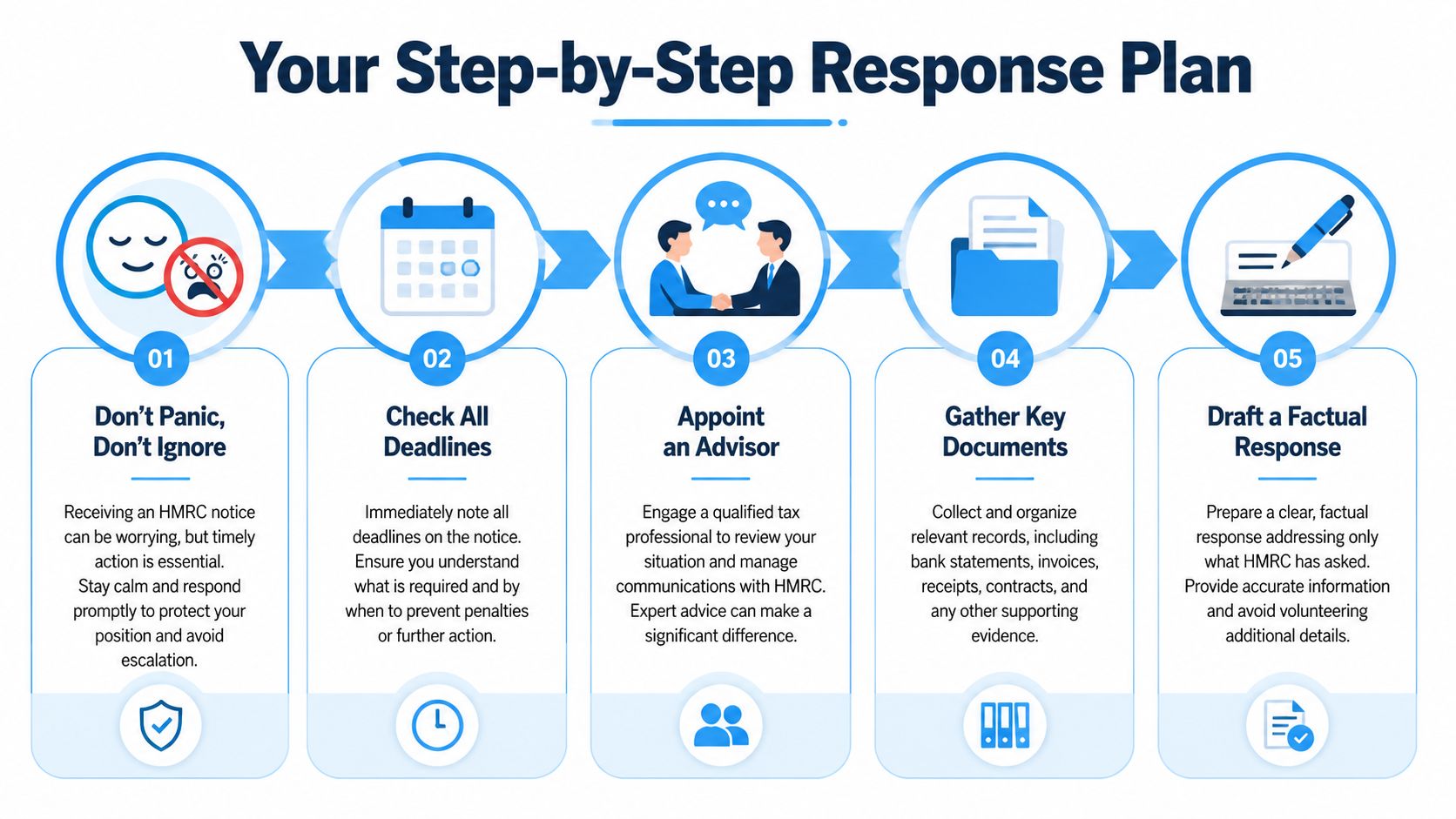
Having a structured response plan like this shows HMRC you’re organised and taking the situation seriously from day one.
How to Mitigate Penalties
The key to keeping penalties low is simple: cooperate. HMRC offers big reductions for what they call ‘telling, helping, and giving’. Being proactive, open, and providing information promptly could slash the final penalty.
A crucial distinction here is between a ‘prompted’ and an ‘unprompted’ disclosure. If you find an error and tell HMRC before they contact you, the penalties are far lower than if they find it during a check.
This is a powerful reason to keep on top of your own finances with regular internal reviews. If you can show you have strong processes and that you act transparently, you put your business in the best possible position.
For an extra layer of protection against the professional fees that come with handling a check, you might also think about HMRC investigation insurance. This can cover your accountant’s costs for managing the whole enquiry, leaving you free to focus on what you do best—running your business.
Prevention Is Always Better Than Cure
When it comes to an HMRC tax check, the best approach is to avoid one altogether. This isn’t about reactive damage control; it’s about proactive prevention. For a growing business, this shift is more than just good housekeeping – it’s a powerful commercial strategy.
Robust, year-round financial management creates the kind of consistency and accuracy that HMRC’s data-driven systems are built to reward. This is especially true for businesses in the £1 million to £15 million turnover sweet spot, where financial processes often struggle to keep up with operational growth, creating invisible risks.
Building Your Financial Defence
Think of a proactive finance function as your best defence against an unwanted HMRC tax check. Instead of a frantic Year End tidy-up, embedding good habits creates a clean, verifiable data trail that stands up to scrutiny.
Here are the key pillars of that defence:
- Immaculate Cloud Bookkeeping: Getting your data entry right in real-time ensures every transaction is correctly categorised. This simple discipline prevents the anomalies that can flag you for attention.
- Regular Management Accounts: When you review your performance monthly or quarterly, you spot and understand fluctuations long before HMRC does. Our guide to management accounts shows how these reports don’t just keep you safe, they drive smarter commercial decisions.
- Strategic Tax Planning: Thinking ahead on Corporation Tax, VAT, and PAYE means your filings are not just compliant, but consistent and defensible.
This is even more important as HMRC continues its digital push. Staying on top of initiatives like Making Tax Digital is a crucial part of proactive accounting. As detailed in Receipt Router’s 2026 MTD handbook, modern compliance doesn’t just streamline your tax filing; it actively minimises risk.
The goal is to make your financial story so clear and consistent that HMRC’s algorithms see no reason to look closer. Proactive accounting turns your finance function from a compliance burden into a strategic asset.
HMRC’s own actions confirm this. The department publishes around 100 regular statistical releases, reinforcing that checks are part of a wider system built on data and risk analysis. For business owners, the message is clear: clean books and timely returns matter because your figures are being compared against this vast data ecosystem. This evidence-based system rewards financial discipline, making it your strongest defence.
FAQs on HMRC Tax Checks
How far back can HMRC look into my company’s tax?
For an error made with ‘reasonable care’, HMRC’s look-back period is typically four years from the end of the tax year in question. However, if they suspect a ‘careless’ error, this extends to six years. For ‘deliberate’ errors, this can stretch to 20 years. Keeping organised records is your best defence.
Is an HMRC tax check just bad luck?
Rarely. While a very small number (around 7%) of checks are random, over 90% are triggered by data. HMRC’s ‘Connect’ system analyses your returns, comparing them to past filings and third-party data. An enquiry almost always means an algorithm has spotted a specific inconsistency, making it a data-driven process, not a lottery.
Do I have to let an HMRC officer visit my business premises?
For certain types of review, such as a VAT audit, an officer may have a right to visit. However, you should never agree to a visit without professional advice. Your accountant can liaise with HMRC to understand the scope and purpose, ensuring the visit is managed correctly and does not escalate unnecessarily.
What happens if I ignore an HMRC letter about a tax check?
Ignoring an HMRC letter is the worst possible action. It signals non-cooperation, leading to automatic penalties and estimated tax assessments which are often inflated. What might have been a simple query can quickly become a serious and costly formal investigation. A prompt, professional response is critical to managing the situation and minimising business disruption.
Worried about an HMRC tax check? Turn uncertainty into control.
An HMRC enquiry can be disruptive, but it doesn’t have to derail your business. Our expert team is experienced in managing HMRC communications, ensuring a swift and professional resolution while you focus on running your company.
Book a free, 30-minute tax check review with our specialists today. We’ll assess your situation and outline a clear, actionable plan. Response within 24 hours.
This article is for informational purposes only and does not constitute professional advice. Tax rules apply as of April 2026. Consult a qualified accountant for your specific circumstances.
