
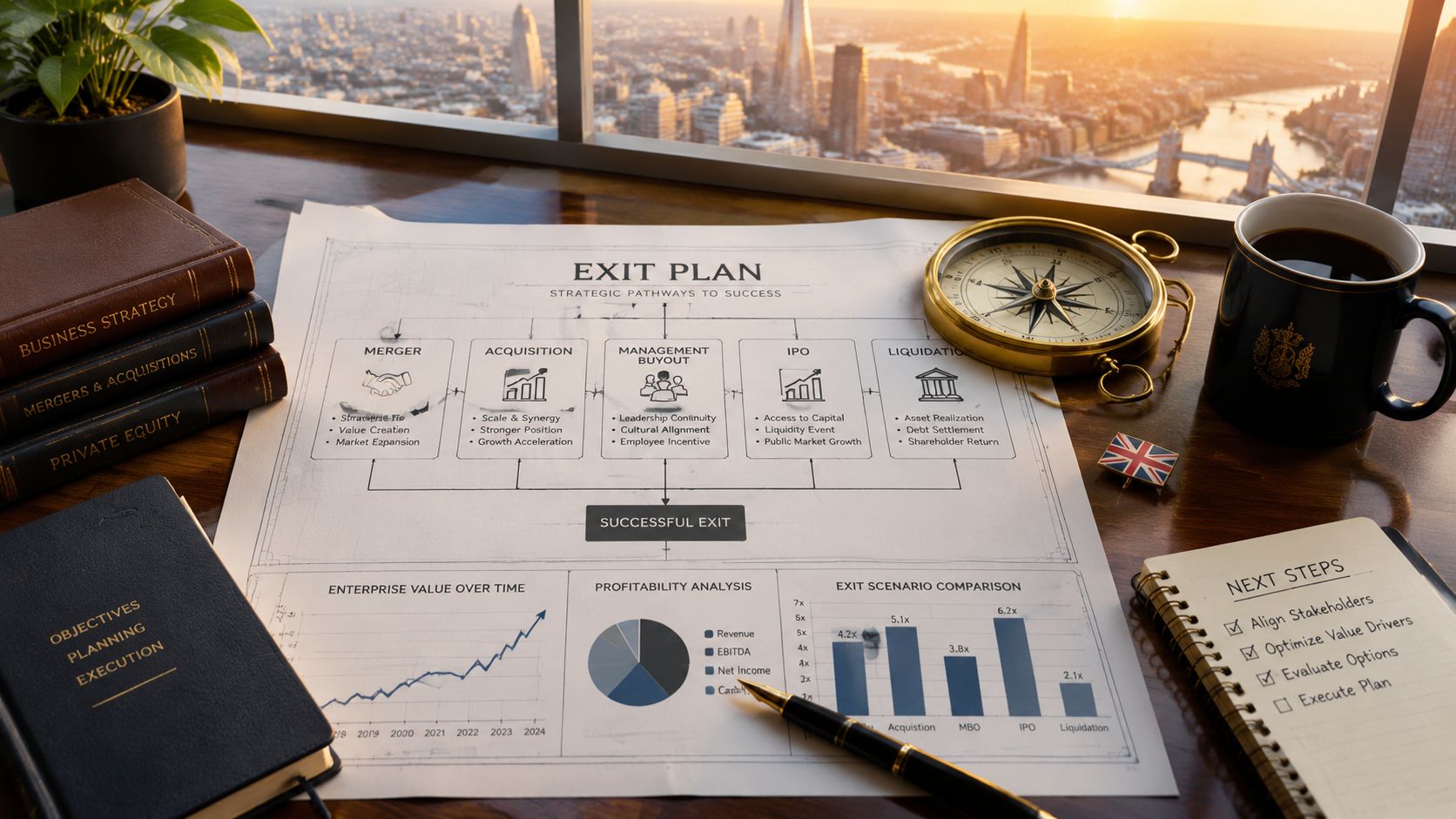

For most business owners, the idea of an ‘exit plan’ feels like something for the distant future. It’s a document you’ll think about when you’re ready to retire. But that’s a dangerous mistake.
An exit plan isn’t about stopping. It’s about building value, starting today. Running a business without one is like putting in all the hard work on the pitch but never thinking about how you’re going to win the game. Effective exit plans for businesses are not about an ending; they are a blueprint for building a stronger, more valuable company.
Why Your Business Exit Plan Deserves Your Attention Now
When you’re buried in the day-to-day running of the business, thinking about selling can feel like a distraction. But for founders of companies turning over £1 million to £15 million, a clear exit strategy is just as vital as your business plan.
It’s not an endpoint. It’s a way of thinking that forces you to build a company that isn’t just profitable, but transferable—a crucial difference that many owners only realise when it’s too late. It’s about creating a business that can thrive without you.
The Quiet Transition in UK Business Ownership
There’s a huge, often unspoken, shift happening right now. Like the US, the UK has a generation of founders and business owners approaching retirement age. Specialist brokers and advisors are seeing this play out across Britain’s small and mid-sized businesses every single day.
This means a wave of businesses will be coming to market. For anyone in the £1 million to £15 million turnover bracket, where the owner is often the heart and soul of the operation, an exit plan becomes a strategy for survival. It’s about continuity for your staff, smart tax planning, and locking in the value you’ve worked so hard to create.
A well-structured exit plan transforms your business from being merely successful into being valuable and sellable. It’s the difference between leaving your legacy to chance and engineering your most profitable final act.
From Unseen Risk to Clear Opportunity
Without a strategy, you’re exposing yourself to massive risks: a sudden drop in value, a stressful fire-sale, or discovering your business is impossible to sell. A documented plan flips these risks into opportunities. It lets you:
- Maximise Your Valuation: By identifying and strengthening the things that make your business valuable, years ahead of time.
- Attract Serious Buyers: A business that can run itself is infinitely more attractive to a wider pool of buyers.
- Protect Your Financial Future: Smart, early tax planning, like getting your Corporation Tax position reviewed, ensures you keep more of the final sale price.
- Stay in Control: You get to decide the timing, the terms, and how you leave. You call the shots.
Having a plan in place isn’t just about the end goal; it delivers real commercial benefits to your business today. It sharpens your focus on what truly drives value, making your company stronger, more resilient, and more profitable right now.
At a Glance: Why Start Your Exit Plan Today?
| Area of Impact | Without an Exit Plan (The Risk) | With an Exit Plan (The Opportunity) |
|---|---|---|
| Valuation | Value is tied to the owner; a “key person” discount is likely. | Value is embedded in systems, IP, and team, leading to a higher multiple. |
| Operations | Processes are inconsistent, reliant on one or two people. | Operations are streamlined, documented, and can run without you. |
| Financials | Messy accounts and unclear reporting make due diligence a nightmare. | Clean, audited financials and clear reporting inspire buyer confidence. |
| Decision Making | Short-term firefighting; decisions made without a long-term goal. | Strategic decisions are aligned with maximising the business’s future sale value. |
| Your Role | You are the business; you can’t take a holiday without chaos. | You work on the business, not just in it, building a sellable asset. |
In short, starting your exit plan isn’t about preparing to leave. It’s about preparing to succeed on your own terms, creating a more robust and valuable business whether you decide to sell in two years, 10 years, or never.

Exploring Your Options: Key Exit Strategies for UK SMEs
Sooner or later, every business owner thinks about their exit. It’s one of the biggest decisions you’ll ever make, and for businesses in the £1 million to £15 million turnover bracket, getting it right is everything. This isn’t just a thought exercise; it’s about shaping your financial future and deciding what happens to the company you’ve built.
The right path depends entirely on your personal goals, your timeline, and the kind of business you run. Each route has completely different implications for your final valuation, the tax you’ll pay, and how the handover will feel.
Management Buy-Out (MBO)
A Management Buy-Out (or MBO) is exactly what it sounds like: you sell the business to your existing management team. If you’ve got a strong, ambitious team who knows the company inside and out, this can be a fantastic route.
The big win here is continuity. For your staff and customers, an MBO often feels seamless, which is great for protecting the company’s legacy. The main hurdle? Funding. Your management team will need to find the cash, and you may need to help them structure the deal. This sometimes involves vendor financing, where you essentially loan them part of the purchase price to get the deal over the line.
Trade Sale to a Strategic Acquirer
This is often the path to the biggest payday. A trade sale means selling your business to another company, usually a larger player in your industry or one looking to break into your market. These ‘strategic’ buyers will often pay a premium because they can see clear synergies—like bolting on your customer base or cutting overlapping costs.
If your business has valuable intellectual property (IP), a unique foothold in the market, or a brand that people trust, you could be a very attractive target. Be warned, the process is intense and the due diligence can feel relentless, but the financial rewards can make it all worthwhile. For a deeper dive into the different options and how to prepare, it’s vital to maximise business value upon exit with proper planning.
Other Key Routes to Consider
MBOs and trade sales are the most common exits, but they’re not the only ones. Depending on your situation, another path might make more sense.
- Private Equity (PE) Investment: A PE firm will buy a controlling stake in your business, aiming for rapid growth over three to seven years before selling it on for a profit. This can be a great fit for high-growth businesses, but you have to be prepared to give up a lot of control.
- Family Succession: For many founders, passing the business down to the next generation is the dream. It’s an emotionally rewarding path, but it needs meticulous planning. You have to navigate tricky questions around fairness, capability, and tax, especially Inheritance Tax. It’s no surprise that research shows this is the second most-considered option for UK business owners.
- Liquidation: This is the exit of last resort. It means closing the doors for good and selling off all the assets. This route almost always brings the lowest return and, sadly, means the end of your business as a living, breathing entity.
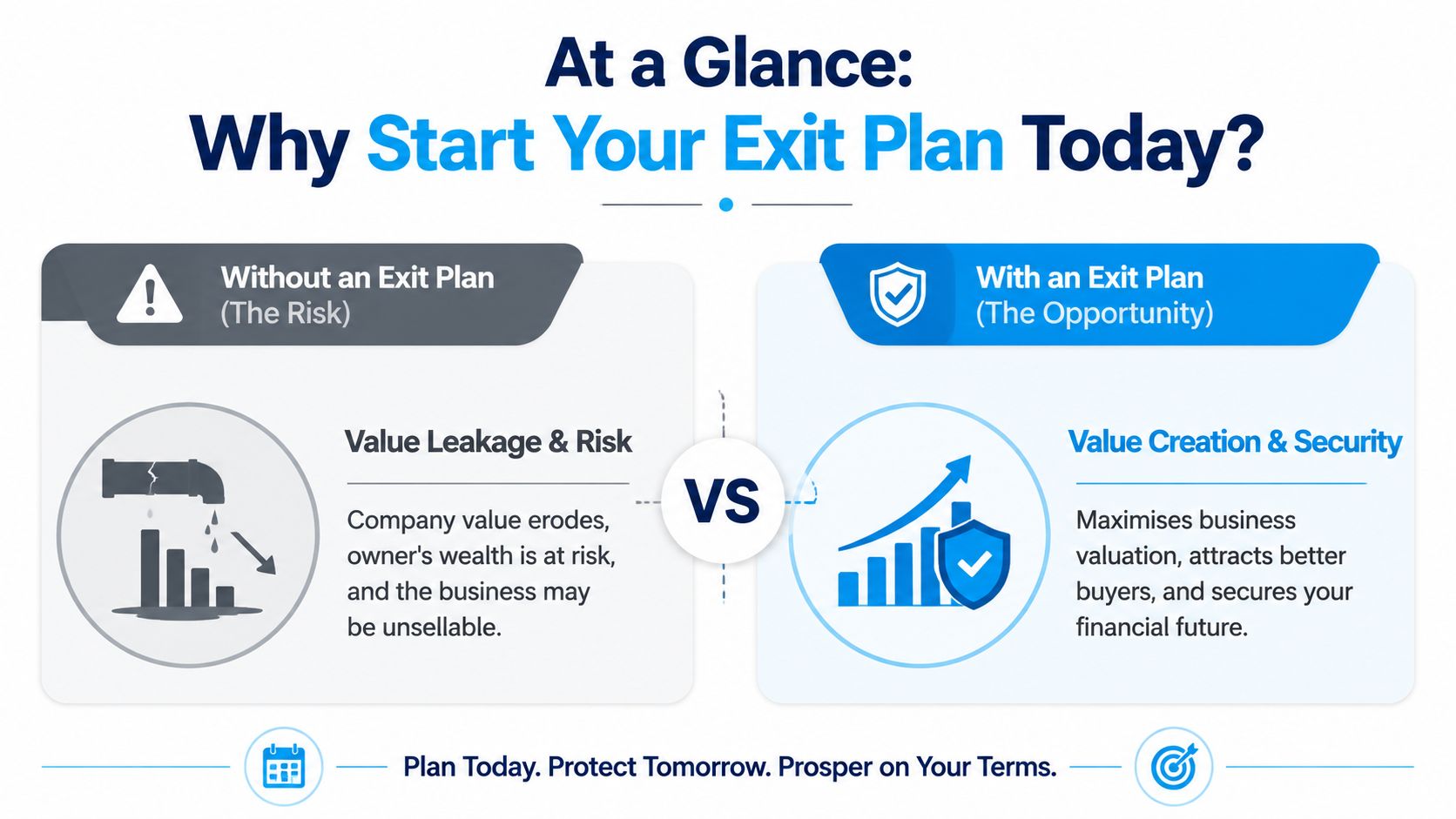
As you can see, a proper plan shifts you from a position of risk and lost value to one of control and opportunity. Each strategy also comes with its own tax bill. A smart approach could make use of reliefs like Business Asset Disposal Relief, which can slash your Capital Gains Tax down to just 10% on qualifying sales.
Figuring out which path works best for you—commercially and personally—is the first, most important step toward a successful exit.
The Reality of Owner Readiness: Are You Really Ready to Sell?
So many successful founders believe that because their business turns a healthy profit, it must be sellable. This is one of the most dangerous assumptions you can make.
The hard truth is that a huge number of UK companies are, in their current state, effectively ‘unsellable’. Why? Because without the owner, the business would grind to a halt. Its value is completely tied to your personal presence, knowledge, and relationships.
This dependency is the single biggest threat to a successful exit. If your business can’t innovate, win new work, or even function day-to-day without you, a potential buyer doesn’t see an asset. They see a job they have to buy, and that’s a terrible investment.
Acknowledging the Readiness Gap
The gap between having a successful business and a sellable one is where value evaporates. It’s a gap created by common, and entirely fixable, problems: messy financials, undocumented processes, and a management team that’s never been truly empowered to lead.
Putting off fixing these issues is the business equivalent of ignoring a slow puncture. It directly erodes your company’s final valuation, pound by pound.
This isn’t a personal failing; it’s an incredibly common challenge for driven founders. Research shows that between 57% and 67% of owners with businesses valued between £500,000 and £5 million have no formal exit strategy in place. UK advisors see this play out constantly, noting that owners often have 80% to 90% of their personal wealth tied up in their business—making poor exit planning a massive financial risk.
This is precisely where value leaks out of a business long before it ever gets to market.
Turning Unsellable into Unmissable
Acknowledging this readiness gap is the first, most important step you can take. It allows you to shift your focus from simply running the business to actively building a valuable, transferable asset.
The goal is to build a business that not only thrives under your leadership but is structured to command its maximum value when you choose to leave. This transition doesn’t happen by accident; it happens by design.
The good news? Every single one of these issues can be fixed with a methodical approach.
By tackling owner dependency and getting your operations in order, you aren’t just preparing for a future sale. You’re building a stronger, more resilient, and more profitable company for today. This is the real heart of effective exit plans for businesses; making your company unmissable to a buyer starts now.
How to Build a More Valuable and Sellable Business
Knowing the theory of a good exit is one thing. Actually putting it into practice is what separates a successful sale from a stressful, last-minute scramble. To make your business genuinely attractive to a buyer, you need to build what’s known as transferable value.
This simply means proving your business is a well-oiled machine that can run perfectly well without you. It’s about turning the business from a job you own into an asset you can sell.
This value is built on three pillars: Financial Robustness, Operational Independence, and Strong Governance. By strengthening each one, you methodically increase your company’s worth and its readiness for a sale.
Pillar One: Financial Robustness
A buyer’s first stop will always be your numbers. They aren’t just looking for profit; they’re searching for clean, reliable financial data that tells a clear story of stability and predictable growth.
- Clean Management Accounts: Your Statutory Accounts are for HMRC, but your monthly management accounts are for making decisions. If they’re messy, late, or inconsistent, it screams risk to a buyer. They want to see a history they can trust.
- Diverse Customer Base: Are you leaning too heavily on one or two major clients? Any potential buyer will see this as a huge concentration risk. A healthy spread of customers makes your turnover far more secure and, in turn, more valuable.
- Healthy Balance Sheet: Strong financial health goes beyond the profit and loss account. It’s also about how well you manage your assets and liabilities. A key part of this is showing you have a grip on your working capital. Proper working capital management proves you can fund day-to-day operations without constant stress.
Pillar Two: Operational Independence
Here’s the acid test: could your business thrive without you for a month? If the answer is no, you have an owner-dependency problem. A buyer is looking to purchase a system, not a person. Your goal is to make yourself redundant from the day-to-day running of the company.
This involves two key actions:
- Empowering Your Management Team: Give them real responsibility and the authority to make decisions. A strong second-tier leadership team is one of the most valuable assets you can have, as it proves the business has a future beyond its founder.
- Documenting Key Processes: Every critical task, from onboarding a client to fulfilling an order, should be documented. This shows a buyer they are acquiring a repeatable, scalable system, not just a collection of unwritten rules inside your head.
The statistics on this are quite stark. It’s estimated that only 30% of small businesses put up for sale actually find a buyer. When you look at why, the successful ones are almost always those that have built transferable value through clean accounts, reliable processes, and a strong management team.
Pillar Three: Strong Governance and Compliance
Good governance is the framework that holds the business together. It’s about having all your legal and commercial ducks in a row. For a buyer, this de-risks the entire transaction.
Think of governance as the business’s MOT. A buyer wants to see a clean history with a full service record, not a long list of advisories and potential failures. Tidy contracts and flawless compliance are non-negotiable.
This means ensuring all customer and supplier contracts are current, signed, and transferrable. It also means having your HR files, from employment contracts to PAYE records, in perfect order. Any hint of non-compliance is a major red flag that could derail a deal during the due diligence phase.
Maximising Your Return with Valuation and Tax Planning
Building a valuable business is one thing. Actually walking away with the maximum cash in your pocket is another entirely. This is where smart, early planning makes a monumental difference.
It all boils down to two things: understanding what makes your business valuable in a buyer’s eyes, and structuring the sale to be as tax-efficient as possible. Get these two right, and you’ll protect the reward you’ve worked so hard to build.
A buyer isn’t paying for your past sweat and tears; they’re paying for the future profits they can generate. That’s why valuations are almost always based on a multiple of your EBITDA (Earnings Before Interest, Tax, Depreciation, and Amortisation). A business might be valued at 5x its EBITDA, meaning every extra £1 of profit you add could put another £5 on your final sale price.
Driving Your Valuation Multiple Upwards
That multiple isn’t set in stone. It’s a direct reflection of risk and opportunity from a buyer’s perspective. Your job, starting today, is to de-risk the business and make that multiple as high as possible.
Here’s how you make your business a less risky, more attractive investment:
- Lock in Long-Term Contracts: Signed, multi-year contracts with your key customers are proof of predictable, stable turnover.
- Improve Your Profit Margins: Demonstrating consistent margin growth shows you have control over your pricing and operations. It’s a sign of a healthy, well-run company.
- Strengthen Your Intellectual Property: Trademarks, patents, and proprietary software are valuable assets a buyer can’t just go out and replicate. They have to buy them from you.
- Invest in Innovation: Well-documented R&D shows a commitment to future growth. You could be making your business more valuable and tax-efficient at the same time by claiming available R&D tax credits for SMEs.
Smart Tax Planning: The Key to Your Net Proceeds
Let’s be blunt. The headline sale price is vanity; the amount you actually deposit in your bank account is sanity. This is where UK-specific tax planning becomes absolutely critical.
The biggest tax wins are achieved through careful planning that starts years, not months, before a sale. Last-minute tax fixes rarely work and can even trigger HMRC’s anti-avoidance rules.
To give you a head start, we’ve put together a simplified checklist of the key areas to focus on with your accountant well in advance of any sale.
Simplified UK Exit Tax Planning Checklist
This table outlines the core tax considerations for a UK business owner planning their exit. The goal is to structure your affairs to meet the qualifying conditions for reliefs long before a buyer is even on the scene.
| Tax Planning Area | Key Objective | Typical Timeframe Before Exit |
|---|---|---|
| Business Asset Disposal Relief (BADR) | Reduce Capital Gains Tax to the 10% rate. | 2-3 years to meet ownership and trading status rules. |
| Share Structure & Ownership | Ensure shares qualify for reliefs and are held by the right individuals/trusts. | 2+ years, as holding periods are crucial. |
| Pre-Sale Dividend Strategy | Extract retained profits tax-efficiently before the capital event. | 1-2 years to plan and execute without impacting the sale. |
| Pension Contributions | Maximise tax-free value extraction into a personal pension wrapper. | 1-3 years, especially for making significant contributions. |
| Inheritance Tax (IHT) Planning | Ensure Business Relief eligibility and consider trusts for succession. | 3-5+ years, as this involves longer-term wealth planning. |
Each of these areas requires careful timing and specialist advice. For example, qualifying for Business Asset Disposal Relief (BADR) is the cornerstone of most exit plans. It can reduce your Capital Gains Tax rate to a flat 10% on gains up to £1 million, but you have to meet strict conditions for at least two years leading up to the sale.
Getting expert advice two to three years before you even think about selling is not premature; it’s essential. It gives you the runway to structure everything correctly and ensures you keep as much of your hard-earned remuneration as you legally can.
Your Next Steps to a Successful Business Exit
If there’s one thing to take away from all this, it’s that a great exit doesn’t happen by accident. It’s the final, most important chapter of a story you started writing years ago, and it deserves to be planned with care, not rushed at the last minute.
The journey from founder to free-and-clear begins now, with the small, deliberate steps you take today. By focusing on building real, transferable value and getting expert advice early, you’re not just selling a company; you’re securing your future and cementing your legacy.
Here are the first three things you should do:
- Look in the Mirror: Take an honest look at your business through the eyes of a buyer. How does it stack up against the three pillars we’ve discussed: Financial Robustness, Operational Independence, and Strong Governance? Be ruthless. Where are the cracks?
- Decide What ‘Done’ Looks Like for You: What do you really want from an exit? Is it purely about the number, preserving the company’s culture, or just a clean break to do something new? Your answer here will shape every single decision that follows.
- Start the Conversation: You can’t value your own business objectively. Getting a professional, outside view is non-negotiable. An initial chat about business valuation support provides a crucial reality check, giving you a benchmark and a clear list of what needs work.
As you move forward, remember that the legal side of transferring ownership can be a minefield. For some extra reading on that front, the team at Kons Law’s business ownership guide offers a solid overview.
FAQs on Exit Plans for Businesses
When should I start my exit plan?
The ideal time to start formally planning your exit is three to five years before you intend to sell. This timeframe allows you to strategically enhance business value, strengthen your management team, and implement tax-efficient structures. Starting earlier ensures you have maximum leverage and options when the time comes to sell.
What is the biggest mistake owners make with exit plans?
The biggest mistake is leaving it too late. Many owners only think about an exit when they are burnt out or receive an unsolicited offer. This reactive approach almost always leads to a lower valuation and a more stressful process. Proactive planning puts you in control of the timing, terms, and ultimate outcome.
How much does it cost to sell a business in the UK?
You should budget for professional fees, including those for brokers, solicitors, and accountants, which typically range from 1% to 5% of the final sale price. While this seems significant, expert advice is an investment. A good advisory team helps maximise the final valuation, often covering their own fees and more.
Do I need a formal exit plan if I plan to pass the business to my family?
Yes, absolutely. A family succession requires just as much, if not more, planning than a trade sale. It involves navigating complex issues of fairness between siblings, assessing capabilities, and structuring the transfer to be tax-efficient, particularly concerning Inheritance Tax. A formal plan prevents family disputes and ensures the business continues to thrive.
This article is for informational purposes only and does not constitute professional advice. Tax rules apply as of April 2026. Consult a qualified accountant for your specific circumstances.
Ready to build a more valuable, sellable business?
At striveX, we help founders of UK companies secure their financial future by building robust exit plans. Our team works with businesses turning over £1m–£15m to maximise their value and ensure a smooth, profitable exit.
Book a no-obligation consultation to discuss your exit plan. We’ll respond within 24 hours to schedule a call.
