

Has academic research ever made a UK founder more money?
Most leaders of businesses turning over £1 million to £15 million would probably say no. They'd be forgiven for thinking management accounting research belongs in universities, not in board packs, pricing reviews, or monthly cash meetings.
That view costs money.
The useful part of management accounting research isn't theory for theory's sake. It's tested thinking about how businesses measure performance, control costs, improve decisions, and organise finance information so management acts sooner and with fewer blind spots. For companies in the messy middle of growth, that's exactly where margin gets protected and cash stops leaking.
Beyond the Bookshelf Why Research Matters to You
The biggest commercial problem in this turnover band is rarely a lack of effort. It's that finance often stays reactive for too long. Teams produce historical reports, explain what went wrong after month end, and call that control. It isn't control. It's commentary.
That matters because the evidence base aimed specifically at scaling UK businesses is still thin. Research highlights a significant gap in management accounting research regarding the specific application of modern practices for UK SMEs scaling between £1m–£15m turnover, as existing studies predominantly focus on large corporations. That leaves founders without clear benchmarks for how their finance function should evolve at the exact point complexity starts rising fastest, as noted in this UK SME research summary.
Why that gap creates an opening
When the market lacks clear benchmarks, most firms default to habit:
- Reporting by tradition: Management accounts get built around what the bookkeeper can produce quickly, not what directors need to decide.
- Forecasting by instinct: Sales, hiring, stock, and working capital assumptions sit in separate spreadsheets with no common logic.
- Cost control by headline number: Teams watch total spend, but miss where delivery effort, customer mix, and process friction are eating gross profit.
Commercial reality: The firm that turns finance into a decision tool usually outmanoeuvres the firm that treats finance as a compliance process.
For directors, that means research matters because it shortens trial and error. It helps answer practical questions that hit the P&L and cash flow directly:
| Business problem | Weak response | Better response informed by research |
|---|---|---|
| Gross profit looks fine but cash is tight | Blame timing | Analyse cost drivers, reporting cadence, and operational signals |
| Forecasts keep missing | Update the spreadsheet more often | Improve information flow and decision speed |
| Managers don't own numbers | Circulate more reports | Use measures that connect activity to results |
A smart starting point is building a stronger base of internal finance knowledge before changing process. The striveX knowledge centre is useful for that because it translates technical finance topics into operational decisions a leadership team can use.
Decoding Management Accounting Research
Management accounting research is best understood as R&D for the finance function. It studies what information helps managers make better decisions inside a business. Not Statutory Accounts. Not year-end compliance. Internal decision-making.
In practical terms, it asks questions such as:
- Which measures improve performance?
- How should leaders track costs when operations are getting more complex?
- What reporting format makes managers act sooner?
- Which finance systems improve planning rather than just recording history?
Research in the UK has widened well beyond narrow control systems. The field now covers trust, information sharing, and knowledge management alongside traditional topics like control systems, showing a move towards more diverse approaches that deal with modern business problems, according to this overview of UK management accounting research.
The four commercial pillars
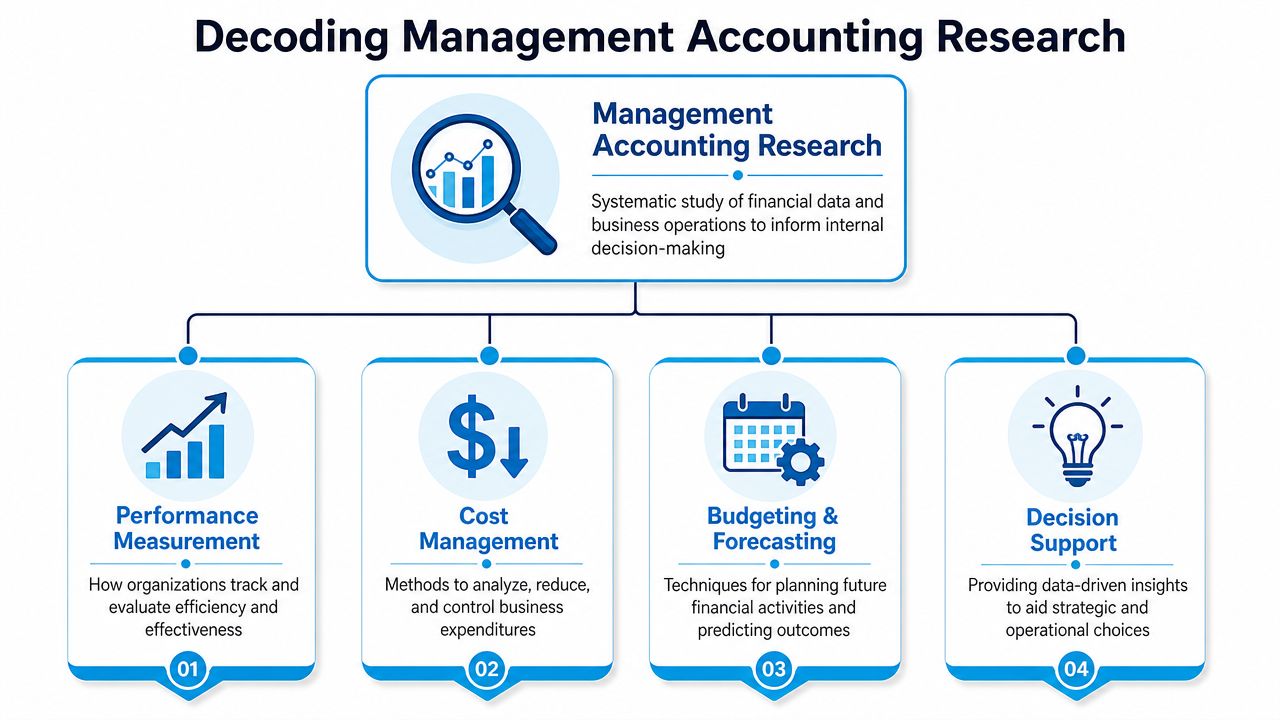
That broad research base is easier to use when broken into four pillars.
Performance measurement
This is about deciding what management should track every month. Not every number deserves airtime. Good performance measurement connects operational activity to financial outcome. For a manufacturer, that might be yield, rework, lead times, and margin by line. For a service business, it may be utilisation, delivery quality, and client profitability.
Cost management
Most firms know their overhead total. Fewer know which activities create avoidable cost. Cost management in this context isn't blunt cost cutting. It's understanding where effort, complexity, and delay inflate delivery cost and reduce contribution.
Strong cost management doesn't ask, "What did we spend?" It asks, "What behaviour caused the spend, and was it worth it?"
Budgeting and forecasting
This pillar deals with planning under uncertainty. A budget is fixed at a point in time. A forecast should move as conditions change. Businesses that confuse the two often protect an outdated plan instead of protecting cash.
Decision support
This is the least talked about and often the most valuable. Decision support means finance produces analysis that helps managers choose between options. Pricing changes. Hiring timing. Stock decisions. Customer terms. Capex priorities. That's where finance becomes commercial, not clerical.
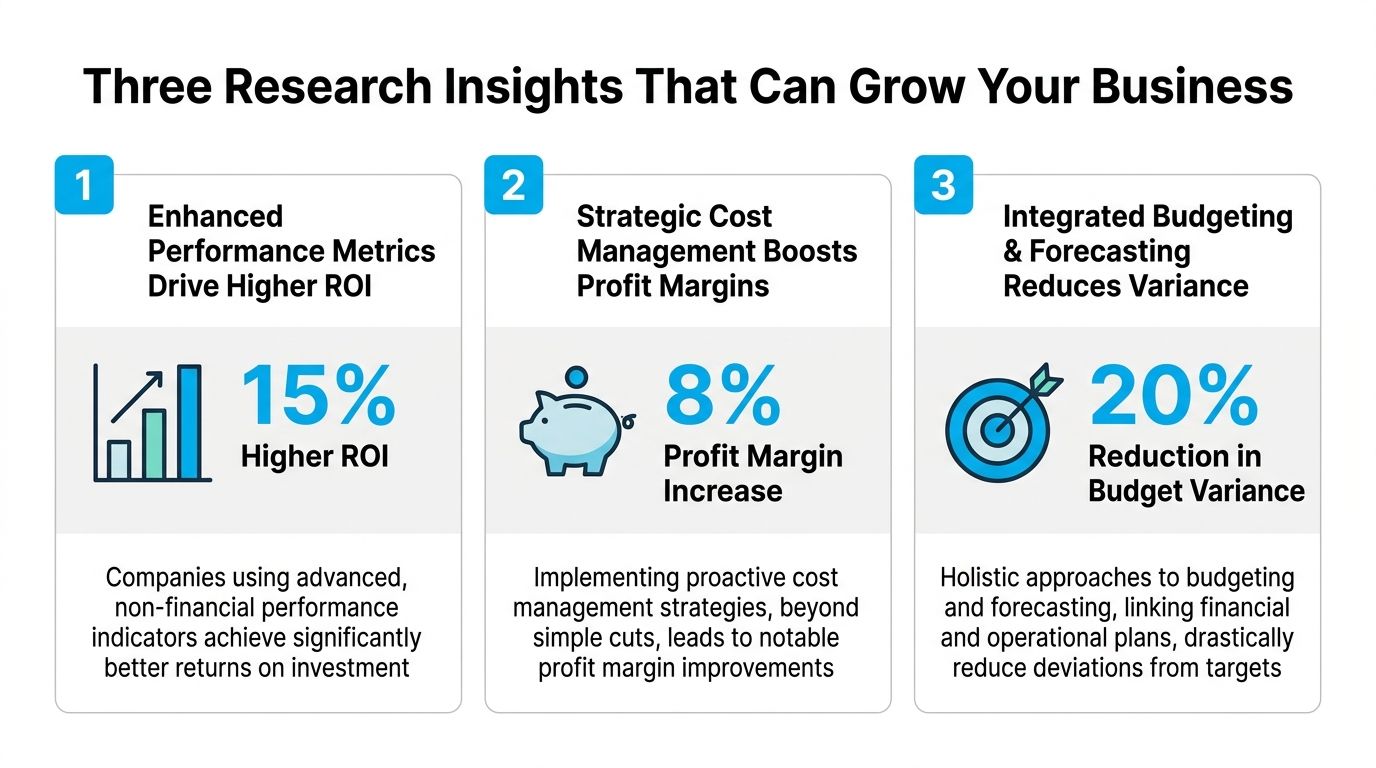
Three Research Insights That Can Grow Your Business
Some findings in management accounting research are immediately usable in a growth business. The strongest ones tend to improve one of three things: forecast accuracy, speed of decision-making, or management attention.
Digital dashboards improve decisions
For UK SMEs, this is the clearest evidence with a direct commercial implication. Research on firms in manufacturing and logistics found that integrating real-time data dashboards and cloud-based accounting systems led to a 23% reduction in forecast error variance and a 15% increase in operational agility, showing a direct link between digital analytics and stronger strategic decision quality in that sample of UK SMEs, as reported in this study on digital analytics and management accounting.
The finance takeaway is simple. Businesses make worse decisions when reporting arrives too late and in too many formats. Real-time or near real-time reporting lets directors spot changes in sales mix, stock pressure, margin drift, and cash conversion before those issues harden into a poor quarter.
If a leadership team is trying to sharpen commercial decision-making, it also helps to understand how return should be evaluated across longer-term investments. This guide to ROI for B2B and SaaS businesses is a useful companion when management wants a clearer investment lens rather than a crude short-term payback mindset.
Not all costs are equal
Many mid-sized businesses still review profitability at too high a level. They know gross margin overall, but not margin by customer type, delivery model, product family, or service complexity. That creates false confidence.
A practical fix is to separate:
- Volume-driven cost: Costs that rise because output rises
- Complexity-driven cost: Costs caused by exceptions, custom work, small runs, poor handovers, or urgent changes
- Delay-driven cost: Costs created by rework, approvals, and bottlenecks
This doesn't require a textbook system. It requires finance to map where work happens and where margin gets diluted. Once directors see which activities consume disproportionate effort, pricing and process decisions get sharper.
Practical rule: If two customers generate similar turnover but one creates twice the internal touchpoints, they aren't equally profitable.
Better scorecards create better behaviour
Traditional reports overweight what happened last month and underweight what drives next month. A more useful scorecard mixes financial and operational measures. The exact metrics vary, but the logic is consistent. Management should monitor the small set of indicators that predict profit conversion and cash performance.
A workable scorecard often includes:
| Area | Example management question |
|---|---|
| Margin quality | Are sales growth and gross profit moving together? |
| Cash discipline | Are debtors, stock, or work in progress rising faster than turnover? |
| Delivery efficiency | Is output getting harder to produce? |
| Commercial traction | Is new business translating into profitable repeat work? |
For teams that want to improve the mechanics of planning as well as the quality of input assumptions, this guide on how to build a great financial forecast is a strong practical next step.
Practical Applications for Your Finance Function
Research only matters if it changes how the finance function operates. In a scaling business, the best improvements usually come from redesigning reporting, tightening the evidence behind claims, and improving how quickly management can model decisions.

Turning reporting into a management tool
A common failure point is the monthly pack that says plenty but changes nothing. It contains a P&L, balance sheet, a few variance comments, and maybe debtor days. What it doesn't contain is a management response.
A better model changes both content and cadence:
- Lead with decisions: Start with the three or four issues that require action now.
- Track drivers, not just outcomes: Add operational indicators that explain margin and cash movement.
- Use trend lines: One month on its own often misleads. Patterns matter more than isolated variances.
That shift is the difference between reporting on the business and helping run it. Firms wanting a more decision-focused setup can discover how management accounting support works.
Building stronger evidence for innovation and claims
Another practical use is improving how a company records technical effort, uncertainty, and project costs. Many businesses carry out qualifying innovation work but capture the evidence poorly. Finance then struggles to support claims or explain investment choices properly.
The strongest businesses build routines around:
- project-level time and cost visibility
- clear records of technical uncertainty
- links between staff effort, subcontracted work, and commercial objective
That discipline supports better management accounting even before any tax benefit is considered. Leaders can see which innovation work is consuming cash, what commercial return is plausible, and where a project should be pushed, paused, or stopped.
Sharpening forecasting with integrated data
Forecasting often breaks because sales, operations, and finance are using different versions of reality. The sales team has one view of pipeline. Operations has another view of capacity. Finance has a third view based on month-end cut-off.
When those signals are integrated, the forecast becomes a live management tool rather than a quarterly exercise. That's particularly relevant as finance teams explore automation and analysis workflows. For leaders considering what that next layer of capability looks like, this piece on implementing finance AI agents is a sensible read because it focuses on process design, not hype.
Good forecasting isn't about being perfectly right. It's about being wrong early enough to respond.
Future Trends and Staying Ahead of the Curve
The next phase of management accounting research matters because finance expectations are changing. Directors don't just need cleaner reports. They need finance functions that can identify emerging commercial pressure before it shows up in year-end pain.
Risk intelligence is replacing passive compliance
In 2026, UK regulators are shifting expectations from basic Anti-Money Laundering compliance to demonstrating "risk intelligence", requiring finance teams to analyse patterns across multiple data points and identify specific risk areas for client profiles, according to this 2026 regulatory update.
That phrase matters beyond regulated compliance work. It reflects a broader direction of travel. Finance teams are increasingly expected to interpret information, not just process it.
For a business in the £1 million to £15 million turnover range, that has real operational consequences:
- Customer risk: Which accounts are becoming slower to pay or less predictable?
- Margin risk: Which contracts or jobs are drifting outside expected delivery cost?
- Cash risk: Which working capital movements are structural rather than temporary?
- People risk: Which parts of the operation depend too heavily on a single individual?
Sustainability is moving into mainstream finance decisions
Management accounting research is also paying more attention to sustainability and non-financial measures. For smaller businesses, this can sound remote. It isn't. Lenders, investors, customers, and supply chains increasingly want better evidence of resilience, energy exposure, and governance quality.
That doesn't mean every business needs a full ESG framework tomorrow. It does mean finance should start tracking the non-financial factors that can affect margin, supplier stability, tender success, or access to funding.
The businesses that stay ahead won't be the ones with the longest reports. They'll be the ones that spot commercial risk sooner and act faster.
Your Next Steps and Key Questions Answered
A sensible first move isn't a finance transformation project. It's a short review of which management information currently drives decisions and which reports fill inboxes.
FAQs
What is management accounting research in simple terms?
It studies which internal finance practices help managers run a business better. In practice, that means reporting, forecasting, cost analysis, and decision support that improve profit, cash flow, and commercial judgement.
How is management accounting different from financial accounting?
Financial accounting is mainly for external reporting, compliance, and year-end requirements. Management accounting is for internal decisions. It helps directors price work, manage costs, forecast cash, and monitor the drivers behind performance.
Does a £1 million to £15 million turnover business need expensive software?
Not necessarily. Better management accounting starts with clearer questions, stronger reporting design, and more disciplined data flow. Software can help, but poor measures in a new system still produce poor decisions.
What should a finance team improve first?
Start with monthly management reporting and forecasting. If leadership can't see margin movement, cash pressure, and operational trends quickly, the business is managing from the rear-view mirror.
Is management accounting research relevant outside large corporates?
Yes, but scaling firms need translation. Much published research focuses on larger organisations, so the commercial value comes from applying the logic in a way that matches the realities of owner-managed growth businesses.
Management accounting research isn't academic decoration. Used properly, it's a practical advantage. It shows how better information, better measurement, and better decision routines can protect margin and strengthen cash at the point a business is becoming more complex.
If a business turning over £1 million to £15 million wants sharper reporting, stronger forecasting, and a finance function that supports commercial decisions rather than just recording them, book a consultation with striveX Ltd. The conversation focuses on where management information is falling short, what to fix first, and how to build a finance setup that supports growth without unnecessary complexity.
This article is for informational purposes only and does not constitute professional advice. Tax rules apply as of April 2026. Consult a qualified accountant for your specific circumstances.