

The monthly pack for striveX's own SaaS product, Strively, has to answer two questions at once. Are the statutory numbers correct, and does the business have enough cash and customer momentum to keep investing?
Why We Track SaaS Metrics Ourselves
striveX runs its own SaaS product, so its finance team sees the practical gap between tidy bookkeeping and useful commercial reporting. A statutory profit and loss account can be accurate while still failing to explain whether recurring income is strengthening, customers are leaving, or acquisition spending is taking too long to recover.
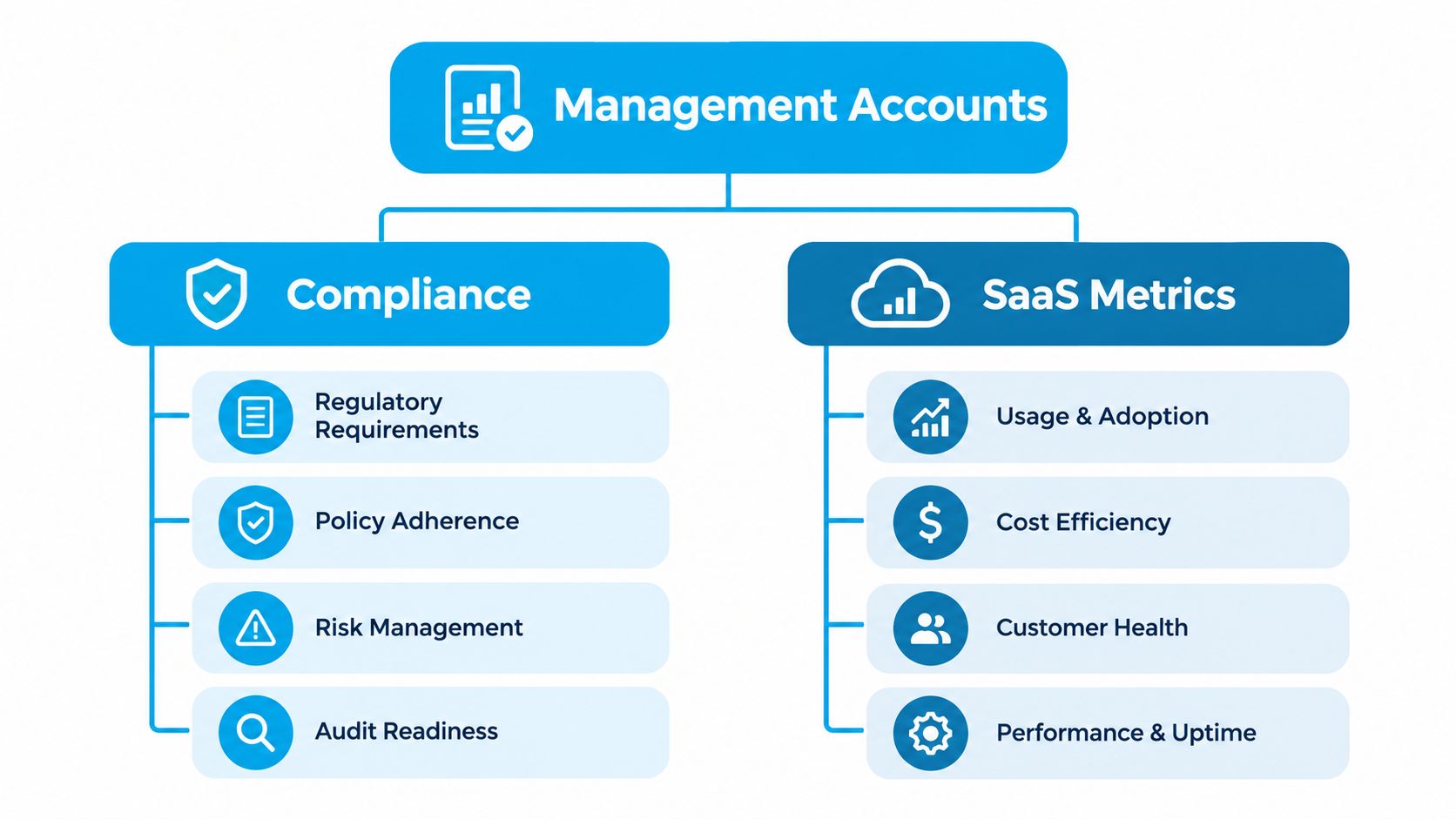
That's why the pack sits on two connected layers. Corporation Tax, VAT, PAYE and Statutory Accounts protect compliance, while MRR, ARR, churn, CAC payback, burn and runway support decisions about pricing, hiring and investment. Neither layer works properly in isolation.
A founder may see cash arriving from annual subscriptions and assume trading performance has improved. The accounts may need to spread that income across the service period instead. The practical consequence is clear: cash collection, recognised income and recurring-revenue metrics must be reconciled rather than presented as competing versions of the truth.
The numbers behind a commercial decision
A useful management pack should show:
- MRR and ARR: recurring subscription value, with movements explained by new sales, upgrades, downgrades and cancellations.
- Churn: customer and income losses, separated where possible so a small number of larger cancellations aren't hidden by customer volume.
- CAC payback: the time required for gross contribution from new customers to recover acquisition cost.
- Burn and runway: monthly cash consumption linked to available cash and the assumptions behind the forecast.
- Statutory profit: the accounting result, reconciled to operational performance and cash movement.
guide to dashboard metrics by role
A dashboard should also give each reader the right level of detail. A founder needs decisions and exceptions, a CFO needs reconciliations and forecast logic, and an investor needs consistent definitions.
Why 2026 changes the conversation
From 1 January 2026, UK companies reporting under FRS 102 face changes affecting subscription revenue recognition, lease accounting and disclosures, including expanded disclosures for small-company Section 1A accounts. The shift makes it more important to distinguish invoice timing from performance-obligation-based revenue recognition, as outlined in this UK SaaS revenue recognition analysis.
Management accounts that show only statutory totals leave operators flying blind. Management accounts that show only SaaS metrics can leave the business exposed to weak controls and unreliable filings. The useful pack makes both tell the same commercial story.
How to Choose SaaS-Specialist Accountants
Not every accountant who works with technology businesses understands subscription economics. The right appointment depends less on a polished software list and more on whether the firm can connect customer data, accounting treatment, tax obligations and board reporting.
Start with the accounting model. Ask how the firm handles annual subscriptions, upgrades, cancellations, refunds, credits and implementation services under UK GAAP. A credible answer should distinguish cash received, invoices raised, deferred income and recognised income. It should also explain how the treatment will be documented for year-end review.

A practical assessment framework
Use these checks before signing an engagement:
- Subscription knowledge: Ask for an anonymised example of a recurring-income reconciliation. The firm should discuss contract terms and delivery, not just invoice dates.
- Management reporting: Request a sample monthly pack. It should connect MRR, ARR, churn and cash to the profit and loss account, balance sheet and cash flow.
- MTD competence: For VAT, the workflow must keep digital records in compatible software and submit VAT Returns through compatible systems. HMRC's Making Tax Digital software guidance sets out that technical requirement.
- R&D Tax Credits: Ask how the firm identifies qualifying work, preserves technical evidence and separates eligible expenditure from ordinary product development.
- Cloud workflow: The firm should be comfortable with bank feeds, approval controls, automated reconciliations and an audit trail.
Cloud adoption is no longer an experimental issue for UK accountants. A UK survey found that 47% were using cloud-based software and a further 34% used a mixture of cloud and on-premises systems, while 56% expected cloud accounting to become the standard for all businesses. Those figures are reported in the UK cloud accounting trends analysis.
Red flags worth taking seriously
A firm that treats a SaaS company like a standard consultancy may produce compliant records but miss the commercial risks. Warning signs include a reluctance to define recurring metrics, no clear process for deferred income, spreadsheet-only revenue schedules, and management accounts delivered after decisions have already been made.
The firm doesn't need to prescribe one technology stack. It does need to explain how the chosen systems will exchange reliable data and who owns each control. The strongest relationship is one where the accountant challenges definitions, documents assumptions and translates the numbers for non-accountants.
Management Accounts Must Cover Compliance and SaaS Metrics
A management pack should be built around decisions, not around whatever reports the accounting system happens to produce. For a UK SaaS company, that means compliance information and operating indicators need to appear in a single controlled reporting cycle.
The compliance layer
Corporation Tax planning starts with taxable profits, associated companies and the accounting period. The main Corporation Tax rate is 19% on taxable profits of £50,000 or less and 25% above £250,000, with Marginal Relief between those limits, according to HMRC's Corporation Tax Marginal Relief guidance. The thresholds reduce for short accounting periods and associated companies. A company with three other associated companies has limits of £12,500 and £62,500.
Marginal Relief isn't a flat discount. HMRC applies a formula based on augmented profits, taxable profits and the standard fraction for the relevant financial year, as explained in HMRC's technical calculation manual. A good pack should therefore show the forecast position, assumptions and likely tax cash requirement.
VAT data should feed cash forecasting. The pack should reconcile VAT owed or recoverable, filing dates, unusual transactions and the effect of payment timing. MTD requires digital records and compatible submission software, so a cloud ledger alone isn't enough if the filing path hasn't been tested.
R&D Tax Credits need the same discipline. The merged regime introduced from 1 April 2024 provides a 20% expenditure credit, subject to the rules, and HMRC explains that qualifying expenditure is multiplied by 20% to calculate the credit. For example, £100,000 of qualifying expenditure produces a £20,000 credit before Corporation Tax treatment, as shown in HMRC's R&D calculation guidance. The claim file should connect technical projects, staff time, costs and supporting evidence.
The SaaS layer
The operational page should explain why the accounting result changed:
- Recurring income bridge: opening ARR, new business, expansion, contraction and lost business.
- Churn analysis: customer churn and income churn, with the affected contracts identified.
- CAC payback: acquisition cost compared with contribution from newly acquired customers.
- Lifetime value: a scenario-based estimate, with assumptions clearly separated from reported facts.
- Burn and runway: cash consumption linked to the forecast, hiring plans and funding assumptions.
- Gross margin: delivery and hosting costs separated from sales, marketing and overheads.
The definitions must remain stable. If the sales team calculates ARR from signed contracts while finance calculates it from active billing, the board receives two numbers with the same label. The pack should state the source, period, exclusions and reconciliation for each key measure.
For a practical explanation of how the reporting cycle fits together, see management accounts explained. The commercial benefit is control. Leaders can see whether a weak month reflects churn, delayed billing, poor collection, rising delivery cost or a genuine change in demand.
Practical rule: Every SaaS metric in the board pack should have an owner, a definition and a reconciliation to an underlying system.
Pricing Models and Onboarding Timelines Explained
Accounting fees should reflect the work required, not just the number of bank transactions. SaaS businesses often need recurring-income reconciliations, reporting design, tax planning, cash forecasting and software controls alongside routine bookkeeping.
A fixed monthly fee offers predictable budgeting and works well when the scope is clear. The engagement should specify the frequency of management accounts, VAT support, payroll, year-end work, tax planning and advisory access. A low fixed fee can become expensive if every useful question is treated as an extra.
A percentage-of-turnover model may appear aligned with growth, but it can penalise a business with high billings and modest margins. It also doesn't necessarily reflect transaction complexity, international activity or the quality of the reporting required.
A project-based onboarding fee is often the cleanest way to pay for a defined setup. It can cover chart-of-accounts design, opening balances, subscription schedules, data migration, integration testing and reporting templates. Ongoing work then starts from a known baseline.
What onboarding should include
The initial process should normally cover:
- Discovery: map billing, collections, expenses, payroll, tax registrations and reporting needs.
- Data review: test opening balances, customer records, bank feeds and historic adjustments.
- Workflow design: define who approves invoices, reconciles accounts, reviews exceptions and signs off filings.
- Compatibility testing: confirm that the chosen software supports the relevant MTD workflow.
- First reporting cycle: produce a management pack, review variances and refine metric definitions.
The timetable depends on data quality, system complexity and how quickly the client can answer queries. A clean migration with clear ownership moves faster than a rushed handover built around incomplete spreadsheets.
Automation should remove repetitive administration, not remove judgement. Teams evaluating workflow design can use these onboarding automation patterns as a prompt for documenting hand-offs, approvals and exception handling.
The Right Tech Stack and Integration Tips
A scalable SaaS finance function doesn't require the most elaborate stack. It requires a reliable flow from the commercial event to the ledger, with controls at every hand-off.
The core architecture normally contains:
- Cloud accounting: the controlled ledger for journals, VAT, supplier payments and statutory reporting.
- Billing and subscription records: the source for plans, contract dates, renewals, credits and cancellations.
- Payment collection: the record of settlements, fees, refunds and failed payments.
- CRM data: the context for new business, expansions and customer ownership.
- Reporting layer: the place where SaaS metrics are defined, reconciled and presented.

Design the connections before choosing software
The most important question isn't whether two systems integrate. It's what each system is allowed to own. Customer status should have one source, billing events another, and the general ledger should receive controlled entries rather than an uncontrolled stream of duplicates.
Payment gateways need reconciliation rules for fees, refunds, chargebacks and settlement timing. Subscription systems need clear treatment for upgrades, downgrades and cancellations. CRM records need a defined hand-off into billing so that sales activity doesn't become accounting data until a contract is approved.
A well-structured workflow also includes:
- Exception queues: failed imports and unusual transactions go to a named reviewer.
- Period controls: closed months cannot be revised by late adjustments.
- Access controls: staff receive only the permissions needed for their role.
- Audit evidence: mappings, approvals and reconciliations remain available for review.
- Metric checks: ARR and MRR movements reconcile to customer-level changes.
HMRC's compatible-software requirement means the filing path deserves a specific test, rather than an assumption based on cloud hosting. The automated bookkeeping and reporting guide provides further context on reducing manual work while preserving review points.
The best stack is the one the finance team can operate consistently. Automation that nobody monitors creates hidden errors. A simpler workflow with clear ownership usually produces more dependable management accounts.
Hiring Checklist and Interview Questions
A shortlist of SaaS accountants should be tested with practical questions, not broad promises. The answers should reveal how the firm thinks about evidence, ownership and commercial decisions.
Questions that expose capability
“How would you account for an annual subscription paid upfront?”
Look for a discussion of deferred income, service delivery, contract terms and the reconciliation between billing and recognised income.
“How would you define ARR for this business?”
The answer should identify included and excluded income, treatment of discounts and the source system. It should also explain how the metric ties to active contracts.
“What would the monthly management pack contain?”
A useful answer includes statutory results, cash, forecast variance, recurring-income movements, churn, acquisition economics and commentary on decisions.
“How would you prepare an R&D Tax Credits claim?”
The firm should describe technical narratives, qualifying activities, staff and subcontractor costs, evidence retention and review controls. It shouldn't present the claim as a simple percentage applied to the development budget.
“How would you prepare for MTD?”
The response should cover compatible software, digital records, connected feeds, submission testing and responsibility for reviewing the return.
Evidence to request
Ask for a redacted sample pack, an onboarding plan and a description of the month-end timetable. Check whether the firm can explain a variance in plain English and whether the report distinguishes actuals, forecast and management assumptions.
Also ask who will do the work. A senior adviser may lead the sale while a different team delivers the reporting. That arrangement can work, but the hand-off, review responsibility and escalation route should be explicit.
The right accountant doesn't just close the books. The right accountant makes it easier for management to decide what happens next.
Next Steps for Scaling Your Finance Function
A finance function becomes more valuable when it connects three disciplines. Compliance keeps filings defensible, management reporting makes performance visible, and commercial analysis helps leaders allocate cash and capacity.
For a company turning over £1 million to £15 million, the transition often starts with better monthly discipline rather than a wholesale system replacement. Define the metrics, document the accounting treatment, reconcile billing to the ledger, and build a pack that explains movement instead of merely displaying totals.
MTD expansion also requires forward planning. MTD for VAT applies to VAT-registered businesses regardless of turnover, and current guidance states that MTD for Income Tax will extend from 2026 to businesses and landlords with income over £50,000, as described in UK MTD guidance for businesses. Client onboarding should therefore include an income or turnover threshold review, compatibility check and test of the digital submission workflow.
The effect of FRS 102 changes from 1 January 2026 should be considered alongside subscription contracts, leases and disclosures. A finance leader who waits until year-end may discover that the accounting treatment, reporting definitions and supporting evidence all need rebuilding at once.
striveX Ltd provides accounting and outsourcing support covering bookkeeping, management reporting, tax, payroll and finance-function support for growing businesses. The practical starting point is a review of the current pack, the systems feeding it and the decisions it needs to support.
This article is for informational purposes only and does not constitute professional advice. Tax rules apply as of April 2026. Consult a qualified accountant for your specific circumstances.
striveX Ltd helps growing UK businesses combine compliant accounting with SaaS metrics, cash visibility and commercially useful management reporting. Become a client to arrange a conversation about building a finance function that supports confident scaling.