

Your engineering team has spent months resolving difficult technical problems, testing prototypes and refining production methods. The finance team has the invoices and payroll data, but the claim discussion still starts with the same question: which projects qualify under the post-2024 rules, and what cash value can the company realistically expect?
That question matters more now. The UK replaced the old SME and RDEC regimes with a single merged scheme for accounting periods beginning on or after 1 April 2024, while loss-making, R&D-intensive SMEs can use a separate enhanced route. HMRC's current approach also puts greater weight on project evidence, expenditure location, subcontracting and the accuracy of the company's submission.
For an engineering or industrial business, R&D tax relief is no longer a generic year-end adjustment. It's an operational decision involving project selection, payroll reconciliation, supplier contracts, technical records and cash-flow planning.
Where R&D Tax Relief Stands After the 2024 Reform
For accounting periods beginning on or after 1 April 2024, most UK companies claim under the merged R&D scheme. The merged R&D expenditure credit rate is 20% of qualifying expenditure, subject to the detailed rules on eligible costs, losses, PAYE and National Insurance liabilities. HMRC sets out the current claim mechanics in its guidance on making an R&D tax relief claim.
A second lane exists for loss-making SMEs that meet the R&D-intensity condition. The Enhanced R&D Intensive Support route, or ERIS, gives an extra 86% deduction and a payable tax credit worth up to 14.5% of surrenderable losses. It isn't a general alternative that every SME can select. The company must be loss-making and meet the relevant intensity test for the accounting period.
The third issue is geography. The reformed rules restrict relief for certain overseas subcontracted work and externally provided workers, with exceptions that need to be tested against the facts. A business with UK design work, overseas testing and international contractors should map the work by location before calculating the claim.
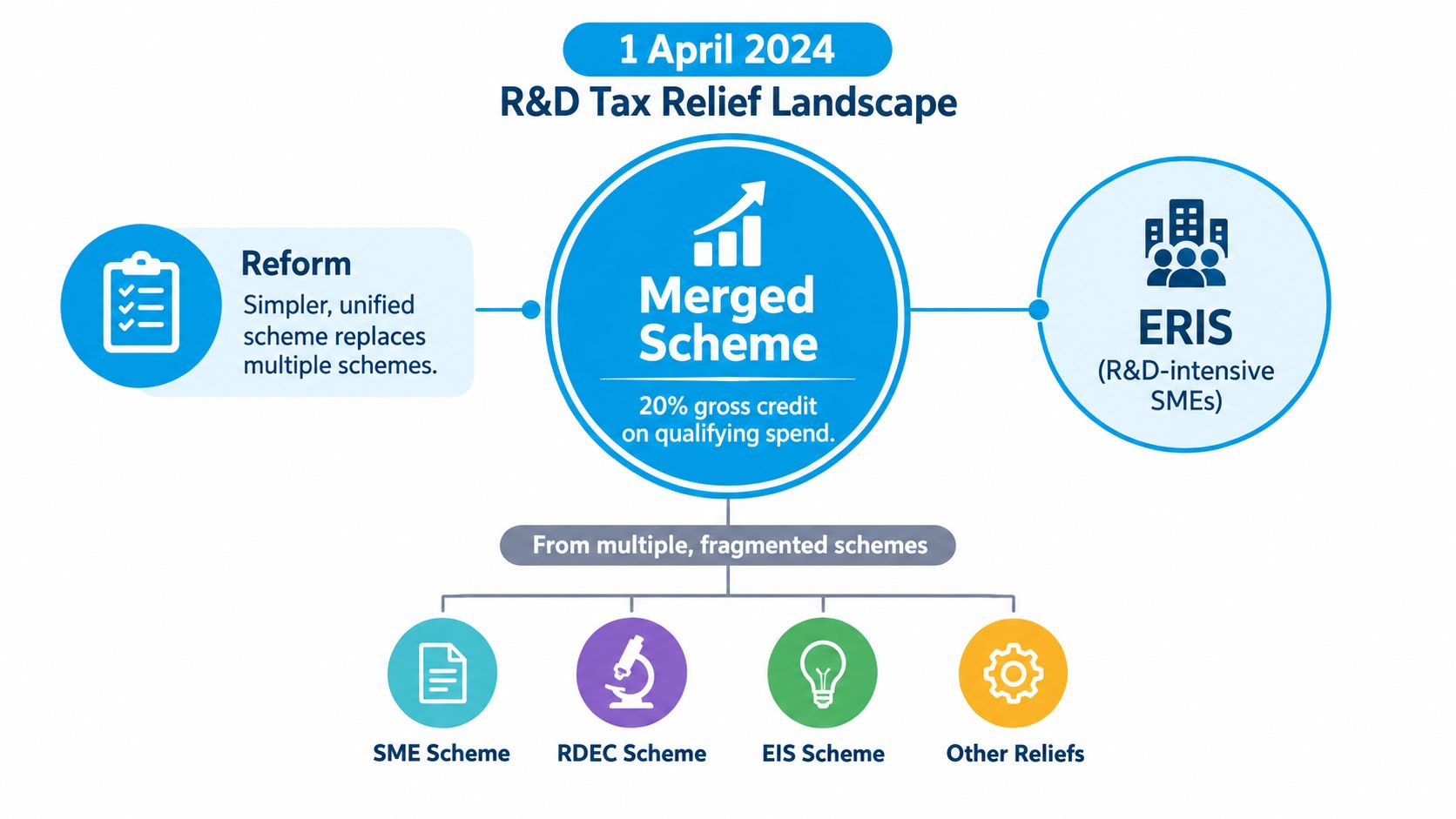
The finance director's decision tree
The correct order of analysis is straightforward:
Accounting period: Identify whether the period begins before or after 1 April 2024.
Profit position: Establish whether the company is profitable or loss-making for the relevant period.
R&D intensity: Test whether a loss-making SME meets the ERIS condition.
Work location: Separate UK activity from overseas activity.
Cost ownership: Check whether the company performed the R&D or was carrying out work contracted by another party.
The regime has attracted continuing political and compliance pressure, so businesses shouldn't assume that today's claim method will remain unchanged. HMRC's statistics show that the cost and usage of the relief have become more volatile. By the 2023 to 2024 tax year, businesses claimed estimated support of £7.6 billion linked to £46.1 billion of qualifying R&D expenditure, with support value down 2% and qualifying expenditure down 1% from the prior year. HMRC's September 2025 statistics also record a fall in claims from 63,780 in 2022 to 2023 to 46,950 in 2023 to 2024.
Commercial rule: Select the correct scheme before estimating the benefit. A polished claim under the wrong route is still a weak claim.
How the Merged Scheme Compares with the Old Rules
The old SME and RDEC schemes ended for most periods covered by the reform. Their rates and mechanics shouldn't be used as a shortcut for a current claim.
| Feature | Merged scheme post-April 2024 | Legacy SME scheme pre-April 2024 | Legacy RDEC pre-April 2024 |
|---|---|---|---|
| Main rate or treatment | 20% merged R&D expenditure credit | Enhanced deduction of 86% | RDEC credit of 13% |
| Typical claimant | Most companies with qualifying R&D | SMEs under the former rules | Larger companies and companies within the former RDEC route |
| Loss-making treatment | Credit treatment follows the merged regime, subject to the rules | Payable credit route under the former SME rules | Credit route under the former RDEC rules |
| ERIS equivalent | Separate enhanced support for qualifying loss-making R&D-intensive SMEs | No direct equivalent in the old structure | No direct equivalent in the old structure |
| PAYE and NIC limits | Relevant cap rules can restrict payable credit claims | Former SME cap rules applied | Former RDEC mechanics applied |
| Accounting-period trigger | Periods beginning on or after 1 April 2024 | Periods beginning before the reform | Periods beginning before the reform |
The commercial change is more than a new percentage. Under the merged regime, a profitable engineering company generally considers a credit against its Corporation Tax position, rather than relying on the old distinction between SME enhancement and RDEC. A loss-making subsidiary may still obtain a payable credit, but the calculation depends on the merged rules, surrenderable losses and the applicable PAYE/NIC cap.
The old SME rate structure is particularly dangerous as a comparison point. A company might remember the former enhanced deduction and assume that a current claim should produce the same result. That can lead to overstated forecasts, poor board reporting and an unexplained difference between the tax computation and the cash expectation.
What the change means for group planning
A group should assess each company separately before considering any wider tax strategy. A profitable manufacturing company, a loss-making software subsidiary and a company performing contracted development may sit in different practical positions even when they share staff, systems or customers.
Companies should also distinguish between a tax reduction and a payable credit. The first reduces Corporation Tax that would otherwise arise. The second can support cash flow where the company has surrenderable losses, but it remains constrained by eligibility and cap rules.
The merged scheme and enhanced R&D-intensive support guidance should be used alongside the company's accounting-period dates, not instead of reviewing them.
What Qualifies as R&D for an Engineering or Industrial Business
R&D normally requires an advance in science or technology that goes beyond what a competent professional could readily resolve. The project must involve appreciable technological uncertainty, meaning the technical solution wasn't known or readily deducible at the outset.
That test doesn't require a groundbreaking invention. An engineering business may qualify where its team is developing a new machine, adapting materials for a demanding operating environment, creating a control system or improving a production process through genuine technical experimentation.
Start with the technical uncertainty
A project description should answer four practical questions:
What was the technical objective?
What couldn't the competent professional determine at the start?
Which possible solutions were evaluated?
What testing, modelling, prototyping or iteration took place?
For a machining business, “developed a new component” is too vague. A stronger description would explain the unresolved issue, such as whether a particular material and tool geometry could achieve the required tolerance without unacceptable heat or tool wear, then connect that uncertainty to the trials performed.
The work may sit inside a broader commercial project, but commercial uncertainty isn't enough. A customer requirement, a tight delivery deadline or a desire to reduce cost doesn't create qualifying R&D unless the technical route was genuinely uncertain.
Costs that often belong in the review
Engineering and industrial claims commonly involve:
Staff costs: Time spent by engineers, technicians and other eligible staff on qualifying activities.
External support: Externally provided workers and subcontracted work, subject to the specific rules and location restrictions.
Software and cloud computing: Software licences and cloud compute used directly in qualifying development.
Datasets: Purchased datasets used for the R&D project where the statutory conditions are met.
Consumables: Materials and utilities consumed or transformed during qualifying development and testing.
predictive maintenance strategies for plants
Routine software upgrades, commercial off-the-shelf implementation, ordinary maintenance and post-project process adjustments usually need to be excluded unless the facts demonstrate a separate technological uncertainty.
Subcontracting requires particular care. HMRC says a company generally can't claim where it is merely carrying out activities contracted to it by another person, because the same work shouldn't generate relief for both parties. For former SME-rule subcontracted R&D, HMRC explains that a company could usually claim on 65% of an unconnected subcontractor payment, or the lower of the payment and relevant expenditure for a connected subcontractor, subject to the required conditions. Those historic rules shouldn't be transplanted automatically into a post-reform claim.
Companies unsure whether a project qualifies should use a structured guide to R&D claim eligibility before asking the finance team to assemble the numbers.
Worked Numbers on an Engineering Claim
Consider a profitable SME machining business with £600,000 of qualifying expenditure. The cost base includes engineers' time, prototype work from subcontractors, software licences and cloud compute.
Under the merged scheme, the headline credit calculation is:
£600,000 × 20% = £120,000
That £120,000 is not automatically a £120,000 cash payment. For a profitable company, the immediate commercial benefit is generally a reduction in Corporation Tax, with the accounting and tax treatment depending on the company's wider position. If the company has a payable-credit calculation, the PAYE/NIC cap may restrict the amount surrendered for cash. The cap must be reconciled to the company's payroll liabilities rather than treated as an afterthought.
A finance director should therefore model at least three outputs:
Gross scheme value: The 20% calculation on qualifying expenditure.
Corporation Tax effect: The amount actually used against the company's tax position.
Cash timing: Any payable credit after loss and cap rules, including when the claim is submitted and processed.
| Metric | Merged scheme, profitable engineering SME | ERIS, loss-making R&D-intensive SME |
|---|---|---|
| Starting position | Company has taxable profits | Company has surrenderable losses |
| Main calculation | 20% credit on qualifying expenditure | Extra 86% deduction plus payable credit route |
| Cash mechanism | Primarily Corporation Tax reduction, subject to the company's tax position | Payable tax credit can create cash value, subject to ERIS and cap conditions |
| Key decision | Use the credit against Corporation Tax or assess available treatment | Confirm loss-making status and R&D intensity before relying on ERIS |
| Main risk | Forecasting gross value as immediate cash | Assuming ERIS applies without testing the statutory conditions |
ERIS can be more valuable for a genuine loss-maker because it offers a payable credit route where there are no profits to shield. It isn't automatically superior. A company with profits may obtain stronger practical value from the merged credit by reducing an imminent Corporation Tax liability, while an ERIS calculation can be constrained by surrenderable losses and PAYE/NIC limits.
The correct model should be prepared before the board approves the claim position. An SME R&D tax credits guide can help a company separate eligibility, cost analysis and cash-flow treatment rather than presenting one headline number.
HMRC Evidence, the Additional Information Form, and Claim Timings
HMRC expects the claim to be supported by a coherent technical and financial record. The Additional Information Form, including the relevant CT600L Schedule 10 process, requires the company to identify the claimant, accounting period, projects, qualifying activities and expenditure. The technical director should be involved because the form cannot be completed reliably from the general ledger alone.
A defensible file links each project to its technical uncertainty, the people involved, the work performed and the costs assigned. It should also explain why the work went beyond routine engineering or ordinary implementation.
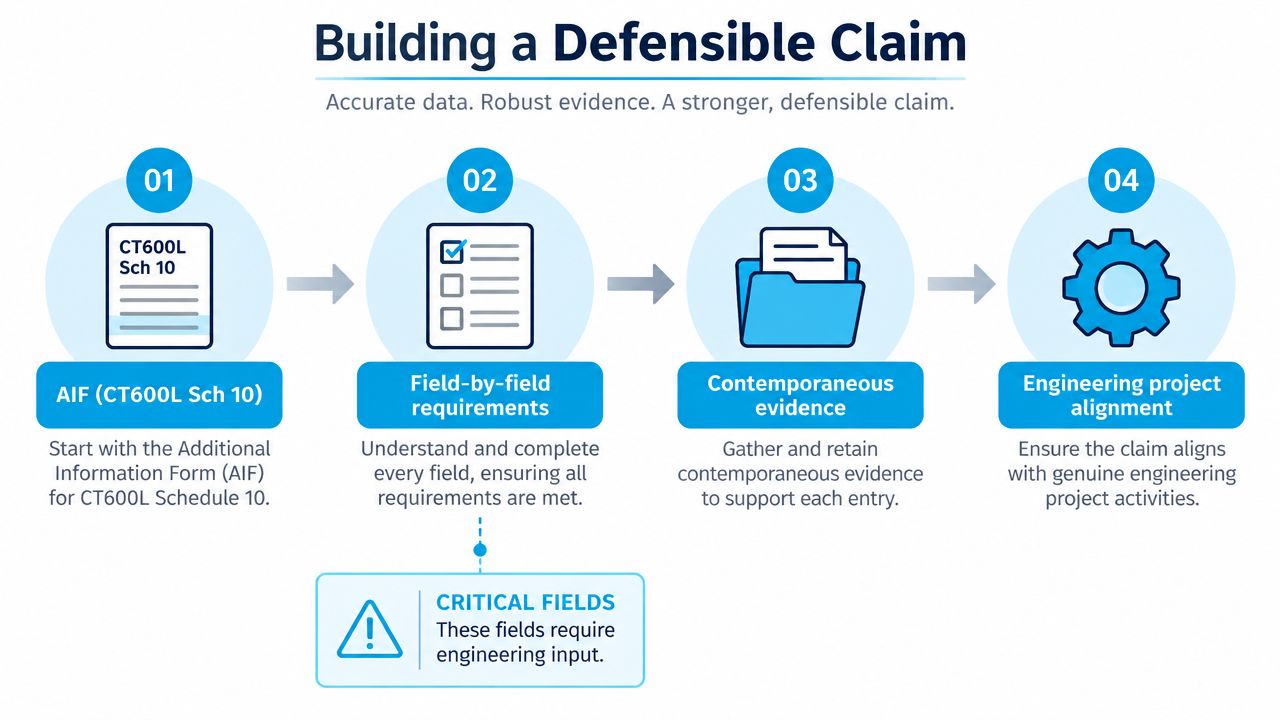
Evidence should exist before the claim meeting
Useful records include:
Project plans and technical reports: These establish the objective, uncertainty and development path.
Time records and monthly summaries: These support staff apportionment and expose gaps before submission.
Supplier invoices and contracts: These show what external parties supplied and whether the work was subcontracted R&D.
Prototype photographs and trial logs: These demonstrate physical experimentation, failed iterations and testing.
Payroll and RTI reconciliations: These connect staff costs to PAYE and National Insurance data.
The claim deadline is important. Claims must be made within two years of the end of the accounting period, according to HMRC's reform guidance. Separate notification requirements can also require a company to flag a potential claim in advance through its Corporation Tax filing process. A company that waits until the Year End to identify projects may discover that its evidence is incomplete or its notification position has already become difficult.
HMRC's scrutiny is reflected in the published error-and-fraud rate. The rate fell from 9.9% in 2022 to 2023 to 5.9% in 2024 to 2025, while claims fell 26% to 46,950, according to HMRC's R&D tax relief collection. Those figures don't prove that every lower-value claim is weak, but they do show why unsupported estimates are a poor strategy.
Evidence standard: If the technical director can't explain the uncertainty and the finance team can't reconcile the cost, the claim isn't ready for submission.
Companies that have claimed incorrectly shouldn't ignore the issue. HMRC directs companies to a disclosure service for claims made in error, and separate claims for the same period can be treated independently in the circumstances described in its current collection guidance. A correction should be considered promptly with professional advice.
Common Errors and Where HMRC Scrutiny Is Landing
The “submit and hope” approach is no longer commercially defensible. HMRC's compliance focus is aimed at claims where the narrative, expenditure and underlying business records don't support one another.
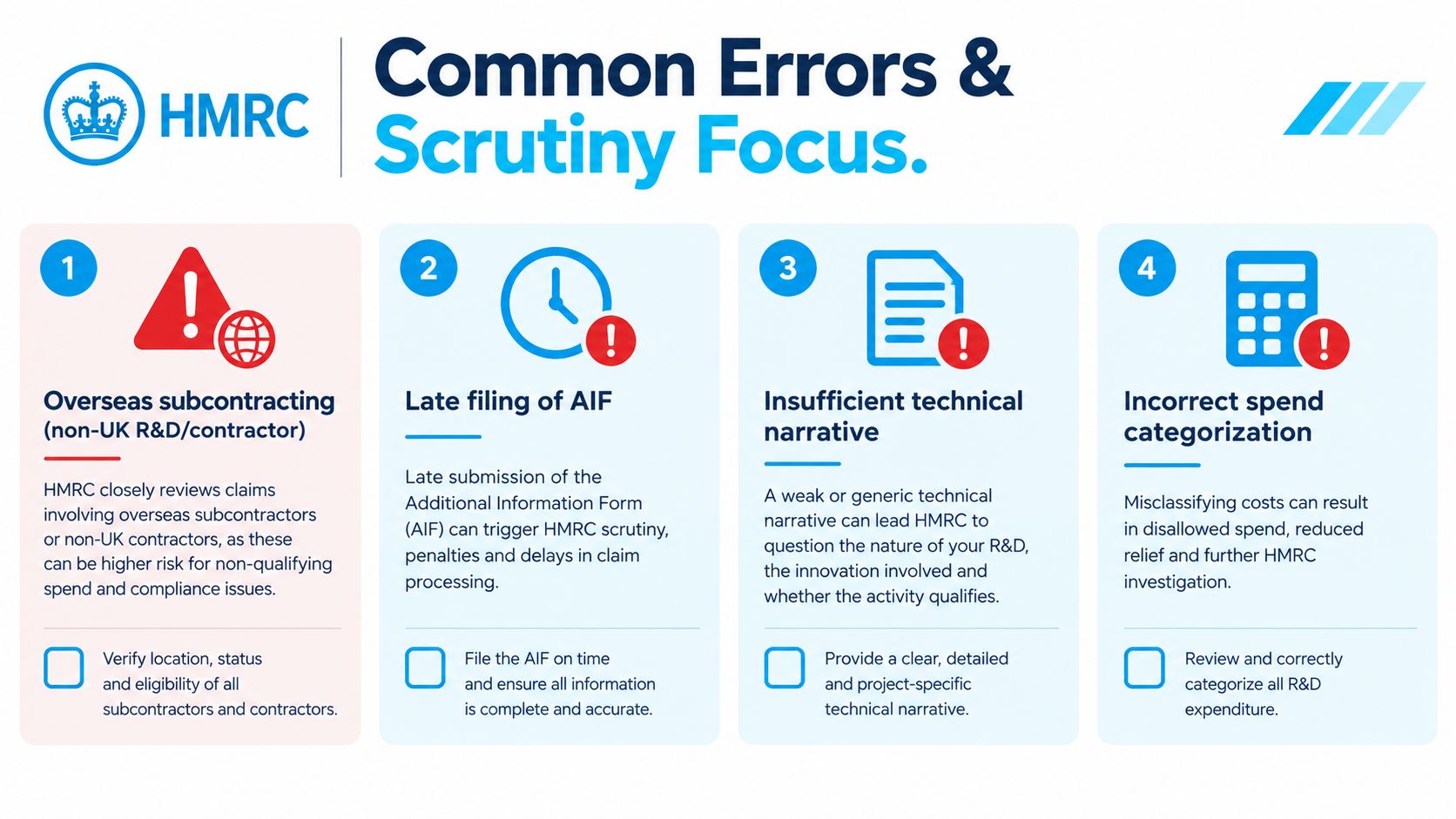
The recurring weaknesses are practical rather than mysterious:
Overseas subcontracting: The claim includes work performed overseas without testing the restriction or relevant exception. The finance team should map where the R&D happened, where the contractor is based and why the work couldn't reasonably be performed in the UK where that matters.
Software-only descriptions: The narrative says the company “built software” but doesn't identify a technological uncertainty. The technical team should explain the system limitation, alternatives considered and tests completed.
PAYE and NIC mismatches: Staff costs don't reconcile to payroll records or the personnel listed in the project narrative. The claim should be rebuilt from payroll and time evidence, not a broad percentage of departmental costs.
Duplicate consumables: Materials or utilities appear in more than one cost category or have already been recovered elsewhere. Each cost should have one clear treatment and supporting invoice trail.
Overstated indirect activity: General management, sales, administration or routine support is included without a valid link to qualifying R&D. The company should ringfence the activity and claim only the legitimate qualifying proportion.
Subcontracting needs a contract review
The legal and commercial wording in a supplier agreement can change the analysis. HMRC distinguishes subcontracted R&D from ordinary service contracts, so the label used by the parties isn't enough. The review should consider who decided that the work was needed, who bore the technical risk, who owned the results and whether the claimant was performing work for another party.
An enquiry consumes management time. It can turn an expected credit into a tax underpayment, interest and potential penalties, while making future claims harder to defend internally. A disciplined evidence process protects both the current submission and the credibility of the next one.
Sector-Specific Considerations and Next Steps
Engineering and industrial businesses should identify qualifying activity inside the project timeline, not inside broad departmental labels. The strongest evidence often appears in failed trials, prototype changes, test results and engineering decisions made before the final method was known.
| Sector | Typical qualifying activity | Common pitfall |
|---|---|---|
| Manufacturing | Novel welding methods, additive tooling, low-carbon heat treatment and materials recovery loops | Treating routine production optimisation as R&D |
| Construction | Temporary project consortia, off-site modular methods and digital-twin validation | Ignoring contract apportionment and subsidy-control considerations |
| Industrial software and automation | Novel control algorithms, machine-vision systems and AI-driven optimisation | Claiming maintenance, configuration or routine data engineering |
Manufacturing and process engineering
A manufacturing claim should isolate the experimental work from normal production. Trial set-ups, altered tooling, material tests and failed iterations may provide the technical story, while routine production runs usually provide the boundary.
Low-carbon process work can qualify where the company is resolving a technological uncertainty around heat, materials, recovery or process performance. The claim should show what the competent professional couldn't determine at the outset and how the business tested alternatives.
Construction and temporary project teams
Construction businesses often work through project-specific arrangements involving several entities. The finance team should review JCT or NEC contract terms, identify who commissioned the technical work and apportion costs between qualifying activity and ordinary delivery.
Off-site modular methods and digital validation can contain genuine R&D, but a commercial desire to accelerate construction isn't enough on its own. The technical narrative must connect the uncertainty to the experimentation.
Industrial software and automation
Automation claims commonly fail because the project description covers installation or configuration rather than development. The qualifying work is more likely to sit in novel control logic, machine vision, hardware-software integration or optimisation where the technical route was uncertain.
Overseas restrictions apply across all three sectors. Any international development, testing, data activity, subcontracting or externally provided worker arrangement should be mapped before the cost calculation is finalised.
The next practical step is to build a project register, gather timesheets and technical narratives, reconcile payroll and supplier records, and check the two-year claim window. A focused review before submission gives the finance director a clearer basis for deciding between the merged scheme and ERIS. Further sector context is available in striveX's engineering and industrial resource hub.
The latest HMRC figures show the incentive remains material. HMRC's 2024 to 2025 annual report records £8.2 billion of R&D relief expenditure supported in that year, as set out in its Chief Executive's Performance Report. The commercial opportunity is real, but so is the cost of treating the claim as a form-filling exercise.
Frequently asked questions
What is the merged R&D tax relief scheme?
The merged scheme is the main UK R&D relief route for accounting periods beginning on or after 1 April 2024. It replaced the former SME and RDEC schemes for most claims and provides a 20% merged R&D expenditure credit on qualifying expenditure, subject to the detailed eligibility, loss, cap and expenditure rules.
Can a loss-making SME claim ERIS?
A loss-making SME may use ERIS if it meets the relevant R&D-intensity condition. ERIS provides an extra 86% deduction and a payable tax credit worth up to 14.5% of surrenderable losses, subject to the statutory conditions and PAYE/NIC cap rules.
What costs qualify for R&D tax relief?
Potentially qualifying costs can include eligible staff time, certain subcontracted or externally provided worker costs, software, cloud computing, datasets and consumables. The costs must relate to qualifying R&D, and subcontracting and overseas expenditure require separate analysis.
How long does a company have to claim R&D tax relief?
HMRC's reform guidance states that claims must be made within two years of the end of the accounting period. Companies should also review whether an advance notification requirement applies before filing the claim.
What happens if an R&D claim was made incorrectly?
The company shouldn't leave an incorrect claim unaddressed. HMRC provides a disclosure route for claims made in error, and the company should obtain qualified advice to assess correction, repayment, interest and any penalty exposure.
This article is for informational purposes only and does not constitute professional advice. Tax rules apply as of April 2026. Consult a qualified accountant for your specific circumstances.
striveX Ltd provides support with assessing engineering projects, identifying qualifying R&D activity, analysing costs and preparing supporting claim documentation for the Corporation Tax return. Finance directors and technical leaders who want tailored help can become a client to arrange a focused review of the company's projects, evidence and scheme position.