

Most scaling SMEs do not have a reporting problem, they have a decision problem. The board pack arrives on time, the numbers reconcile, and yet the MD still cannot tell whether cash is tightening, margin is slipping, or a customer issue is turning into a working capital headache. That is usually the point where management accounts training stops being a finance project and becomes a commercial one.
The gap is rarely about effort. It is about whether the team understands how to turn monthly reporting into action, which is exactly why structured management accounts training matters for UK businesses trying to grow without losing grip on cash, controls, and strategy. Good reporting gives the board confidence. Better training gives the business better decisions.
Why Your Management Accounts Are Failing Your Board
A weak board pack usually looks busy but feels thin. It contains plenty of historical data, a few explanations after the fact, and not enough evidence that the finance team understands what leaders need to decide next. The result is predictable, the board starts asking for separate spreadsheets, side conversations, and ad hoc explanations that should have been built into the monthly pack in the first place.
That is not a formatting issue. It is a training issue. Management accounting is about internal financial information used to run the business, not the statutory accounts filed with Companies House or HMRC, and becoming a qualified management accountant can take 5–8 years (Learnsignal). That gap between compliance reporting and commercial control is where many SMEs lose time and confidence.
Practical rule: if a board member can read the pack and still not know what decision needs to be made, the pack is reporting history instead of guiding action.
A better approach starts by recognising that management accounts are not a year-end compliance document. They are a management tool. For a scaling SME, the value lies in the questions the pack answers, not the pages it produces.
A useful way to reset the conversation is to send the team to management accounts explained before asking for another revised pack. That creates a shared language around purpose, not just output.
Designing a Training Syllabus That Delivers Commercial Insight
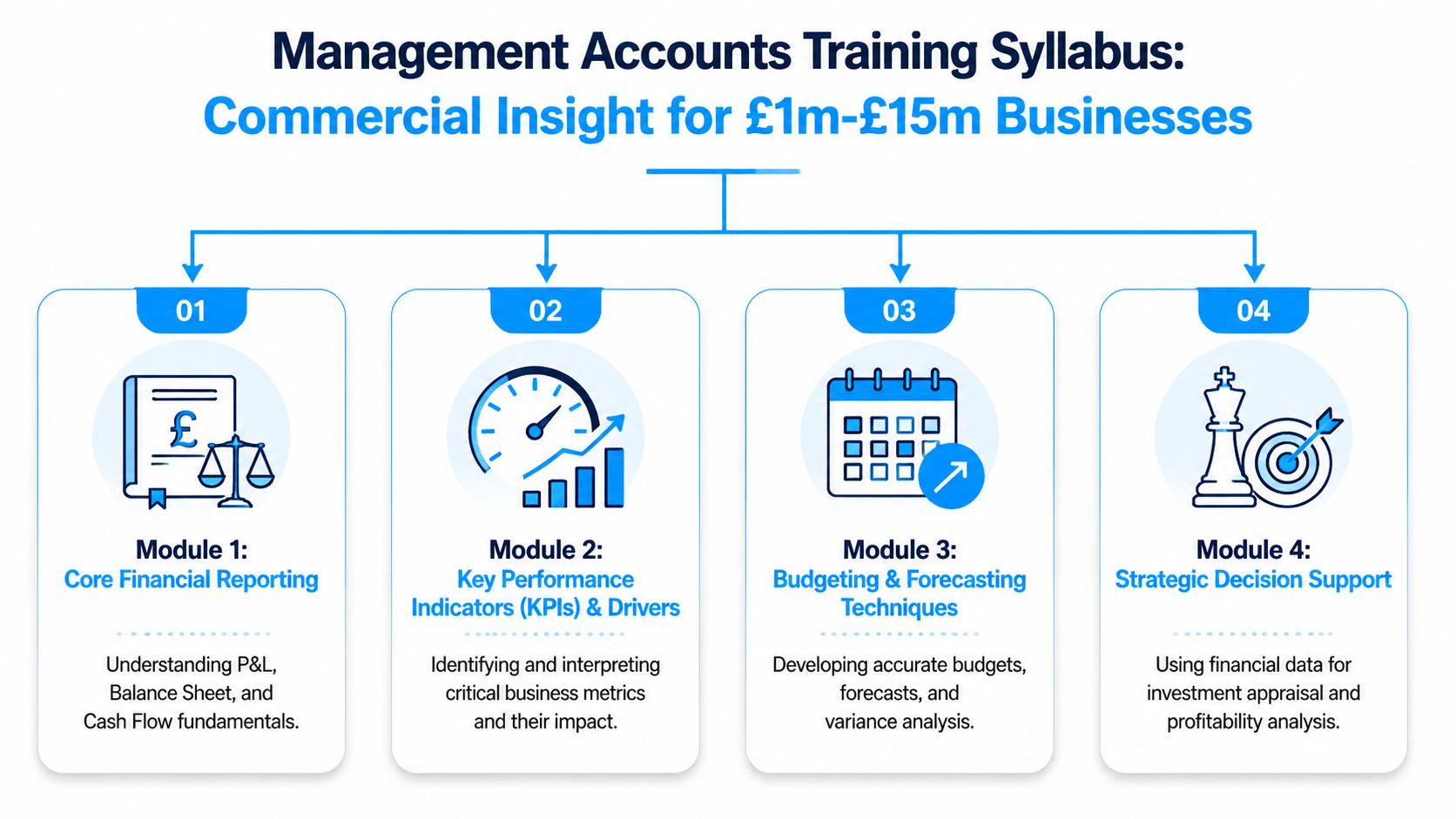
A useful syllabus does not try to teach everything. It teaches the parts that change decisions. For a business in the £1 million to £15 million turnover range, the training should build confidence in four areas, because those are the areas where leadership teams usually need clarity first.
Core financial reporting
The first module should cover profit and loss, balance sheet, and cash flow fundamentals, but not as accounting theory. The team needs to know what each report tells the board, what it hides, and how the three reports connect. The right question is not, “Can we produce the statements?” It is, “Can we explain what they mean for trading, funding, and control?”
Key drivers and KPIs
The second module should focus on the handful of metrics that tell the story behind the numbers. Focusing on these metrics makes management accounts training commercially useful. A board does not need a wall of data; it needs a short list of indicators that show whether sales quality, gross margin, debtor discipline, or overhead control is improving.
Budgeting, forecasting, and variance analysis
The third module should teach how to turn a budget into a live forecast and then use variance analysis to explain the difference between expectation and reality. The aim is not to produce a prettier spreadsheet. It is to answer why the business missed plan, whether the gap is temporary, and what management should do differently next month.
Strategic decision support
The final module should move beyond reporting into commercial judgement. That includes investment appraisal, margin analysis by product or customer, and decisions on hiring, pricing, or cost control. In a scaling SME, finance starts influencing strategy rather than recording it.
For a practical template on how monthly management accounts should be structured for decision-making, the Professional Careers Training guide is a helpful reference point. UK good-practice guidance says monthly management accounts should include income and expenditure, budget variance, rolling cash flow forecasts, balance sheets, and aged debtor analysis, with the emphasis on reviewing performance and enabling action rather than reporting history (gov.uk).
Selecting the Right Tools and Templates for Training

Training falls apart when people learn the idea but not the workflow. If the team cannot build the report pack in the system they use, the knowledge stays theoretical and the month-end close stays messy. The practical fix is to train the process in the same environment where the report will be produced, reviewed, and reused.
Build the session around real tasks
A strong training session should start with one business task, such as running a variance report, changing a P and L layout, or filtering by cost centre. That keeps the lesson commercial. It teaches the team to use the system to answer a question, not just to move through menus.
UK management accounting courses go beyond basic bookkeeping and explicitly cover cost behaviour, break-even analysis, standard costing, variance analysis, budgeting, and forecasting to support internal decision-making (LSFL). Those topics matter because they shape how a report is built, not just how it is read.
Standardise the outputs
A training programme should also leave behind standard templates. That means one version of the monthly board pack, one structure for variance commentary, and one forecast layout. Without that discipline, each month becomes a reinvention exercise and no one can compare performance cleanly over time.
The best template is the one the finance team can produce consistently when the month is busy and the numbers are under pressure.
Where a business needs support to structure the reporting rhythm, an option such as striveX Ltd can sit alongside internal finance capability and recurring review meetings. The point is not the brand. The point is having a repeatable framework that turns the data into decisions.
Choosing Your Trainer Internal Champion vs External Expert
The choice of trainer shapes the culture of the programme. An internal champion can embed the habits properly, because they already understand the systems, the people, and the reporting rhythm. An external expert can bring distance, challenge, and pace, which matters when the business needs a reset rather than gentle coaching.
Internal champion
This model works best when the company already has a capable finance manager or controller who can be developed into the trainer. It usually suits businesses that want long-term capability and tighter cultural fit. The downside is obvious, the person may already be busy, and if their current habits are poor, they may pass those habits on.
External expert
This approach works well when the board wants a clean start, fast improvement, or specialist input on a short programme. It can also help when the existing finance team needs confidence before it can teach others. The trade-off is cost and continuity, because the knowledge may not stick unless someone internal owns it after the engagement ends.
The policy backdrop matters here too. Since the Apprenticeship Levy was introduced in April 2017, UK employers have increasingly used structured, employer-funded routes like apprenticeships to build finance and management capability, rather than relying only on ad hoc short courses (CIPD). That shift suits SMEs that want a repeatable training pathway, not a one-off workshop.
A useful comparison point for growing firms is what a virtual financial controller can do for your business, because the right trainer often needs to combine reporting discipline with commercial interpretation.
How to Roll Out and Embed the Training Programme
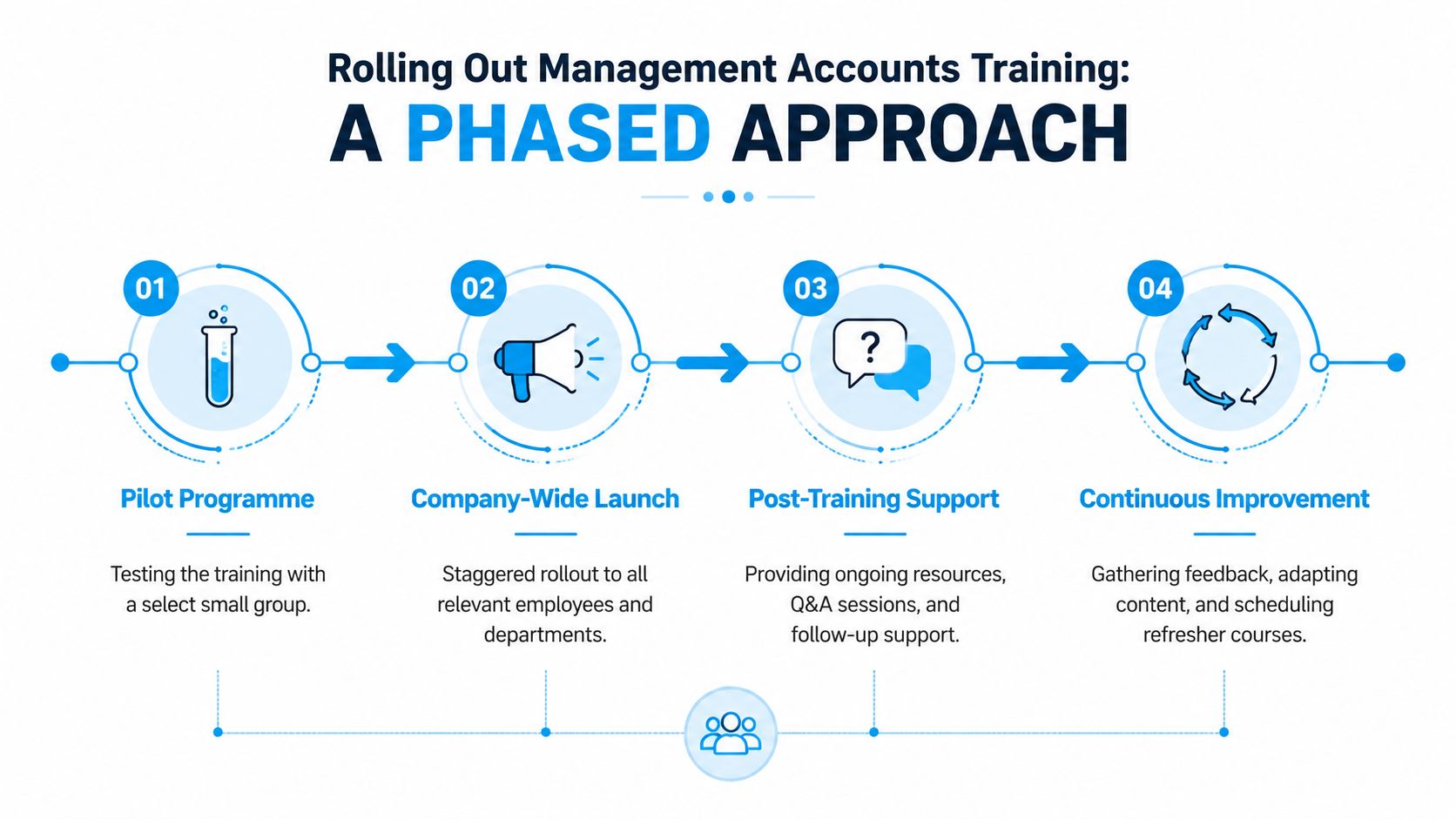
A training programme only works if it lands inside the business rhythm. The safest way to do that is to pilot it first, because a small test group will surface the messy bits before the whole company sees them. That also gives leadership something more powerful than a presentation, it creates internal advocates.
Start with a pilot
Choose one or two people who already touch reporting, forecasting, or commercial analysis. Give them the new pack structure, the commentary template, and the meeting rhythm, then test what breaks. If they can explain the numbers clearly after the pilot, the wider rollout becomes much easier.
Communicate the commercial reason
Leadership needs to explain why the programme exists. That message should link training to cash control, margin discipline, and sharper board decisions. Staff usually respond well when they see that the goal is not more paperwork, but better decision support.
Make the rollout staged
A simple rollout can be organised like this.
- Weeks one to four: pilot training with a small group.
- Week five: collect feedback and refine the content.
- Weeks six to eight: roll out to the wider team.
- After launch: keep a support loop open for questions and refresher sessions.
That sequence keeps the programme manageable and gives the finance team time to absorb new habits. It also creates a document trail that can be reused for future hires, which matters in a scaling SME where turnover is often lower than the pace of change.
Measuring Success and Building a Governance Rhythm
Training only matters if it changes behaviour in the boardroom. A board pack can be technically correct and still fail if directors leave the meeting with no clear actions, no ownership, and no sense of whether the business is ahead or behind. The ultimate measure of management accounts training is whether it improves judgement, not whether it impresses on paper.
A UK government evaluation found training effects decrease as programmes become more advanced, with behavioural changes dropping from 1 in 4 for foundation training to 1 in 20 for senior training, and it warns that small samples may not detect modest effects reliably (government evaluation). The practical lesson is simple. Measure a few core behaviours, otherwise the impact becomes hard to see.
What to measure
The strongest indicators are often operational rather than financial.
- Board pack timing: reports arrive when expected, not after the meeting.
- Commentary quality: explanations say what happened, why it happened, and what happens next.
- Meeting behaviour: directors spend more time on decisions and less time decoding the numbers.
- Action follow-through: owners leave the meeting with clear responsibilities.
These are the signs that the finance function is working as a management tool. They are also the signs that the training has stuck.
For businesses that want a more formal way to link training outcomes to business value, it can help to calculate training ROI in parallel with the board-level behaviour checks. ROI alone does not tell the whole story, but it helps leadership keep the programme accountable.
Good governance rhythm: prepare the pack, review it internally, present it to the board, capture actions, and close the loop before the next month-end.
A focused reporting service such as kpi tracking and reporting fits neatly into that rhythm because the board can only govern what it sees clearly and regularly.
Frequently Asked Questions
What is management accounts training?
It is structured training that teaches finance teams and leaders how to turn monthly numbers into decisions. The goal is not just to prepare reports, but to explain performance, cash pressure, and the actions the board should take next.
Who should attend management accounts training?
Usually the finance manager, controller, FD, MD, and any leader who uses monthly performance data. In a smaller SME, the same person may wear several hats, so the training should suit both finance and commercial decision-makers.
How often should management accounts be reviewed?
Monthly is the most practical cadence for most scaling SMEs because it keeps cash, margin, and working capital under control. The pack should be reviewed in a regular governance meeting so actions are tracked and closed.
What should a good management accounts pack include?
At minimum, it should cover income and expenditure, budget variance, rolling cash flow forecasts, balance sheets, and aged debtor analysis. It should also explain what changed, why it changed, and what management needs to do about it.
Should the training be delivered internally or externally?
It depends on the business. An internal champion helps with long-term embedding, while an external expert can bring speed and objectivity. Many SMEs use a mix of both, external design with internal ownership.
This article is for informational purposes only and does not constitute professional advice. Tax rules apply as of April 2026. Consult a qualified accountant for your specific circumstances.
A CTA for striveX Ltd. Book a practical management accounts review with striveX Ltd to tighten your board pack, improve cash visibility, and build a training rhythm that your team can sustain. It takes 15 minutes to arrange, and a response will follow within 24 hours.