

A growing fleet can look profitable on the monthly profit and loss while cash headroom vanishes unnoticed. Fuel invoices arrive before customers settle, agency-driver costs move with demand, and a vehicle that appears fully utilised may still lose money once maintenance, depreciation and empty mileage are included. For a logistics or transport FD, the practical question isn't merely whether turnover is rising. It's whether every mile is earning enough to fund the next week of operations.
That's where specialist transport accountants add commercial value. They turn telematics, fuel records, payroll, vehicle schedules and customer billing into management information that shows where margin is being made or lost. A useful monthly pack puts cost per mile, fleet depreciation, maintenance, fuel margin and agency-driver spend alongside a 13-week cash forecast, so an MD can act before a weak route or heavy wage week becomes a funding problem.
Why Growing Fleets Need Specialist Transport Accountants
A fleet operator may begin with straightforward bookkeeping. Supplier invoices are posted, customer invoices are raised and payroll is processed. As the fleet expands, that approach becomes increasingly detached from how the business makes money.
A vehicle can complete a full schedule and still underperform if fuel consumption is poor, maintenance is rising or the contracted rate doesn't cover empty running. A generic year-end accountant may produce compliant Statutory Accounts without showing which customer, route or vehicle is absorbing the margin. By the time the issue appears in annual figures, the operational cause may be difficult to isolate.
The gap between bookkeeping and fleet economics
Transport businesses need accounting that follows the movement of vehicles and people. That means matching fuel to vehicle activity, separating productive from non-productive mileage, tracking driver costs by work type and reviewing maintenance against fleet age and usage.
Official transport data demonstrates the scale of the underlying activity. The Department for Transport's Transport Statistics Great Britain collection covers road, rail, air, water, freight, passengers, licensing, accidents, investment, expenditure, energy use and environmental impact. Its 2024 freight release recorded 206 billion tonne-kilometres of domestic freight, with 82% moved by road, alongside 21 billion tonne-kilometres by water and 17 billion tonne-kilometres by rail.
That scale creates a reporting challenge for finance teams. High-frequency operational data has to become reliable management information, not a collection of disconnected spreadsheets.
Practical rule: A monthly transport pack should explain the operational reason for a margin movement, not merely record that the movement happened.
What specialist reporting changes
Consider a growing haulier where turnover is increasing but gross margin is tightening. A conventional review may identify higher fuel and labour costs. A specialist review goes further by asking whether fuel consumption changed by vehicle, whether agency hours replaced employed-driver hours, whether customer rates reflect the work performed and whether downtime is being recovered through pricing.
A sector-aware finance function also helps the management team connect accounting decisions with fleet decisions. StriveX's logistics and transport accounting support is designed around haulage, freight and logistics businesses, where management reporting needs to support decisions on utilisation, pricing, tax and cash.
The difference is not more paperwork. It's faster visibility of the decisions that affect cash headroom. For a fleet operator, management accounts that arrive after the next pricing or vehicle-investment decision have limited value.
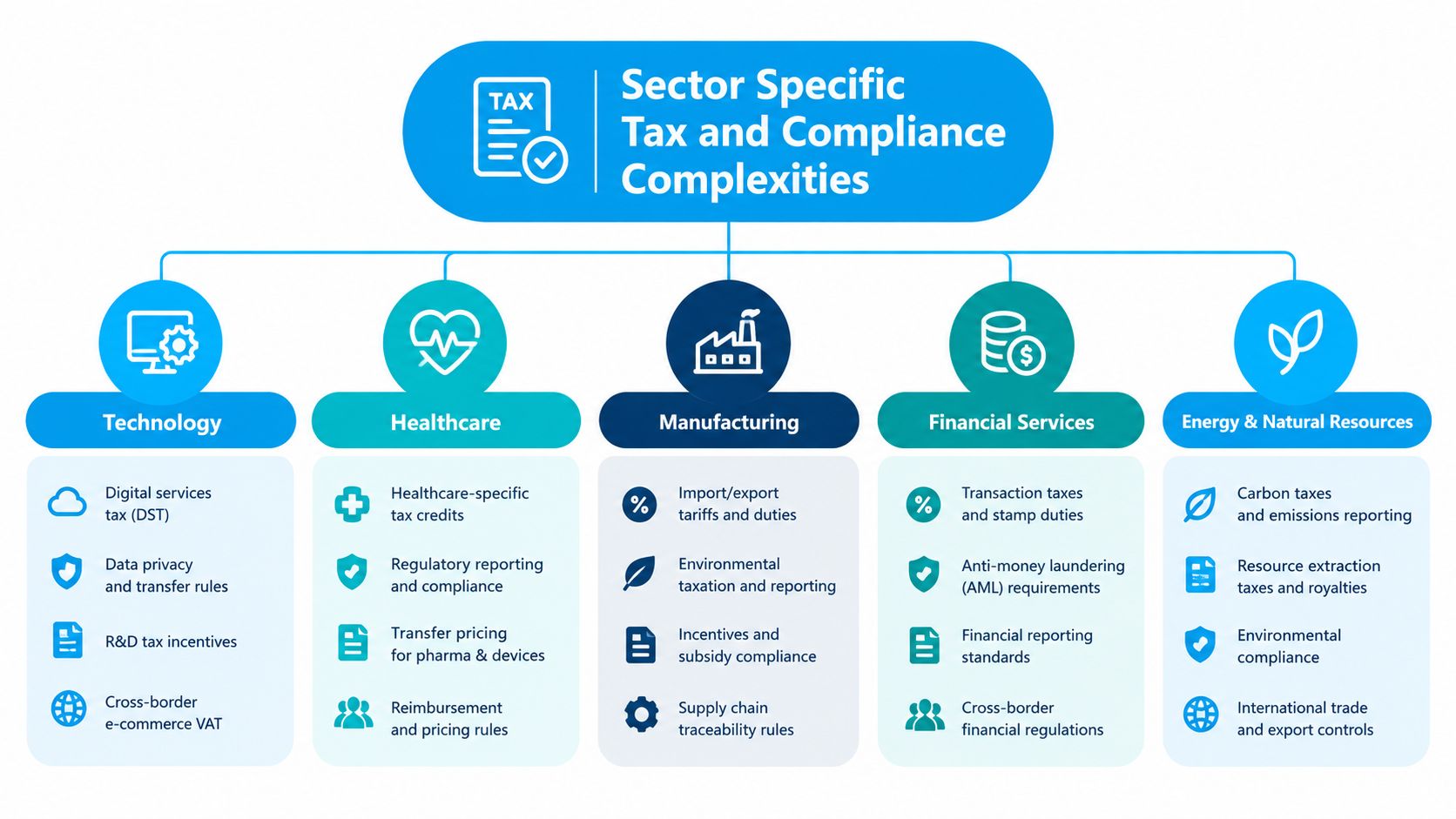
Sector Specific Tax and Compliance Complexities
Transport tax work becomes difficult where an accounting entry depends on how an asset, vehicle, journey or fuel purchase was used. The risk isn't confined to a year-end adjustment. Incorrect classification can distort VAT recovery, Corporation Tax planning, cash forecasts and the reported cost of a route.
UK freight volumes show why small errors deserve attention. On a high-mileage fleet, a small cost-allocation error can repeat across a substantial volume of activity.
Fuel, VAT and duty require operational evidence
Fuel records need to show more than a supplier total. Accountants should be able to identify the vehicle or activity, distinguish on-road from off-road use where relevant, and retain evidence supporting the treatment applied. The same discipline matters when considering fuel duty relief, because the claim depends on eligibility and accurate records.
required records for VAT mileage claims
Businesses reviewing their process should document the records needed to support VAT mileage claims. The useful principle is simple: the finance team must be able to reconcile the claim to genuine business mileage and supporting source records.
Mixed-usage operators need particular care. Vans, HGVs, site vehicles and ancillary equipment may not share the same VAT or tax treatment. A single fuel category in the nominal ledger can conceal ineligible recovery and make route profitability look better than it is.
Vehicles, depots and cross-border activity
Capital allowances on commercial vehicles and depot infrastructure need to be considered alongside the timing of cash payments. Outright expensing may appear simpler, but the correct treatment depends on the asset, its use and the applicable tax rules. Accountants should also separate vehicle repairs from capital improvements, because the distinction affects both reporting and tax planning.
Cross-border work adds customs and VAT considerations. The finance team needs clear processes for import and export documentation, customer billing, duty, currency and the point at which responsibility transfers. Employment tax and driver-related costs also need consistent treatment, particularly where staff travel across different operating locations.
A practical business tax planning process should therefore start with the fleet and operating model, not with a generic list of tax opportunities. The strongest control is a documented link between operational evidence, accounting treatment and the tax position taken.
Building a Management Pack Around Cost Per Mile
The monthly pack should answer three questions quickly. Which work is profitable, which vehicles are consuming margin, and how much cash is available to operate through the next difficult trading period?
Cost per mile is the central measure because it turns a large fleet operation into a comparable unit of economics. It should include the costs that genuinely belong in the decision, not just fuel. A useful calculation can be built by vehicle, route, customer or operating division, provided the allocation rules remain consistent.
The core measures
The pack should include a bridge from billed work to contribution. That bridge needs operational quantities as well as financial values, otherwise a change in mileage or utilisation can be mistaken for a pricing improvement.
| Metric | Commercial Purpose | Reporting Frequency |
|---|---|---|
| Cost per mile | Tests whether rates cover fuel, driver, maintenance and fleet overheads | Monthly, with weekly exception review |
| Fleet depreciation | Shows the economic cost of using vehicles and supports replacement decisions | Monthly |
| Maintenance cost per vehicle | Identifies ageing, downtime and repair trends | Monthly |
| Fuel margin | Compares fuel recovery or customer pricing with actual fuel cost | Weekly and monthly |
| Agency-driver spend | Shows the effect of temporary labour on route contribution | Weekly and monthly |
| Empty mileage | Highlights non-productive activity and pricing leakage | Weekly |
| Vehicle utilisation | Supports fleet-sizing and replacement decisions | Weekly and monthly |
| Debtor days and aged debt | Links invoicing performance to available cash | Weekly and monthly |
The precise calculation should match the operating model. A subcontracted delivery may require a different contribution view from an owned vehicle, while a fixed-price customer contract needs a sharper review of mileage and fuel assumptions.
Make variance analysis actionable
A variance is useful only when someone can act on it. If fuel cost per mile rises, the pack should identify whether the cause is price, consumption, route mix, idling, vehicle condition or a billing failure. If agency-driver spend rises, management needs to know whether the extra cost protected a profitable service commitment or merely covered weak planning.
Maintenance reporting should combine invoices with vehicle downtime and mileage. A low repair bill isn't necessarily good news if vehicles are being deferred until a larger failure occurs. Depreciation should also remain visible, even where it doesn't create an immediate cash payment, because replacement planning fails when management sees only current repairs.
A fleet can be busy without being economically productive. Cost per mile exposes that difference.
Cloud bookkeeping can support the process, but it won't create the management logic. Finance teams still need agreed coding, vehicle identifiers, cut-off rules and a monthly close timetable. Operational data should be reconciled to invoices and payroll, with exceptions assigned to an owner rather than left in a suspense account.
The output should fit the decisions made by the FD and MD. It might include a route repricing list, vehicles requiring review, customers with weak contribution, overdue invoices and the cash effect of upcoming fuel, wage and tax payments. A static profit and loss statement can sit behind the pack, but it shouldn't be the pack.
Protecting Cash Headroom Through Forecasting and Tax Planning
Transport businesses can report a healthy accounting profit and still face a cash squeeze. Fuel and wages often need funding before customer invoices are collected, while vehicle repairs and deposits can arrive without much warning. A 13-week cash view gives the FD a rolling map of those pressure points.
The forecast should be built from expected receipts and committed payments, not from a straight-line assumption based on last month. Each week should show opening cash, customer receipts, fuel, wages, agency labour, suppliers, vehicle costs, tax payments, finance commitments and closing cash. The forecast then needs a clear minimum cash headroom target agreed with the MD and funders.
Use the forecast to test decisions
A useful forecast isn't a single optimistic line. It should allow management to test operational choices:
- Fuel pressure: Model a period of heavier fuel purchases and compare it with the expected timing of customer receipts.
- Wage concentration: Isolate weeks with payroll, holiday accruals or high agency-driver usage.
- Fleet investment: Add deposits, finance payments, insurance, maintenance and tax effects before approving a vehicle purchase.
- Customer delay: Stress-test slower collections from major accounts rather than assuming every invoice arrives on time.
- Tax timing: Schedule VAT, PAYE and Corporation Tax obligations using the actual payment dates relevant to the business.
The forecast should be reviewed weekly, with actual results replacing assumptions. StriveX's cash-flow forecasting service provides a relevant framework for businesses that need to connect operational commitments with available cash.
Tax planning should protect liquidity
Capital allowances can improve the timing of tax relief, but the decision shouldn't be made in isolation. A business may prefer a particular investment route because of tax treatment, yet the cash commitment, finance structure and replacement cycle may matter more to short-term headroom. Transport accountants should present the options clearly, including the accounting, tax and cash consequences.
Depot costs deserve similar attention. The 2026 business-rates revaluation may change the cost base for businesses operating from depots, so the forecast should include the expected effect once the business has reliable property-rate information. Fuel-duty decisions announced in the Autumn Budget can also affect planning assumptions, but they shouldn't be treated as certain until the applicable policy is confirmed.
Transport and storage businesses accounted for around 5% of UK business turnover in recent ONS business population data, and fuel remains a material cost driver for hauliers and couriers. That combination makes cash forecasting a board-level discipline, not an accounts-office exercise.
A strong forecast changes behaviour. It gives the MD time to adjust collections, defer non-essential expenditure, renegotiate supplier timing or reconsider a fleet commitment before the bank balance forces the decision. The guidance on building a great financial forecast is useful when formalising that process.
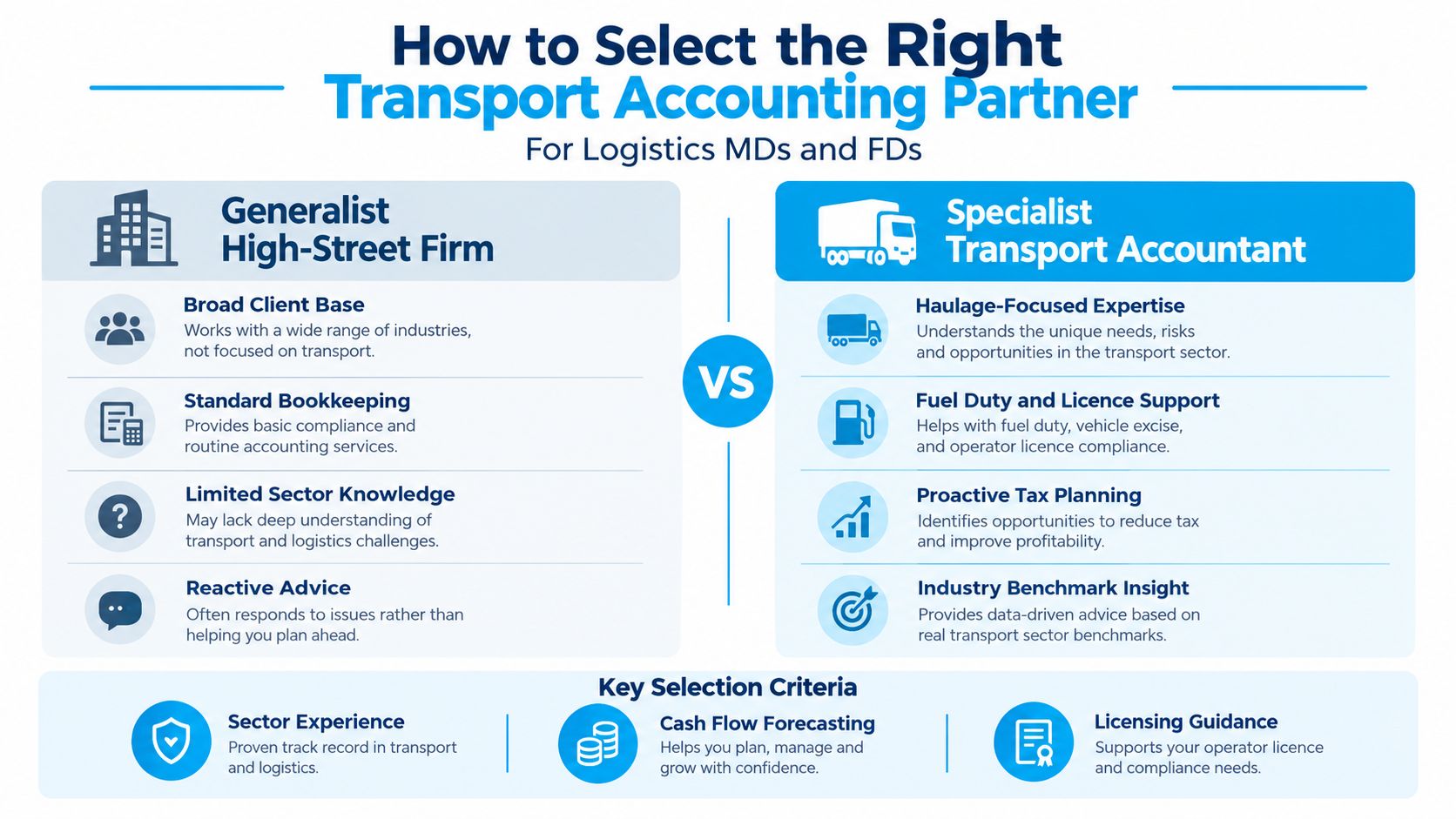
How to Select the Right Transport Accounting Partner
The right accounting partner should improve the quality and speed of decisions, not just take responsibility for submitting returns. A generalist firm may handle compliance competently, but a transport business should test whether the firm understands vehicle economics, fuel records, driver costs, depot obligations and customer profitability.

Compare the working model, not the sales presentation
A useful selection exercise asks each potential partner to explain how the monthly pack would be built. The answer should cover the data required, responsibility for reconciliations, treatment of vehicle costs and the timing of management meetings.
| Selection question | Strong response | Warning sign |
|---|---|---|
| How will cost per mile be calculated? | Clear allocation rules by vehicle, route or customer | A single fleet-wide average with no operational context |
| How will fuel be reconciled? | Supplier invoices matched to usage and supporting records | Fuel posted as an unexplained monthly total |
| How will agency-driver spend be reviewed? | Separate visibility by period, route and service requirement | Buried within general wages |
| What does the cash forecast include? | Weekly receipts, fuel, wages, tax and fleet commitments | A simple profit projection |
| How will management accounts be used? | Regular review with assigned actions | Reports issued without discussion |
Questions worth asking before appointment
The FD or MD should ask for a sample anonymised pack, an explanation of the close timetable and evidence of how exceptions are handled. The firm should also explain how it will work with existing bookkeeping staff, payroll providers and operational managers.
The partner doesn't need to replace every internal process. It does need to make accountability clear. A capable arrangement can combine internal transaction processing with external review, tax planning and board-level interpretation.
StriveX Ltd offers accounting, tax planning, management reporting and financial strategy support for growing UK businesses, including logistics and transport operators. Its relevance should be assessed against the same criteria as any other provider, particularly the quality of its cost-per-mile reporting and forecasting process.
The final decision should reflect the business's present complexity and its next stage of growth. A firm that can only produce historical accounts may be adequate for a simple operation, but a fleet facing investment, labour volatility and changing depot costs needs a partner that can connect operational evidence to forward decisions.
Frequently Asked Questions and Next Steps
What do transport accountants do for a logistics business?
Transport accountants combine compliance with operational reporting. They help management track cost per mile, fuel, maintenance, depreciation, driver costs, VAT, Corporation Tax and cash requirements. Their value is greatest when the monthly pack explains why margin changed and what action should follow.
How should a transport business calculate cost per mile?
The business should divide relevant operating costs by productive or total miles, using a consistent definition. The calculation should show fuel, driver costs, maintenance, depreciation and appropriate overheads, then be reviewed by vehicle, route, customer or division where the data supports it.
How should mixed-usage vehicle fuel be treated for VAT?
Mixed-usage fuel requires evidence of business use and a clear separation of on-road and off-road activity where the rules require it. Records should support the mileage and purpose of the claim. A qualified accountant should confirm the correct treatment for the specific vehicle and operating pattern.
When should a transport business outsource management accounts?
Outsourcing becomes valuable when internal bookkeeping records transactions but doesn't explain route profitability, fleet performance or cash pressure. It can also help when the FD or MD lacks time to maintain a reliable monthly close and 13-week forecast.
What should a monthly transport management pack include?
At minimum, it should include cost per mile, vehicle depreciation, maintenance, fuel margin, agency-driver spend, utilisation, empty mileage, debtor performance and a rolling cash view. The pack should finish with actions, owners and deadlines, not just figures.
A transport business doesn't need more historical reporting for its own sake. It needs a finance process that shows which work funds growth, which costs consume headroom and which decisions need to be made before the next fuel or wage-heavy week.
Before the next Year End, the FD or MD should review whether the current accounts process can answer those questions. A focused management accounts review can expose missing cost allocations, weak fleet measures and forecasting gaps while there's still time to correct them.
This article is for informational purposes only and does not constitute professional advice. Tax rules apply as of April 2026. Consult a qualified accountant for your specific circumstances.
StriveX Ltd helps logistics and transport businesses build management accounts around cost per mile, fleet costs and cash forecasting, alongside practical tax planning.