

In the Department for Business and Trade's 2024 late-payments research, businesses selling to other businesses received an average of 17% of payments late.
Working capital management is controlling cash tied up in customer invoices, stock and supplier bills so wages, suppliers and tax are paid on time. For a growing business, the key question is whether cash funds a necessary trading cycle or covers avoidable delays, excess buying and weak billing. That distinction separates a structural leak from a temporary funding need, and it decides whether finance will help or mask the problem.
What Working Capital Management Covers
A bakery buys flour before it sells bread. If it supplies wholesale customers on credit, it may also pay its bakers before those customers settle their invoices. The business needs cash throughout that gap, even when every order earns a margin.
Working capital is the balance available to support day-to-day trading, calculated as current assets minus current liabilities. Current assets include trade debtors, meaning unpaid customer invoices, stock and cash. Current liabilities include supplier bills, short-term borrowing, VAT, PAYE and Corporation Tax falling due within a year.
Why profit isn't cash
Illustrative example: a bakery with £1.5 million turnover can report a profitable Year End while struggling to fund its next flour delivery. Its accounts may include sales that customers haven't paid for, while its storeroom contains ingredients bought ahead of demand.
The Department for Business and Trade's 2024 late-payment study puts that collection risk in context, with late payments ranging from an average of 11% in insurance to 21% in goods.
The operating response involves three levers:
Collect cash faster. Remove delays between delivery, invoicing, dispute resolution and payment.
Pay suppliers on agreed terms. Retain cash until it's due without shifting an unagreed financing burden onto suppliers.
Hold stock the trade requires. Match purchasing to demand, replenishment lead times and service commitments.
For founders who need a plain-English reference before discussing these decisions with their finance lead, AmbitionCFO's working capital guide for founders provides useful background.
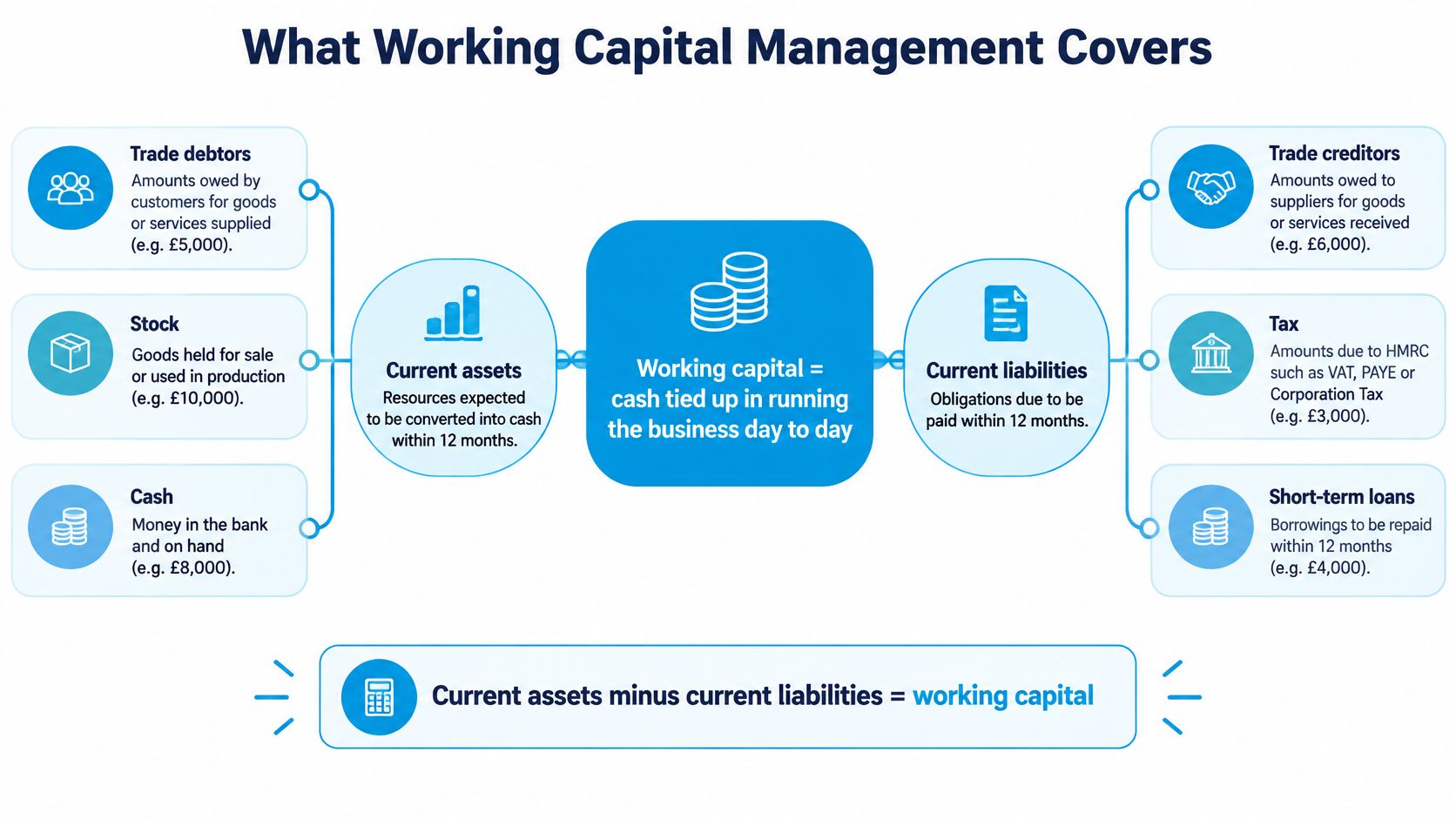
Practical distinction: collecting an invoice converts a debtor into cash. It doesn't create another sale or another profit.
These timing changes work through the balance sheet and appear in the cash forecast. Any associated discounts, write-offs or financing costs also affect the profit and loss account, so releasing cash shouldn't be judged separately from protecting margin.
The Metrics That Show Where Cash Is Stuck
Six measures separate a structural cash leak from a temporary squeeze. Calculated monthly, they show whether cash is trapped in receivables, stock or supplier terms, or whether one large order has distorted a single balance sheet date.
Core working capital metrics and how to calculate them
| Metric | Formula | What it tells the business | Healthy direction |
|---|---|---|---|
| Working capital | Current assets minus current liabilities | Short-term trading cushion, though part may sit in stock or unpaid invoices | Higher is safer until assets become idle or difficult to realise |
| Debtor days | (Trade debtors divided by turnover) multiplied by 365 | Average days customers take to pay | Lower, within agreed credit terms |
| Stock days | (Stock divided by cost of sales) multiplied by 365 | Average days stock sits before sale | Lower, without causing stockouts |
| Creditor days | (Trade creditors divided by cost of sales) multiplied by 365 | Average days taken to pay suppliers | Higher, within agreed supplier terms |
| Cash conversion cycle | Debtor days plus stock days minus creditor days | Days cash is tied up in trading | Lower, or negative where suppliers fund the cycle |
| Current ratio | Current assets divided by current liabilities | Coverage of obligations due within a year | Above 1.0 as an initial check, then inspect what the assets contain |
Read the balances before trusting the ratios
Take a business with £6 million of annual credit turnover and £1 million of trade debtors. Debtor days come out at roughly 61: £1 million divided by £6 million, multiplied by 365. Against 30-day terms, around a further month of sales is sitting in receivables.
Debtor days is a trend indicator, so check individual invoices when a large recent sale, seasonal trading or a dispute distorts the average. Use average balances where possible, and keep VAT treatment consistent between the balance and the turnover figure.
Stock days express inventory in time rather than pounds. The related turnover calculation, explained through SIX ERP's COGS divided by average inventory, measures how often stock turns over; COGS means cost of goods sold.
Creditor days require similar care. Cost of sales works as a practical denominator; credit purchases give a closer match where reliable purchasing information is available.
Follow the movement, not a universal target
A negative cash conversion cycle means customers generally pay before the business pays the suppliers funding that cycle. Safety still depends on what sits behind the figure: customer deposits may already be committed to substantial delivery obligations.
A current ratio below 1.0 means current liabilities exceed current assets. A figure above 1.0 can still conceal obsolete stock or doubtful debts, so read the asset side line by line.
Compare terms. Assess debtor and creditor days against actual contractual commitments.
Track trends. Review monthly results across the trading year rather than relying on a year-end snapshot.
Assign actions. Connect each adverse movement to a customer, product line or payment decision.
Use monthly management accounts to keep the measures beside the commercial decisions they inform. A pack that includes the balance sheet, cash flow statement and variance analysis gives each ratio its context: rising debtor days should be traceable to the customers and terms driving them. Calculate all six measures and record their direction of travel.
Fixing Cash Leaks Before You Borrow
A funding-first approach can turn an operating weakness into a recurring interest bill. An overdraft may cover the immediate shortfall, but it won't correct invoices raised late, stock bought without demand or contracts that require substantial expenditure before billing.
The British Business Bank's 2025/26 finance report found that 50% of businesses seeking finance wanted it for working capital, while smaller businesses identifying cash-flow or late-payment issues as a major obstacle increased from 19% in Q3 2024 to 22% in Q3 2025.
Diagnose the operating cycle
Map each customer group or product line. Record when costs are committed, when delivery occurs and when cash is realistically collected. A blended company average can hide an expensive customer segment.
Compare customer and supplier terms. Identify gaps the business has agreed commercially, then distinguish them from delays caused by poor administration.
Inspect stock by product line. Separate dependable sellers from speculative purchases, obsolete items and stock reserved against uncertain orders.
Compare billing with expenditure. Check whether contracts allow deposits, applications for payment or milestones before the business incurs most of its costs.
Construction contractors need to model certification, applications for payment and retention separately. A completed job doesn't necessarily produce immediately billable or collectable cash.
A software subscription business faces a different trade-off. Annual prepayments bring cash forward but create deferred income, meaning income relating to services still to be delivered. Spending those receipts as though the full contract were already earned can leave delivery underfunded.
Distributors commit cash to physical goods before orders become receipts. A purchasing discount isn't attractive if the business then finances slow-moving stock and eventually sells it below the intended margin.
Separate persistent funding from avoidable leakage
Regular overdraft use isn't, by itself, proof of poor management. A profitable business can have a legitimate, persistent financing requirement because of its trading model. The warning is borrowing that grows without an explained increase in productive activity.
| Test | Operating problem | Genuine funding requirement |
|---|---|---|
| What creates the gap? | Billing delays, excess stock or disputed work | A documented trading cycle or seasonal build |
| What closes it? | A process or commercial change | Identifiable future receipts |
| What happens after repayment? | The unexplained shortfall returns | Funding reduces as the planned cycle completes |
Borrowing should fund an understood requirement, not postpone a difficult conversation about contract economics.
A review of costs in a limited company can support this diagnosis, but expenditure cuts aren't a substitute for fixing payment timing. Repair avoidable cash leaks first, then size finance around the remaining requirement.
Collecting Cash Faster and Charging Late-Payment Interest
A late invoice usually signals a design failure upstream: unclear acceptance criteria, a monthly billing habit, or credit extended without a limit. Collections therefore work best when finance, sales and delivery share responsibility. Finance alone cannot chase down missing acceptance documents, and a disputed invoice needs a decision-maker rather than another reminder email.
The Small Business Commissioner's late-payment findings estimate that businesses are owed £26 billion at any given time, while 22% of surveyed businesses reported spending staff time chasing invoices, averaging 86 hours per affected business annually. That is management attention spent recovering money the business has already earned.
Build collection controls into the sale
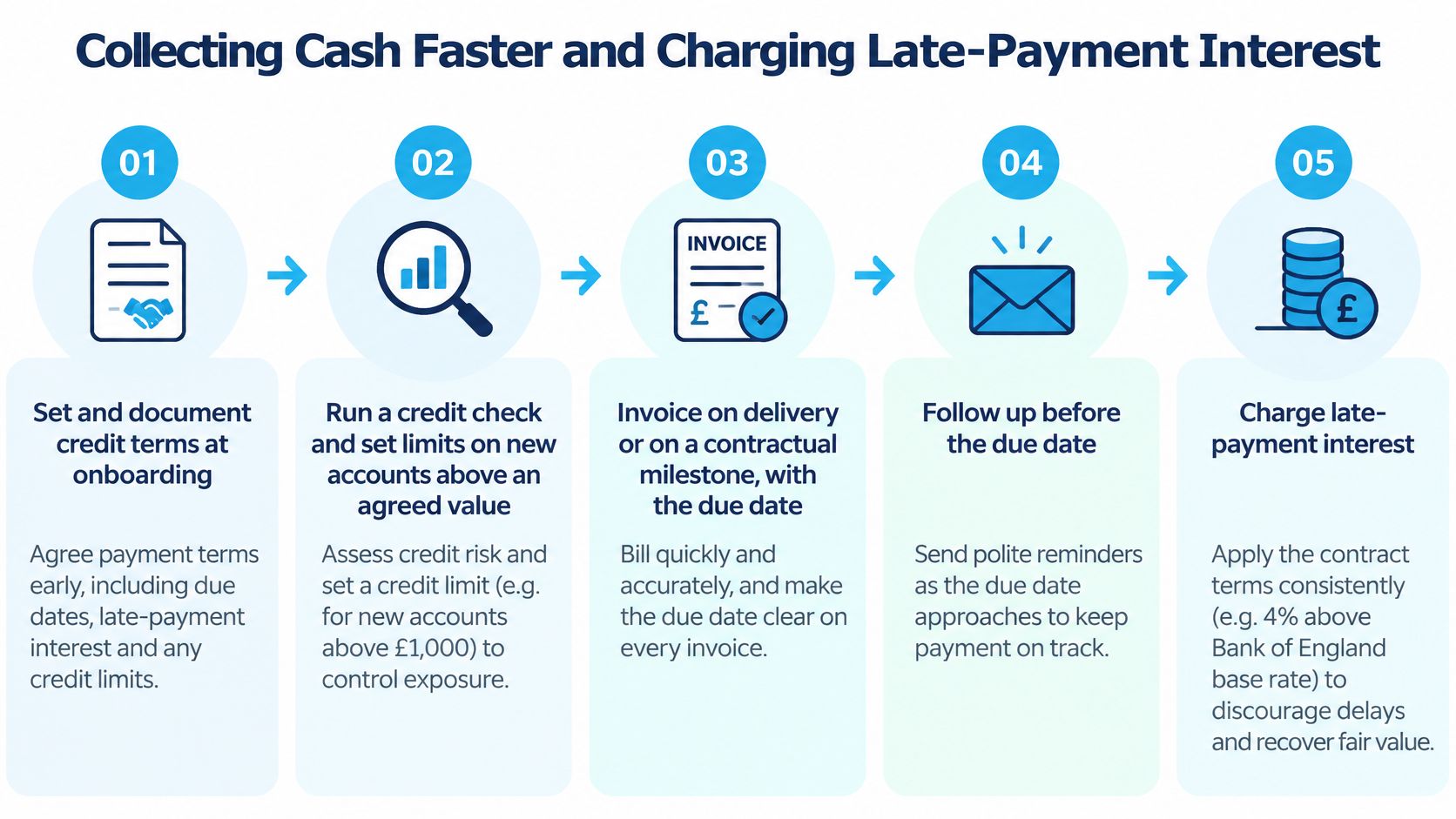
Document credit terms at onboarding. Agree the contracting entity, billing contact, payment terms and purchase-order requirements before work starts. Obtain confirmation that the customer accepts the terms.
Check credit and set exposure limits. Apply a consistent approval policy to new accounts above an internally agreed value. Include delivered but unbilled work when assessing exposure, alongside issued invoices.
Invoice on delivery or a contractual milestone. Put the due date, purchase order, supporting evidence and correct payment details on the invoice. Waiting for an internal monthly billing run extends the funding period for no commercial gain.
Send reminders before the due date. Confirm receipt and ask whether anything prevents payment. Automated reminders suit routine accounts; a material balance deserves direct contact with someone authorised to pay.
Escalate at an agreed lateness point. Give a named person authority to contact the customer's finance lead, review credit availability or pause further work where the contract permits.
Log disputes with a resolution deadline. Record the disputed amount, reason, evidence required and responsible manager. Pursue undisputed amounts separately so a single contested line cannot stall an entire account.
For high-value work, deposits and staged billing align receipts with delivery costs. Milestones need objective definitions, supporting evidence and a format the customer's approval process can handle.
Truespeak's guide to step-by-step overdue invoice chasing offers a supporting reference for documenting follow-up. The commercial control is consistency: staff need to know what happens when a promised payment fails to arrive.
Put a cash value on improvement
Illustrative calculation: the metrics section applied the debtor-days formula to a larger sales base. On £3 million of annual credit sales, each day of collection improvement releases roughly £8,200 (£3 million divided by 365), so an eight-day reduction frees approximately £65,750. The released cash was already earned, which makes it the cheapest funding available to the business, and the figure assumes a consistent sales pattern and calculation basis.
Monthly reporting should show debtor days, overdue debt as a proportion of sales and customer concentration. A weekly collection forecast should separate:
Committed receipts. Payments with a credible confirmation and expected bank date.
Uncertain receipts. Overdue balances weighted for dispute status, customer behaviour and collection evidence.
At-risk balances. Debts requiring a recovery decision rather than optimistic scheduling.
Use interest to encourage payment
Under GOV.UK's commercial debt interest guidance, statutory interest on qualifying late business-to-business payments is normally eight percentage points above the Bank of England base rate, where the contract doesn't provide a different substantial remedy.
The calculation uses simple interest:
Debt × annual interest rate × days late ÷ 365
Illustrative calculation: at an assumed annual rate of 8.5%, a £1,000 debt accrues £85 over a full year, roughly £0.23 a day and £11.64 over 50 days. Scaled up to a typical overdue balance, the cost of waiting becomes visible, which is precisely what makes the charge effective in negotiation.
The government's late-payment directive guide specifies the reference periods: the base rate on 31 December applies from 1 January to 30 June, and the rate on 30 June applies from 1 July to 31 December.
Staff should check the applicable reference rate, contractual remedy and eligibility for fixed recovery sums before issuing a demand, and standard terms should state the remedy clearly. Interest compensates for the wait once a debt is already late. The stronger control sits earlier, in the credit decision, because an insolvent customer stays unable to pay whatever the rate.
Paying Suppliers and Holding Stock Without Starving the Business
A distributor with £4m of annual cost of sales can free about £109,600 by cutting stock days by 10, or about £54,800 by gaining five extra days of supplier credit, using cost of sales as a simplified proxy for purchases. That is the scale of the operating-design choice: release cash from routines and holdings before pricing outside finance.
Negotiate payment timing rather than imposing it
Compare each supplier's agreed terms with the dates the payment run settles. Automatic runs often pay early when no early-payment discount exists, so tighten the run first.
Where a discount exists, weigh it against financing cost and the cash buffer given up. Where longer terms would help, agree them before the order is placed. Paying late after the fact usually converts a cash benefit into price, credit and service pressure.
Commercial test: judge a payment change by total cost. If prices rise, credit tightens or delivery reliability slips, the apparent cash gain is already spent.
Give single-source components protected payment arrangements, agreed by purchasing and finance, because a stopped line costs more than the float saved.
Release stock selectively
Use the stock lever for availability and the supplier lever for settlement timing. Stock reduction changes what can be shipped; supplier terms change when an existing obligation falls due.
Review stock days by product line. Aggregate figures can hide obsolete items behind fast sellers.
Set sell-through deadlines. Give slow movers a disposal, promotion or purchasing decision.
Base reorder points on actual demand. Include replenishment lead time and justified safety stock.
Change the supply arrangement. Test smaller deliveries, more frequent replenishment or supplier-held stock where commercially workable.
Track fulfilment, lost orders, emergency freight and gross margin beside the cash released. If emergency freight becomes routine or dependable customers leave, rebuild the stock policy before treating the release as progress.
Building a 13-Week Cash Forecast Around Tax Dates
A 13-week cash forecast translates trading decisions into expected bank movements. It should show when the business needs cash, how much room remains under its facilities and which assumptions could cause a shortfall. Done properly, it also separates a temporary funding gap, such as a heavy tax quarter, from a structural leak that drains cash whatever the calendar says.
Build from the bank, not the profit forecast
Start with reconciled bank balances. Use the opening position on the first Monday, identifying restricted cash and available facilities separately.
Schedule customer receipts. Build from debtor ageing and expected new billings. Keep uncertain overdue receipts distinguishable from confirmed payments.
Date the outgoing payments. Include payroll, supplier runs, rent, loan repayments, capital commitments and director remuneration. Reflect payment dates rather than accounting recognition.
Add tax liabilities explicitly. Include VAT, PAYE and Corporation Tax on their applicable dates. Under HMRC's VAT return guidance, standard VAT returns and payments are normally due one calendar month and seven days after the accounting period ends, with funds reaching HMRC by the deadline; late-payment interest applies for periods starting on or after 1 January 2023, and penalties may also arise.
Run a downside case. Model slower collections, a delayed contract or the loss of a major customer. Adjust related costs realistically rather than assuming every cost disappears with the sale.
Measure the remaining room. Show the minimum cash buffer and covenant headroom, meaning the margin before the business breaches a lending condition.
Reserve tax cash before it becomes payable
Tax is the forecast line most often treated as an afterthought, and one of the most expensive to get wrong. I recommend ring-fencing the estimated liability in a separate account as soon as each period closes, so operating decisions run off the cash that belongs to the business.
For businesses using annual accounting, HMRC's VAT Annual Accounting Scheme deadlines set a different rhythm: monthly payments generally fall at the end of months four to 12, or quarterly at the end of months four, seven and 10, followed by a balancing payment within two months of the accounting period ending.
VAT cash treatment by scheme
| Scheme | When to reserve the cash | What the forecast shows |
|---|---|---|
| Standard VAT returns | As each return period closes | One dated outflow per return, entered before the liability falls due |
| Annual accounting, monthly instalments | Between each instalment | Instalments plus the balancing payment as separate dated outflows |
| Annual accounting, quarterly instalments | Ahead of each instalment | Three instalments plus the balancing payment as separate dated outflows |
VAT periods, PAYE months and the Corporation Tax deadline rarely align, so build a separate tax calendar covering all three and check every due date against the bank forecast each week. Reconcile forecast receipts and payments against bank movements weekly, refresh the operating assumptions monthly, and roll the forecast forward so the planning horizon doesn't shrink.
Use cash flow forecasting support to connect collection expectations, purchasing commitments and tax reserves in one dated view. A useful forecast explains why cash differed from expectations, so record the reason behind each material variance and feed it into the next version.
Working Capital Questions Answered
Is working capital the same as cash flow?
Working capital is the balance left after short-term liabilities are deducted from short-term assets. Cash flow measures money moving through the business over a period. Current assets may look substantial while much of the balance sits in overdue invoices, disputed work or stock that cannot be sold immediately. Treat the balance-sheet figure as context, then use a dated payment forecast to decide whether the business can meet its commitments.
Does growing a business always use up cash?
Growth generates cash when customers pay before the business incurs delivery costs. It consumes cash when stock, work in progress or customer credit grows faster than collections. Check the peak cash requirement against the facility limit and confirm the delivery margin can absorb delay before accepting the contract. A profitable order can still create a funding problem if its cash requirement peaks before payment arrives.
Can invoice finance fix working capital?
Invoice finance can bridge a temporary gap between issuing eligible invoices and receiving payment. It cannot repair an underlying loss, make obsolete stock saleable or resolve a contractual dispute. Separate that timing gap from a structural cash leak before borrowing, then assess fees, eligibility, concentration restrictions and recovery arrangements. The facility makes sense only when identifiable receipts can repay it and the plan covers delayed payment.
Start Your Cash Review This Quarter
Pull debtor and creditor ageing reports. Reconcile them to the ledger and flag disputed, duplicated or unallocated items.
Calculate the measures in the table. Compare their direction with the previous quarter and identify the operating reasons for movement.
Assign the largest overdue balances. Give each material account a named owner, next action and escalation decision.
Test collection and supplier changes. Choose a billing improvement and an agreed payment-timing change, then check their effects on cash, margin and relationships.
For businesses turning over £1 million to £15 million, striveX Ltd recommends monthly management accounts as a minimum. Its management reporting includes profit and loss, balance sheet, cash flow and variance analysis, with narrative commentary explaining the numbers; reporting frequency can include weekly cash flow reports or quarterly strategic reviews according to client needs.
A focused review should establish what cash is recoverable through operating changes, what funding is required and who owns delivery. That gives directors a decision, rather than another dashboard.
This article is for informational purposes only and does not constitute professional advice. Tax rules apply as of April 2026. Consult a qualified accountant for your specific circumstances.
Know where your cash is tied up, but unsure what to tackle first? Bring your debtor ageing report, stock figures and 13-week cash forecast to a no-obligation consultation with the striveX team. We can discuss whether management accounts and cash-flow reporting would help you spot the biggest pressure points and plan your next steps. Get in touch through our contact page.