

Sales have beaten budget for four months running. The order book looks stronger than it did this time last year. Then the bank statement arrives on a Friday morning and nobody in the business can answer two simple questions with confidence: will the balance cover the VAT bill and the payroll run in the next three weeks, and what will cash look like 13 weeks from now?
That moment, where recorded performance and forward visibility part company, is where the conversation about a part-time finance director usually starts. Not because the business is failing, but because growth has pushed the finance set-up past the point where monthly accounts alone can guide decisions. What follows is a practical view of what the role owns, the deadlines it tracks, what it costs, and how to tell whether the gap in your business is leadership or bookkeeping.
Part-Time Finance Director Versus Other Finance Roles
Take a managing director at a business turning over £4 million. Sales are ahead of plan, margins look reasonable on paper, and the year-end accounts will probably show a profit. Yet the timing of cash out is running ahead of the timing of cash in, and no one is accountable for spotting it before it bites. The difference between the four roles below is not seniority for its own sake. It is who decides.
| Role | Main Focus | Working Pattern | Decision Authority |
|---|---|---|---|
| Bookkeeper | Recording transactions and reconciling accounts | Ongoing, task-based | Low: processes what it is given |
| Management accountant | Monthly reporting and variance analysis | Monthly or ongoing | Medium: flags issues to owners |
| Part-time finance director | Cash, tax, forecasting and board reporting | Scheduled days each month | High: delegated authority set by the board |
| Full-time finance director | Whole finance function and strategy | Full-time employment | High: executive board member |
The rows follow one logic. A bookkeeper records what happened, a management accountant reports it, and a finance director decides what happens next. The step change is not the volume of work but the ownership of judgement: pricing, credit terms, hiring timing, funding and tax reserves all sit with the person holding that authority.
A part-time finance director is a senior finance leader engaged for a scheduled number of days each month, with clearly delegated authority from the board. The role owns the rolling cash forecast, tax timing, board reporting and a documented set of financial decisions, usually through a fractional finance director arrangement. The transition from producing numbers to acting on them is the pivot many growth businesses get wrong, and it is covered well in Lucentive's guide for growth-stage CFOs for anyone weighing how much decision rights to delegate.
The trade-off is plain. Fewer hours on site means fewer hours to supervise processing, so the model works best when a finance manager, controller or bookkeeper runs the daily transaction flow underneath. Without that layer, a part-time finance director ends up doing reconciliations at board-level rates.
The five-minute self-test: can anyone in the business state the cash position 13 weeks ahead, and name the next tax bill and the date it falls due? If both answers are no, the gap is leadership rather than bookkeeping.
What a Part-Time Finance Director Owns and the Deadlines It Tracks
A part-time finance director turns financial records into decisions the board can act on each month. That means a management pack short enough to read in 20 minutes and specific enough to change a decision, supported by a monthly KPI dashboard that ties financial results to the operational drivers behind them.
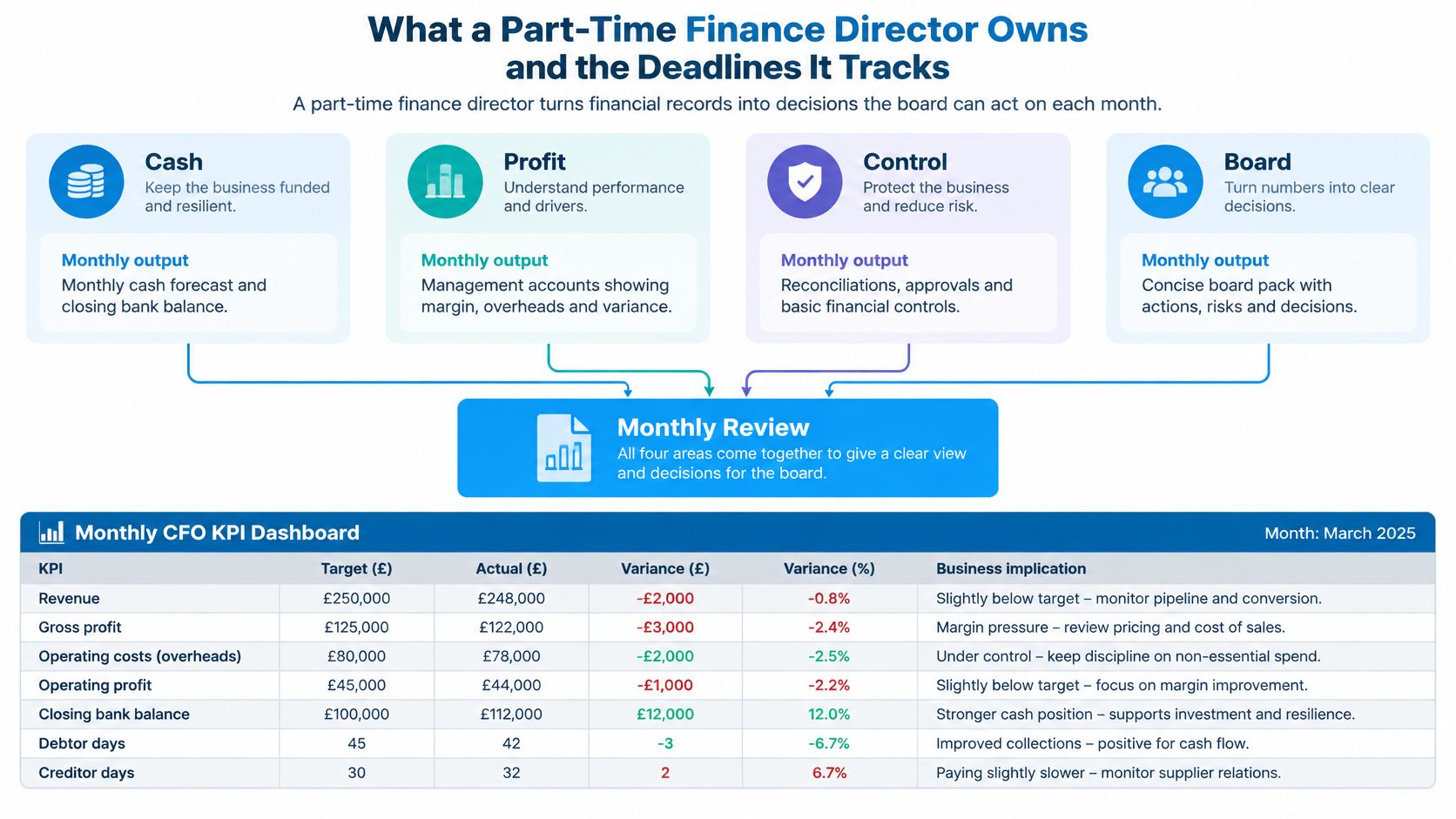
The four pillars and what each produces
Cash and working capital. The output is a rolling 13-week cash-flow forecast, refreshed every week and compared with what landed. Alongside it sits a weekly review of aged debtors, debtor days tracked against a target, and a written escalation rule for accounts that pass 60 days. The forecast is what converts a collection problem into a decision: chase harder, extend terms, or borrow.
Tax and deadlines. A Corporation Tax provision built from monthly profit rather than year-end accounts, a rolling check that taxable turnover stays the right side of the VAT registration threshold, and a year-end timetable with internal sign-off dates. Tax is a cash event with a date attached, and the role exists to make sure the date is never a surprise.
Management reporting. Monthly management accounts with budget variances, a small set of tracked KPIs, and a short written commentary on what changed and why. The commentary matters more than the spreadsheet. Numbers without an explanation get filed; numbers with a reason get acted on.
Strategy and the board. Scenario modelling before a hiring round, a price change or a capital purchase. Lender conversations prepared rather than improvised. A candid view on whether growth is generating cash or consuming it.
Bookkeeping records the journey. The finance director plots the route and warns of a fuel shortfall before the tank runs dry.
The shape of a working month
A well-run engagement follows a predictable rhythm, which is what makes a small number of days effective:
Week one closes the books and reconciles the bank, debtors and creditors.
Week two produces the management accounts and the KPI dashboard, with variance commentary.
Week three reviews the cash forecast, aged debt and the tax position, and updates the full-year projection.
Week four builds the board pack: decisions required, risks, and the actions carried forward.
Deadlines and limits worth diarising
Corporation Tax is usually payable nine months and one day after the accounting period ends, while the Company Tax Return is normally due 12 months after the same date, as the UK business tax guidance explains. The accounting period cannot exceed 12 months, so a long period of account can mean two returns. A profitable year can therefore end with the cash already spent and the bill still to come.
The rate depends on profit. Companies with profits of £50,000 or less pay the small-profits rate of 19%; the main rate of 25% applies above £250,000, with marginal relief between the two and thresholds divided between associated companies, as GOV.UK's summary of UK taxes sets out. Group structure and associated-company status change the cash requirement, not just the computation.
The Companies House deadline is calculated to the exact day, and it is the date acceptable accounts are delivered that counts rather than the date they are posted, per Companies House guidance on the life of a company.
| Threshold or Deadline | Figure | Why It Matters |
|---|---|---|
| VAT registration, rolling 12-month taxable turnover | £90,000 | Registration normally within 30 days of the end of the month the threshold is breached |
| VAT registration, expected turnover in next 30 days | £90,000 | Applies when a sharp rise in sales is expected |
| Corporation Tax small-profits rate | 19% on profits of £50,000 or less | Sets the tax reserve for smaller profit levels |
| Corporation Tax main rate | 25% on profits above £250,000 | Marginal relief applies between the two limits |
| Corporation Tax payment | Nine months and one day after period end | Cash must be ready before the bill falls due |
| Company Tax Return | 12 months after period end | Filing date is separate from the payment date |
| Companies House accounts (private company) | Nine months from accounting reference date | For a 31 December year end, normally 30 September, and accounts must be accepted by then |
Practical rule: diarise the payment date, not the filing date. The return can be filed later; the tax cannot be paid later without interest.
Engagement Models and What Drives the Cost
Cost is the second question, not the first. What a part-time finance director costs depends on four variables: the number of days or hours a month, the seniority of the person doing the work, whether the scope includes systems implementation or funding support, and whether the first 90 days need extra time to fix the basics. A business with clean books and a working forecast needs fewer hours than one where the ledger has never been reconciled.
| Model | Typical Commitment | Best Fit | Pricing Basis |
|---|---|---|---|
| Fixed monthly retainer | Set days or hours each month | Businesses wanting steady oversight | Monthly fee agreed upfront |
| Project-based engagement | Defined scope such as a funding round or systems change | One-off gaps with a clear end date | Fixed project fee or agreed hourly rate |
| Interim cover | Short term while a permanent hire is found | Recruitment gaps or leadership change | Day rate or agreed period fee |
| Ad hoc advisory | Called on as needed | Companies needing occasional challenge on major decisions | Hourly rate |
Interim cover is not a small-business workaround. Companies House recorded in its 2025–26 annual report that it appointed an Interim Director of Finance and Commercial through an off-payroll engagement while recruiting a permanent, full-time replacement, as the Companies House annual report and accounts notes. Flexible leadership as a deliberate bridge, not a stopgap.
To judge affordability, ignore the fee in isolation and test it against the cash released. As an illustration, a retainer of £2,500 a month costs £30,000 a year. If tighter credit control and a 13-week forecast release £150,000 that was sitting in unpaid invoices, the decision turns on the cash released, not the fee. The same test applies in reverse: if the only outcome is a prettier report pack, the money is better spent elsewhere.
Three questions before signing anything:
What the fee includes, specifically: are management accounts, the cash forecast, VAT returns and board attendance inside the retainer or billed separately?
Who covers absence, so a holiday or illness does not leave the forecast and the payroll run unattended.
How knowledge transfers, including where decision rights, controls and the reporting calendar are documented when the engagement ends.
A project engagement suits a defined gap such as a funding round, a systems migration or a year-end clean-up. A retainer suits ongoing oversight. Monthly management accounts remain the minimum useful output for a business of this size, which is why the management accounts service is usually the anchor of any scope.
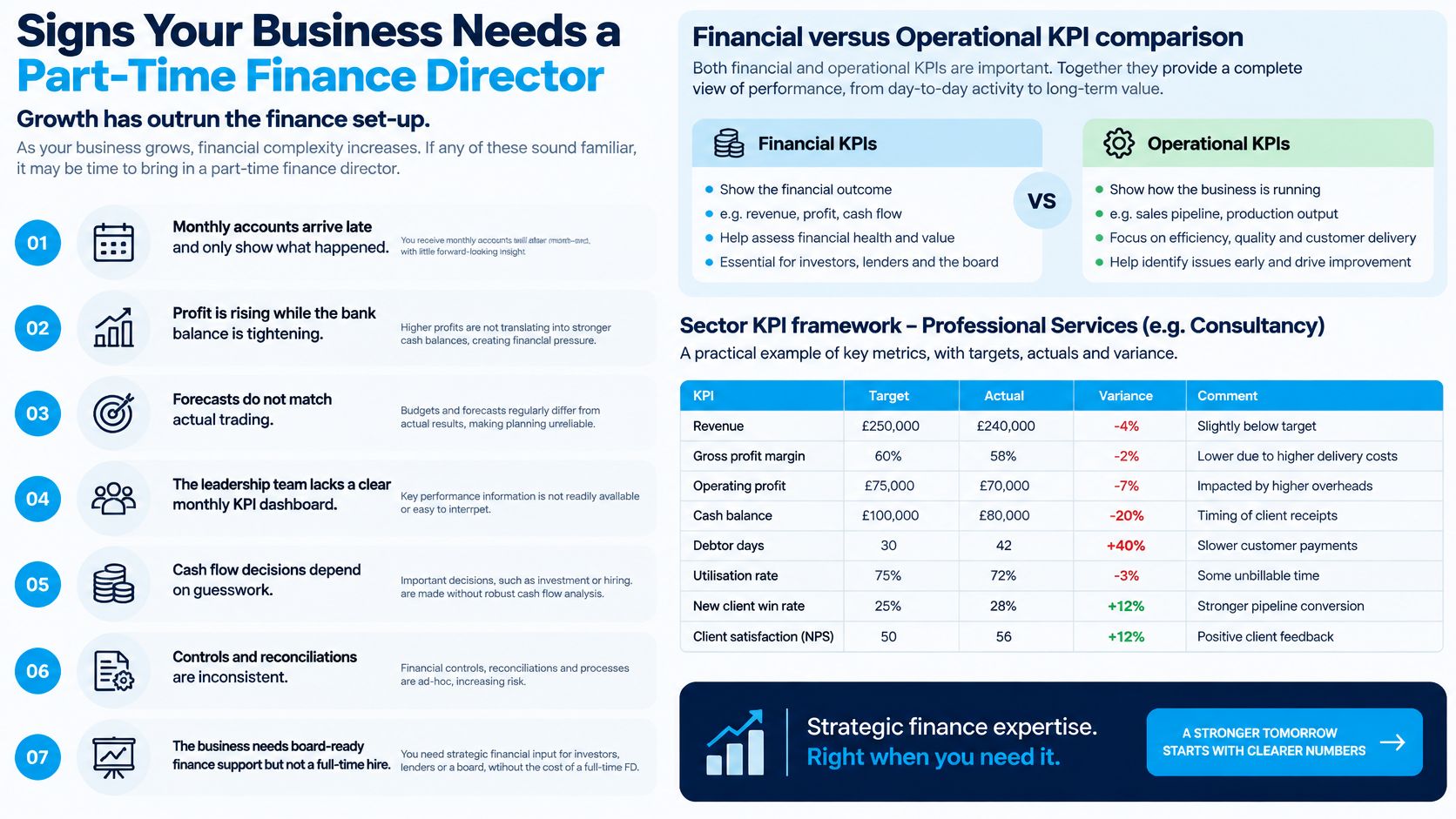
Signs Your Business Needs a Part-Time Finance Director
Growth has outrun the finance set-up long before anyone admits it. The signs are behavioural rather than technical:
Late, backward-looking accounts. The monthly pack arrives three weeks after month end and only describes what already happened.
Profit without cash. Profit is climbing while the bank balance tightens, and no one can reconcile the two.
A VAT threshold approaching. Rolling taxable turnover is closing on the registration threshold, and the timing of that registration is a cash event rather than a formality, as GOV.UK's VAT registration rules make clear.
An audience ahead. Lender, investor or buyer conversations are scheduled and the numbers aren't board-ready.
A messy balance sheet. Year end is near and unreconciled items have been carried for months.
Decisions without a forecast. Pricing, hiring and stock commitments are made on gut feel.
Evenings spent chasing cash. Personal time absorbed by invoices and reminders.
That last sign has a measurable cost. The UK Small Business Commissioner's late payments research found 28% of businesses, more than 1.5 million, are affected by late payments each year, with affected firms owed approximately £26 billion at any given time. The same research found 22% of surveyed businesses spend staff time chasing overdue invoices, averaging 86 hours annually per affected business.
The counter-signs matter just as much. A business under £1 million turnover with simple, predictable cash flow, or one that only needs compliance filing, is better served by a bookkeeper and a year-end accountant. The role earns its fee where complexity, timing and external scrutiny collide.
As an illustration: a Midlands-based manufacturer with £3.2 million turnover was profitable but slow to collect from two large customers. A weekly debtor review and a 13-week forecast gave the board forward visibility, and the conversation moved from "can we afford it" to "when do we start".
Three or more of the signs above justifies a trial on a defined 90-day scope, with success measured in debtor days, forecast accuracy and on-time filings.
How to Brief and Measure a Part-Time Finance Director
Engaging the role without a brief produces a well-meaning visitor who turns up, asks for data and leaves without changing a decision. The procedure below keeps the engagement accountable.
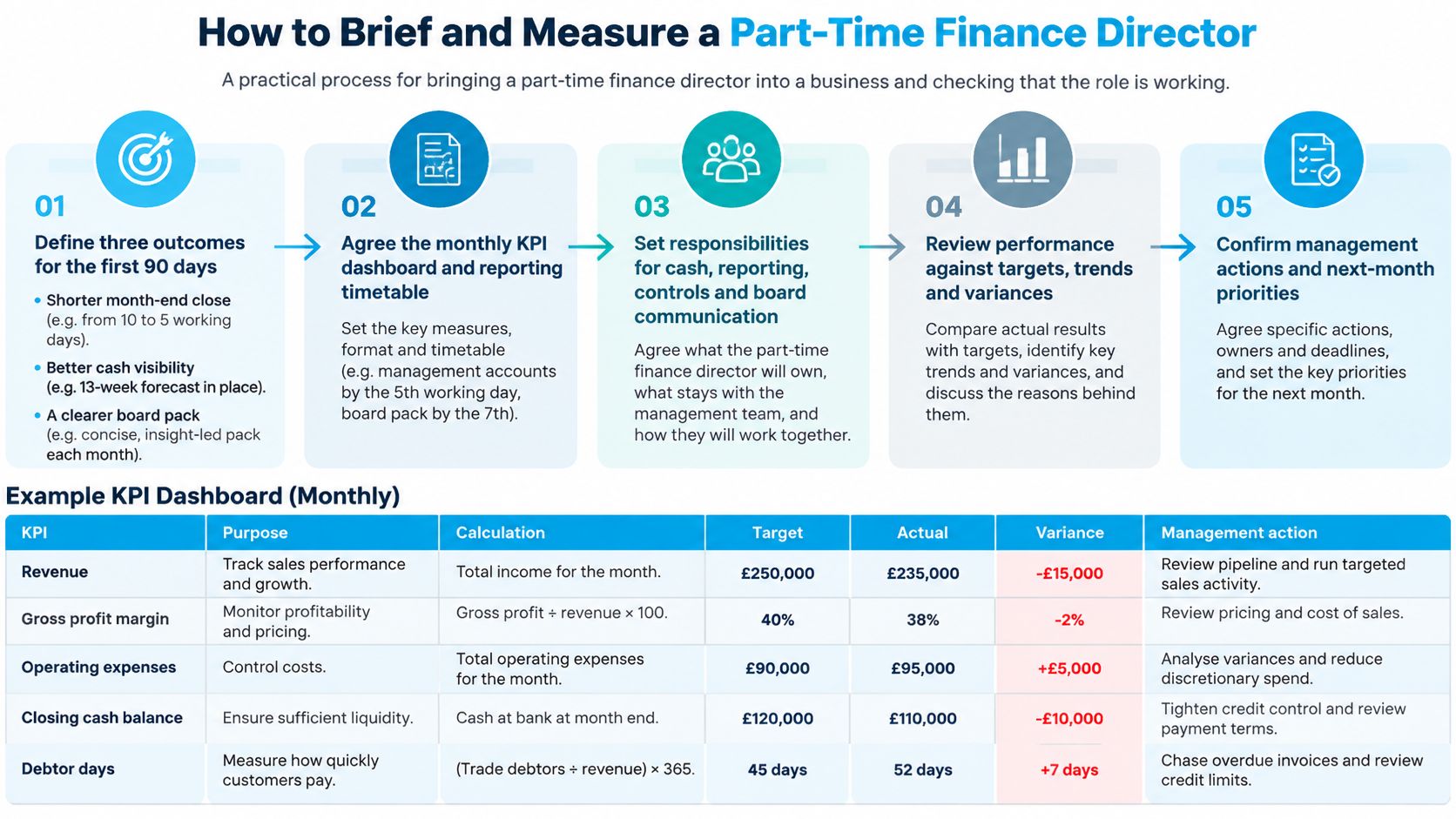
Define three outcomes for the first 90 days. Shorter debtor days, a working 13-week cash forecast, and VAT returns filed on time are concrete. "Improve the finance function" is not.
Agree the reporting pack and its calendar. The board should see the same format, on the same date, every month, with variance commentary attached. A consistent board pack structure is what makes month-on-month comparison possible.
Build the year-end timetable. Work backwards from the filing deadline in the table above, and set internal sign-off dates several weeks earlier so there is room to fix what the review uncovers.
Document decision rights. List which spending, pricing and credit decisions the finance director approves alone, which need board sign-off, and which stay with the managing director. Ambiguity here causes more friction than capability gaps.
Schedule the strategy and tax planning meetings. Compliance does not manage itself either. A dedicated accountant keeps filings on time and holds the regular strategy and tax planning meetings, which is the division of labour that lets the finance director concentrate on decisions.
Measures that show whether it is working
Review at 30, 60 and 90 days against four measures: debtor days against target, forecast accuracy compared with actual cash, on-time filings, and the number of board decisions informed by the new reporting. That last one is the key test.
Measuring the role by hours worked rewards attendance over outcomes. Measure the decisions instead.
Protect the knowledge
Require a written handover plan at the outset. Process notes, the control calendar, access to the forecast model and a decision-rights register should live in the business, not in the finance director's head. Engagements end, sometimes abruptly, and the controls need to survive the exit.
Common Questions About Part-Time Finance Directors
How much does a part-time finance director cost?
Fees depend on the engagement model, the days committed and the scope, so no single figure applies. Compare the fee with the cash, tax or management time it protects rather than against a salary. A retainer costing £30,000 a year that releases £150,000 of working capital is cheaper than a full-time hire that costs more and starts three months later.
How many days a month does a part-time finance director work?
A retainer usually sets scheduled days each month, commonly clustered around month end and the board meeting. The first 90 days typically need more time while the forecast, reporting pack and controls are built. A project engagement runs to its defined scope and then ends, rather than tapering indefinitely.
Is a part-time finance director the same as a fractional CFO?
There's substantial overlap. A CFO typically leads strategy, funding and investor relations, while a finance director often runs the finance function, reporting and controls. Many providers use both titles, so the useful question is which outcomes sit in scope and who holds decision authority, not which label appears on the agreement.
Can a part-time finance director replace my accountant?
Rarely. Statutory filing, year-end accounts and tax returns usually still need an accountant, while the finance director owns forecasting, credit control, financial decisions and board reporting. The two should coordinate closely, sharing one reporting calendar. Replacing compliance work entirely is a decision to review separately.
The engagement review described in the next section is the quickest way to establish which of these applies.
Book a 30-Minute Finance Leadership Review
The outcome of the call is a clear view of three things: where cash is leaking, which tax deadlines need cash reserved, and whether a part-time finance director would close the gap or whether a bookkeeper and a better reporting rhythm would do the job.
What follows the conversation is structured. A chartered, senior Implementation Accountant initially looks after new clients and builds the processes, financial information and service that suit them; after three months of dedicated onboarding, clients are handed over to a dedicated accountant. Reporting then covers management accounts, cashflow forecasts, budgets, burn rates and KPI tracking, sized for a business turning over £1 million to £15 million.
Book a 30-minute finance leadership review and bring the last three sets of management accounts and the current cash balance. If reading this has raised questions about scope rather than timing, contact the team with the details and the review can be framed around them. The call takes 30 minutes.
This article is for informational purposes only and does not constitute professional advice. Tax rules apply as of April 2026. Consult a qualified accountant for your specific circumstances.
Ready to get a clearer view of your cash and next decisions? If your management accounts tell you what happened but not what to do next, contact the striveX team for a no-obligation consultation. Bring your latest management accounts and the questions keeping you up at night. Together, you can work out whether you need senior finance support or a better reporting rhythm.