

A profitable subsidiary and a loss-making subsidiary often sit side by side in the same UK group, and the finance team is left deciding which entity should carry the tax pain. Without group relief for Corporation Tax, the profitable company pays tax as if the other company's losses didn't exist, while the group's cash stays trapped in the wrong place. That is why this relief matters commercially, it lets one company's current-period losses reduce another company's current-period profits, so the group's overall tax bill can fall in the year the numbers arise.
For many multi-entity businesses, that timing is the point. The loss doesn't need to sit idle until some future year if the group can use it now, provided the structure and paperwork line up. HMRC's official monitoring shows this is widely used, with group relief received claimed by around 67,337 companies in one year and rising to 75,539 in another, with other recent years at 72,411, 67,874, 67,391, and 66,973 claims (HMRC Corporation Tax Statistics). That volume tells its own story, this is a mainstream cash flow tool for UK groups, not a niche technical point.
A clean group relief process also supports better forecasting. When the tax team can see where profits and losses sit across the group, the board gets a more accurate view of Corporation Tax outflows and less year-end noise. For practical workflow discipline around this sort of planning, Wisely's tax workflow expertise is a useful reference point for how structured tax processes can support busy finance teams.
Why Group Relief Matters for Multi-Entity Businesses
A group rarely has every company moving in the same direction at once. One subsidiary may be profitable from steady trading, while another is absorbing launch costs, new premises, or restructuring spend and drifting into a loss. If those companies are eligible to share losses, the profitable member can absorb the loss now, rather than carrying a tax bill that ignores the group's wider reality.
That matters because group relief for Corporation Tax is not a theoretical concession. The legislation says the claimant company gets a deduction from its total profits for the claim period once a valid claim is made (Corporation Tax Act 2010, Part 5). In plain terms, the surrendered loss is turned into a lower taxable profit inside the claimant company, which is what produces the cash saving.
Practical rule: if the group can move a loss into a profit-making company in the same period, it should usually do that before year end planning becomes a hindsight exercise.
This is also why the relief is central to cash flow rather than just compliance. A group with several UK companies may technically be profitable overall, but still have one entity under pressure and another carrying the tax burden. Group relief helps rebalance that mismatch, so the tax charge follows the group's real economic position more closely.
Commercially, that can free up funds for stock, payroll, debt service, or investment. It won't fix every loss-making company, and it won't create a tax benefit where none exists, but it can stop losses sitting idle in the wrong legal entity. For a Finance Director, that difference is often the gap between efficient planning and unnecessary tax leakage.
Qualifying for Group Relief
The ownership test is where many groups find they are closer than they thought, or farther away than they assumed. HMRC's technical rule for standard group relief is a 75% group relationship, which means one company must be a 75% subsidiary of another, or both must be 75% subsidiaries of a third company. That test is based on beneficial ownership of ordinary share capital, and in some cases it also looks at entitlement to profits and assets.
What the 75% test means in practice
A direct holding is the cleanest case. If Parent Co owns enough of Subsidiary A to meet the statutory threshold, and the rest of the group relationship is intact, those two companies may be able to share losses. Indirect ownership can also work, but only if the beneficial ownership still passes through the chain in the right way.
That is why the share register alone is not enough. Finance teams need to understand who owns what, how much of the ordinary share capital is held, and whether any step in the chain breaks the 75% relationship. A reorganisation, a share issue, or a partial disposal can change the position quickly, which is exactly where timing traps start to bite.
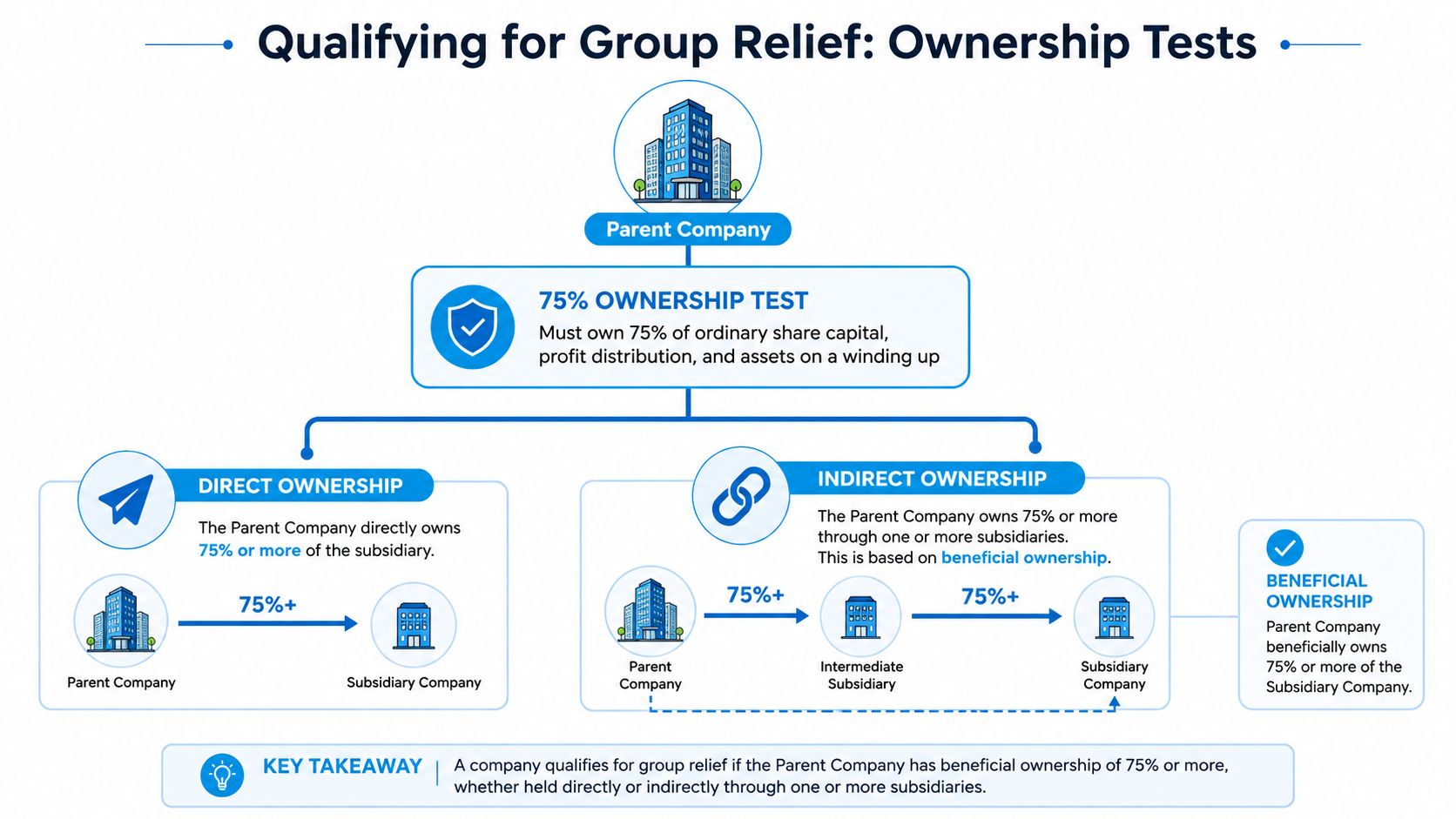
A useful habit is to map the group as HMRC sees it, not as the board discusses it. Legal titles, voting rights, and profit entitlements can point in different directions if the structure has become untidy.
When the answer is no
If the 75% threshold is not met, standard group relief usually is not available. In those situations, a group may need to look at other forms of loss sharing, but the structure has to support the claim first. The best time to check is before a year end, not after the accounts are signed and the tax computation is already fixed.
The practical takeaway is simple. If ownership has moved during the year, or the group uses multiple holding companies, the relief position needs reviewing alongside the Statutory Accounts and the corporation tax provision. That is where groups often find avoidable friction, because the tax claim can fail even though the commercial relationship between the companies looks obvious.
How Group Relief Claims Work in Practice
HMRC treats group relief as a profit-matched claim, not a free transfer of losses. The maximum claim is capped at the lower of the surrendering company's surrenderable amounts and the claimant company's available total profits (HMRC CTM80105). That means the relief only works to the extent that a loss can meet actual taxable profits in the receiving company.
A simple worked example
If one company has a loss and another company has profit in the same period, the surrendering company can give up part or all of that loss, subject to the cap. The claimant company then deducts the surrendered amount from its total profits, which lowers the Corporation Tax computation. The precise amount claimed depends on the figures in each company, and on whether the periods align cleanly.
| Group Relief Calculation Example | Company | Trading Profit/(Loss) | Other Profits | Total Profits | Group Relief Claimed | Taxable Profits |
|---|---|---|---|---|---|---|
| Example within one group | Company A | £100,000 | £0 | £100,000 | £30,000 | £70,000 |
| Example within one group | Company B | (£30,000) | £0 | (£30,000) | £30,000 surrendered | £0 |
The commercial point is straightforward. Company A's taxable profits fall because it receives the surrendered amount, and Company B's loss is put to work instead of staying stranded. That reduces the group's overall Corporation Tax in the period, provided the claim is valid.
What makes the calculation messy
The calculation becomes less tidy when accounting periods don't line up neatly across the group. A company might have a shorter period, a different year end, or a transaction that changes profits mid-year. In those cases, the tax team has to be careful about what falls into the claim period and what doesn't.
A good control is to reconcile profits, losses, and year-end dates before deciding what to surrender. If the numbers are assembled too late, the group may miss the chance to use the loss in the period where it would have done the most good. For commercial planning around wider loss relief options, a related discussion sits in corporation tax planning for growing businesses.
Making and Withdrawing Group Relief Claims
A group relief claim can save cash in the current period, but only if the paperwork and the timetable are handled properly. HMRC requires the claim to be made in writing and for the surrendering company to consent to it, so the process is administrative as well as technical, as set out in HMRC CTM97060. In practice, that means the tax team needs to treat the claim as a formal group decision, not as an internal adjustment to be tidied up later.
The procedural steps that matter
The claimant company usually drives the process, but the surrendering company still has to agree. If that consent is missing or poorly documented, the claim can fail even where the companies are otherwise within the group relief rules. For a Finance Director, the commercial risk is simple, the group loses the chance to set a current loss against current profits, and the cash stays trapped in the wrong company.
A claim that looks obvious on the numbers can still be overturned by weak process. HMRC does not relax the formalities because the group intended to do the right thing.
Timing is just as important. Under CTSA, HMRC says claims can be made or withdrawn only up to the latest of four dates, including the first anniversary of the claimant company's filing date, or 30 days after an HMRC enquiry is completed, amended, or finally determined on appeal, as set out in HMRC CTM97060. Once those limits pass, the group may no longer be able to change the position, even if the original filing no longer matches the commercial reality.
Timing traps that catch groups out
The usual mistake is leaving the claim until the return has already been treated as finished. By then, the team may have less room to correct the numbers, and a useful claim can become a missed opportunity for the period that mattered most. Another common failure is assuming consent can be inferred from the group relationship itself. HMRC expects the surrendering company's agreement to be there in writing, not just understood informally.
A third trap is leaving review until an enquiry has started. At that point, the deadline pressure tightens, and the group may find it has far less flexibility than expected to make or withdraw the claim.
For a Finance Director, the control is straightforward. Build group relief into the year-end timetable, identify the claimant and surrendering companies early, and keep the written consent with the final computation and supporting numbers. That discipline protects the claim from avoidable challenge and helps the group use losses in the period where they produce the most cash flow benefit.
Group Relief Versus Other Loss Relief Options
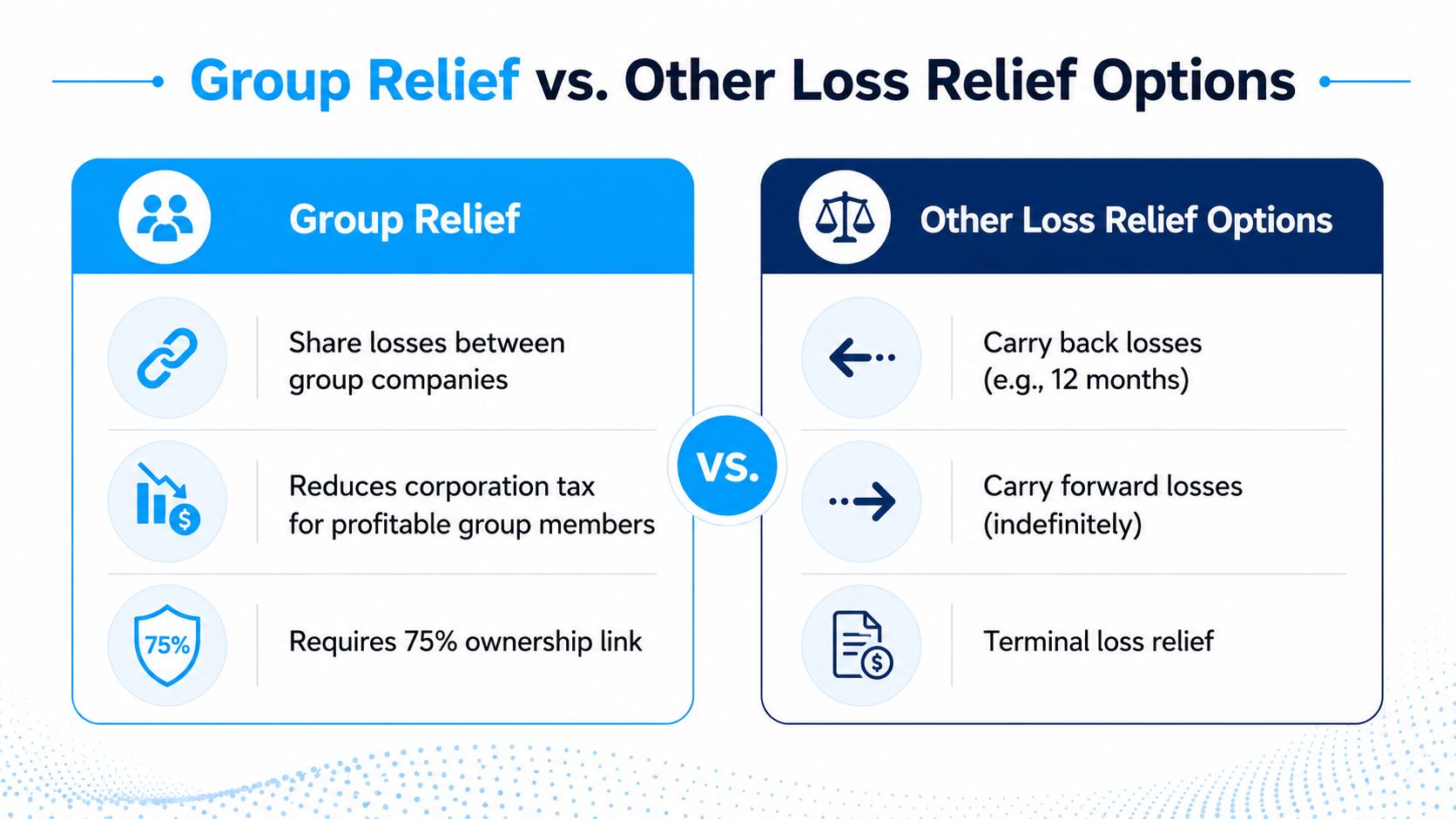
Group relief is useful because it solves a same-period problem. Other loss relief options solve different problems, and the wrong choice can leave cash locked away for longer than necessary. Where the group has current-year profits in one company and current-year losses in another, group relief is usually the cleanest route because it moves value across the group immediately.
How the options differ commercially
Loss carry back is useful when there were earlier profits in the same company, and a group wants to recover tax already paid. Loss carry forward matters when the loss company expects future profits, but that only helps later. Group relief sits in the middle, because it can relieve current-period profits now rather than waiting for another accounting period.
That matters when cash flow is tight. A profitable company can't always wait for the loss-making company to turn the corner, and a loss-making company doesn't always have its own historic profits to offset. Group relief fills that gap where the ownership and consent requirements are satisfied.
A useful outside reference for groups weighing loss relief choices is Stewart Accounting Services corporation tax advice, particularly where the group also needs to think about how historic losses and current-period profits interact.
Where groups go wrong strategically
The common mistake is choosing one relief route too early. A company may carry a loss forward by habit, even though another group company is sitting on profits that could have absorbed it now. Another company may focus only on one entity's return and forget the group-wide picture.
Commercially, the best choice depends on three things: the profit profile, the timing of the loss, and whether the companies qualify to share it. If the structure supports it, group relief is often the most direct way to reduce the current Corporation Tax bill and improve near-term cash flow.
Common Mistakes That Cost Groups Their Relief
The losses do not usually disappear because the group misunderstood the policy. They are more often lost because someone missed a practical step, then discovered the error after the filing window had started to close. In a live finance process, that means avoidable tax leakage and a slower return of cash to the group.
The first pressure point is consent. Group relief depends on a written claim and the agreement of the company giving up the loss, so an informal sign-off inside the finance team is not enough. The second is the group relationship itself. A structure can look connected commercially and still fail the ownership test, which leaves the intended surrender outside the rules.
The traps that recur most often
- Missing surrendering company consent: the claim needs clear agreement from the company surrendering the loss, not just an internal note or an assumption that everyone is aligned.
- Misreading the ownership chain: a group can look straightforward on the org chart and still fail the required control test.
- Leaving the claim too late: once the deadline has passed, a claim that would otherwise have been valid can be lost.
- Ignoring accounting period alignment: the loss has to fall into the correct period before it can be surrendered properly.
- Trying to surrender the wrong items: only amounts that meet the group relief conditions should be included, which is why the workings need checking before anything is signed off.
The timing issue matters just as much as the technical one. If the claim is wrong, the finance team should first check the deadline and the supporting papers, then decide whether the problem can still be fixed. Once the window has closed, the options narrow quickly, and the group may have to carry a tax cost it expected to avoid.
That is why group relief should sit inside the close process, not as a tidy-up task after the return is already on the way out. A short review against the HMRC tax check guidance can help finance teams spot filing and compliance pressure points before they become missed relief.
Maximising the Commercial Value of Group Relief
The value of group relief for Corporation Tax is not the rule itself, it's the timing. Used properly, it turns one company's loss into another company's tax deduction in the same period, which supports cash flow and reduces avoidable tax leakage. Used badly, it becomes a missed opportunity that only shows up after the return is filed.
A sensible Finance Director checklist is simple. Confirm the ownership chain, align the periods, secure written consent, and review which company should surrender and which should claim. For groups planning acquisitions, disposals, or restructures, a specialist review before the change lands can protect eligibility and keep the relief available. For a structured review of tax efficiency across the group, tax efficiency reviews can help identify where losses and profits should be matched before deadlines close in.
This article is for informational purposes only and does not constitute professional advice. Tax rules apply as of April 2026. Consult a qualified accountant for your specific circumstances.
If your group has profits in one company and losses in another, striveX Ltd can review the ownership structure, the claim mechanics, and the timing risk before year end. Visit striveX Ltd to arrange a practical Corporation Tax review and make sure your group relief position is being used properly.
