


A business can be profitable on paper and still feel financially unclear day to day. Orders are moving, the team is busy, turnover has climbed past the early-stage phase, yet key decisions still depend on last quarter’s numbers, rough instinct, and a year-end meeting that arrives too late to influence anything important.
That’s where many businesses in the £1 million to £15 million bracket get stuck. The accounts are filed. Tax returns go in. Payroll runs. But the finance function isn’t helping leadership decide whether to hire, invest, borrow, reprice, or hold back.
That gap is exactly where finance consultancy services matter. The shift isn’t from “bad accounting” to “better accounting”. It’s from reactive reporting to active commercial guidance. For an MD, FD, or CFO, that changes the quality of decisions across cash flow, profit, and growth.

Introduction When Your Accountant Becomes a Historian
A common pattern shows up once a business moves beyond the founder-led scramble and into a more complex growth stage. The external accountant still does what they were originally engaged to do. Statutory Accounts, tax returns, compliance queries, and year-end tidy-up. The problem is that the leadership team now needs something else.
They need someone who can interpret the numbers while there’s still time to act on them.
If the most detailed financial conversation happens after the Year End, the finance function has become historical. It can explain what happened, but it can’t support pricing decisions in the current quarter, challenge a hiring plan before costs land, or test whether a new contract will improve cash.
Practical rule: If management only sees meaningful financial analysis after decisions have already been made, finance is reporting history rather than shaping outcomes.
That’s often the ceiling for growing SMEs. The business is too substantial to run on gut feel alone, but not yet large enough to justify a full in-house finance leadership team with broad commercial depth.
Finance consultancy services sit in that gap. Done properly, they don’t just keep the business compliant. They give directors a working model for decision-making. Which customers are profitable. Which overheads are drifting. Which tax choices are sensible. Which forecasts are strong enough to support growth, rather than describe ambition.
Beyond Compliance The Strategic Role of Finance Consultancy
Traditional accountancy still matters. No serious business can ignore compliance, reporting, and tax obligations. But compliance on its own won’t tell a board whether expansion is affordable, whether margin erosion is creeping in, or whether current working capital can support a larger sales pipeline.
That’s why finance consultancy services are different in both purpose and rhythm.
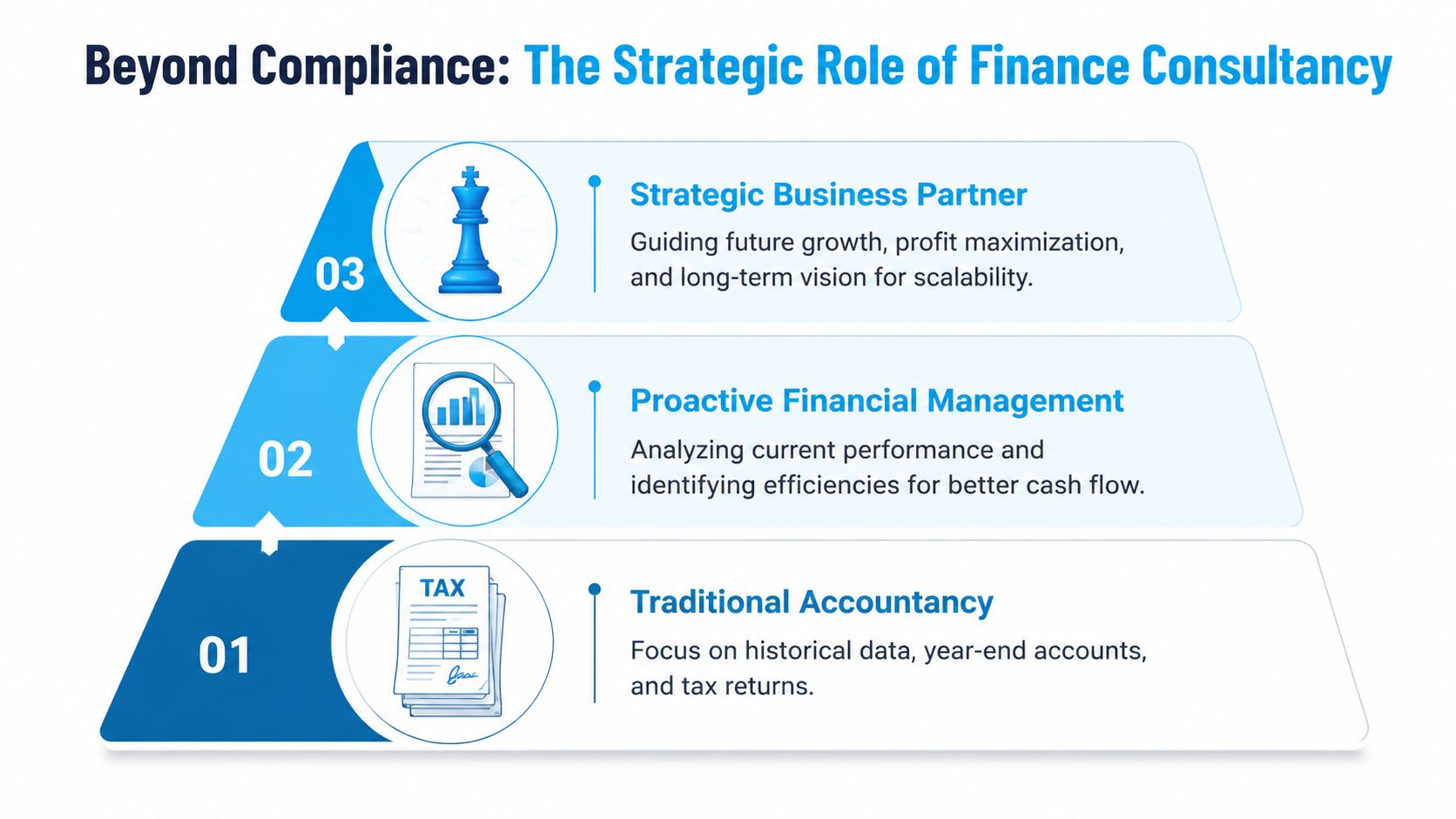
Rear-view mirror versus active navigation
Compliance accounting is a rear-view mirror. It records accurately. It confirms obligations. It provides an important record of where the business has been.
Finance consultancy is closer to navigation. It uses current financial signals to help leadership choose the next move. That means looking forward, not just backwards.
For most scaling businesses, that shift shows up in questions such as:
- Cash timing: Are profits converting into cash quickly enough to fund growth?
- Margin quality: Which products, customers, or projects carry the strongest contribution?
- Tax position: Can remuneration, investment timing, or group structure be arranged more efficiently?
- Decision risk: What happens if sales slip, costs rise, or payment terms lengthen?
A finance consultancy partner should be able to move comfortably between the detail and the boardroom. They should understand bookkeeping accuracy, but also challenge whether the commercial model still works.
What the strategic role looks like in practice
The practical difference is simple. Instead of waiting for a question, the adviser brings one first.
That may mean spotting a squeeze in debtor days before payroll pressure appears. It may mean challenging a sales push that looks healthy at turnover level but weak at gross margin level. It may mean building a forecast that tests whether a planned investment creates short-term strain before it creates long-term benefit.
A finance partner earns trust by making decisions clearer, not by producing more paperwork.
For leadership teams trying to apply situational analysis to your business, this forward-looking approach matters because finance is rarely an isolated function. Commercial pressure, operational capacity, hiring plans, tax exposure, and cash all interact. Looking at one in isolation usually creates avoidable mistakes.
The Core Services That Fuel Business Growth
Finance consultancy services aren’t one line item. They’re a connected set of capabilities that turn finance from an admin function into an operating advantage. For businesses in the target turnover range, a handful of services usually have the greatest commercial effect.
Outsourced FD and board-level support
An Outsourced Finance Director (FD) gives a business senior financial judgement without the commitment of a full-time appointment. That matters when the business needs sharper decisions but doesn’t yet need, or can’t yet justify, permanent in-house finance leadership at that level.
The role goes beyond reviewing numbers. A strong outsourced FD helps leadership frame the right commercial questions, pressure-test plans, and create accountability around targets.
Typical areas of value include:
- Decision support: Reviewing hiring plans, capex, pricing moves, and funding choices before they hit the P&L.
- KPI design: Focusing management on the handful of measures that influence profit and cash.
- Board communication: Turning financial detail into clear options for directors and shareholders.
Weak providers often fail by staying too close to technical accounting and never influencing live decisions. A proper FD-level service should challenge assumptions, not just summarise them.
Management reporting that helps someone act
Many management accounts are technically correct and commercially useless.
If a report arrives too late, buries the important point, or repeats a trial balance in cleaner formatting, it won’t help leadership improve performance. Good management reporting isolates movement, explains why it happened, and points to likely action.
Useful reporting often includes:
- Trend analysis: Revenue quality, gross margin movement, overhead drift, and cash conversion.
- Segment insight: Department, service line, contract, site, or customer-level performance where relevant.
- Forward view: Forecast updates rather than a pure historic snapshot.
A leadership team doesn’t need more pages. It needs better signal.
For businesses that want a clearer planning discipline, a structured approach to cash flow forecasting often becomes the point where finance starts influencing decisions in real time.
The best monthly report usually creates an uncomfortable but useful conversation. That’s how margin leaks, stock issues, or over-optimistic sales assumptions get caught early.
Strategic tax planning that protects working capital
Tax compliance is about filing correctly. Strategic tax planning is about making commercial decisions with tax consequences in mind before the deadline arrives.
That can include:
- Corporation Tax planning: Timing expenditure, investment, and profit extraction sensibly
- VAT planning: Avoiding preventable errors in treatment, registration, and cash timing
- PAYE and remuneration: Structuring director and shareholder pay in a way that supports both cash and tax efficiency
What doesn’t work is treating tax as a year-end tidy-up. By that stage, most of the meaningful choices have already been made. The businesses that manage this well bring tax into planning conversations earlier, especially around growth, restructuring, asset purchases, and owner remuneration.
R&D claims and specialist reliefs
A surprising number of businesses do technically advanced work without realising it may qualify for relief. Others assume their activity qualifies, but don’t document it thoroughly enough.
The commercial point isn’t the form itself. It’s whether a specialist process can identify qualifying work, translate it properly, and secures a vital cash injection or a reduced tax burden without creating unnecessary risk.
This tends to matter most where the business develops processes, software, systems, engineering improvements, or technical solutions as part of normal commercial delivery.
Cloud bookkeeping and automation as the foundation
Strategic advice is only as good as the underlying data. If the numbers are late, inconsistent, or manually patched together every month, decision-making will always lag behind the business.
That’s why cloud bookkeeping and automation matter. Not because software is exciting, but because clean live data gives management a usable picture of current performance.
The outcome is practical:
- Faster month-end visibility
- Better cost coding and fewer manual workarounds
- Less internal time spent chasing paperwork
- More confidence in the numbers used for planning
At this level, finance consultancy services work best as an integrated system. Reporting depends on clean data. Tax planning depends on visibility. FD support depends on timely information. Weakness in one area usually limits the value of the others.
Measuring the Return How Consultancy Impacts Your Bottom Line
The return from finance consultancy rarely appears as a single neat line item. It shows up across better cash discipline, stronger margins, fewer avoidable tax leaks, and more confident decisions under pressure.
That’s why it shouldn’t be viewed as a pure overhead. In a growing business, the finance function either sharpens performance or allows value to slip.
Cash improves when visibility improves
Many directors first feel the value of consultancy through cash flow. Not because the business suddenly becomes more profitable overnight, but because it starts managing timing better.
That often comes from a few changes working together:
- Better forecasting: Spotting pressure early enough to respond
- Working capital discipline: Tightening debtor follow-up, stock decisions, and supplier timing
- Commercial planning: Testing whether new work improves cash or merely adds activity
For readers looking at practical ways to achieve and sustain positive cash flow, the key point is that cash strength usually comes from routine control, not heroic last-minute fixes.
Margin loss is easier to stop early than recover later
One of the clearest financial gains comes from seeing deterioration early. A management team can usually fix a margin issue in motion. It’s much harder to recover it once it has worked through several months of trading.
A common example is operational cost creep. Distribution, subcontractor, fulfilment, staffing, discounting, or project overruns can all erode profit without triggering alarm if reporting is too broad or too late.
That’s where structured KPI tracking and reporting becomes commercially useful. It helps management focus on movement in the drivers beneath the headline profit figure, not just the final result.
Good consultancy doesn’t just explain why profit fell. It identifies the pressure while there’s still time to protect it.
Tax planning creates value when it happens before decisions are fixed
Strategic tax support has a direct commercial effect because tax is one of the largest controllable outflows in many owner-managed businesses. The important word is controllable. Not avoidable, not speculative, just manageable through better planning.
A Midlands-based manufacturing client might, for example, need guidance on investment timing, asset treatment, group structure, remuneration, or the consequences of extracting profit in one way rather than another. The gain comes from structuring decisions in advance, while there are still options available.
The less obvious return is decision quality
The final return is harder to measure but often more significant. Leadership teams move faster when they trust the numbers. They can challenge underperformance earlier, negotiate from a stronger position, and invest with more confidence.
That matters for fundraising, succession, acquisition planning, and eventual sale as much as it matters for day-to-day trading. Buyers, lenders, and investors don’t just look at historical accounts. They look for a business that understands its model, monitors performance, and can explain future assumptions with credibility.
How to Select the Right Finance Consultancy Partner
The wrong adviser usually looks acceptable at the start. Meetings sound polished. Deliverables look tidy. The issue only shows up later, when the reporting doesn’t influence decisions, communication slows down, and the advice never really moves beyond compliance.
A useful selection process should test how the firm thinks, not just what services sit on its website.
What to ask before appointing anyone
Use a practical checklist. The strongest answers are usually specific and commercial rather than technical and vague.
- Commercial judgement: Ask how they help leadership improve profit, cash flow, or decision-making. If every answer returns to filings and deadlines, that’s a warning sign.
- Sector understanding: Ask what issues they commonly see in your kind of business. Different sectors carry different pressures around stock, contract timing, utilisation, project overruns, or recurring income.
- Operational fit: Ask how they work with internal staff. A good partner should strengthen the existing team, not create friction or duplicate effort.
- Communication rhythm: Ask what happens monthly, quarterly, and at Year End. If there’s no clear cadence, proactivity usually won’t appear later.
- Technology competence: Ask how they improve data quality, reporting speed, and process discipline. Good advice depends on reliable finance operations.
A partner worth appointing should be able to describe how they’ll help the business make better decisions within the first quarter, not just what documents they’ll produce.
Common Finance Consultancy Pricing Models
| Model | Best For | Typical Cost Structure |
|---|---|---|
| Monthly retainer | Ongoing advisory, management reporting, regular leadership support | Fixed monthly fee linked to scope and complexity |
| Project fee | Forecasting projects, finance process redesign, transaction support | One-off agreed fee for a defined piece of work |
| Specialist success-linked fee | Relief claims or targeted advisory work with a clear claim outcome | Fee tied to scope, with terms agreed in advance |
| Hybrid model | Businesses needing a core monthly service plus ad hoc support | Monthly base fee with separate project pricing |
Price matters, but structure matters more. A cheap retainer that never reaches the boardroom is expensive in practice. A clear monthly fee linked to defined outputs, meetings, and responsibilities is usually easier to manage.
What a sensible onboarding process should include
Onboarding should feel structured, not rushed. The consultancy needs enough context to advise properly, and leadership needs clarity on who owns what from day one.
A strong process usually includes:
- Initial diagnostic review of current finance reporting, tax position, systems, and leadership priorities
- Data and process handover so records, deadlines, and responsibilities are clear
- Goal setting aligned to commercial outcomes such as cash visibility, margin improvement, or board reporting
- A short implementation plan for the first phase of work
For businesses comparing options, it often makes sense to book a free consultation and test whether the discussion quickly gets into commercial substance. That first conversation should feel like the start of problem-solving, not a generic sales call.
Putting Strategy into Practice with striveX
The most effective finance consultancy services do one thing well. They connect accurate financial data with commercial action. That’s the point where finance stops being a back-office necessity and becomes part of how the business grows.
For companies that have outgrown purely reactive support, the priority is usually the same. Better visibility. Better planning. Better financial leadership without unnecessary complexity.
One option in that market is outsourced finance director services, which combine strategic oversight with ongoing financial control. That model suits businesses that need stronger board-level input but don’t want to build a full senior finance function internally yet.
The difference in practice comes from integration. A consultancy partner should understand how tax planning, management reporting, forecasting, and leadership decisions affect each other. If those parts are handled in isolation, the advice often stays fragmented.
At striveX, the focus is on closing the gap between compliance and commercial decision support for UK businesses in the £1 million to £15 million bracket. The aim isn’t to add more finance process for its own sake. It’s to give directors clearer choices, earlier warnings, and a finance function that supports scale.
This article is for informational purposes only and does not constitute professional advice. Tax rules apply as of April 2026. Consult a qualified accountant for your specific circumstances.
Frequently Asked Questions
At what turnover should I consider finance consultancy?
There isn’t a single trigger point, but businesses approaching £1 million in turnover often start to feel the need for more forward-looking financial support. A key sign is complexity. If cash is tighter to manage, decisions carry more weight, or reporting feels too backward-looking, it’s time to consider it.
Is a finance consultancy a replacement for my bookkeeper?
Not always. In many cases, the two roles work together. The bookkeeper maintains accurate records and daily processing, while the consultancy turns that information into analysis, planning, and leadership support.
How much do finance consultancy services cost for an SME?
Costs vary by scope, sector, and how much strategic input is required. Some businesses need ongoing monthly support, while others need project-based work. Pricing is usually clearer and more useful when linked to defined outcomes, reporting cadence, and decision support requirements.
What’s the difference between finance consultancy and standard accountancy support?
Standard accountancy support usually centres on compliance and historical reporting. Finance consultancy services focus on current performance, forward planning, and the financial choices that shape profit, cash flow, and growth.
If your finance function is still telling you what happened after the fact, it may be time for a different level of support. striveX Ltd works with growing UK businesses that need clearer reporting, stronger cash control, and commercially focused financial guidance. A conversation can quickly show whether the current finance setup is helping the business scale or holding it back.
