
Choosing an accountant for your hospitality business can feel like you’re speaking a different language. A general firm might understand Corporation Tax, but they’ll be completely lost when it comes to the unique financial pressures and opportunities in your sector.
For a business turning over between £1 million and £15 million, this isn’t just a small inconvenience—it’s a major commercial risk. A specialist team of accountants for hospitality is not a luxury; it’s essential for survival and growth in a competitive UK market.
Why Generic Accountants Put Hospitality Businesses at Risk
Relying on a generalist accountant for a complex hospitality operation is like asking a GP to perform open-heart surgery. They’re both professionals, but only one has the deep, specific knowledge to handle what’s in front of them. In the same way, only specialist accountants have the financial expertise your business truly needs to grow and stay profitable.
A standard chart of accounts used by a generalist simply won’t cut it. It completely misses the critical performance metrics that actually determine your profitability, such as:
- RevPAR (Revenue Per Available Room)
- TRevPAR (Total Revenue Per Available Room)
- GOPPAR (Gross Operating Profit Per Available Room)
- Average Daily Rate (ADR)
- Food and beverage cost percentages
Without tracking these KPIs, you’re flying blind. You have no real way to measure your performance or make smart, strategic decisions that drive commercial success.
The Real-World Financial Consequences
The dangers of a non-specialist approach become painfully obvious in day-to-day operations. A general accountant is far more likely to make critical mistakes that directly eat into your profits and create compliance nightmares.
For example, getting VAT wrong on mixed-rate sales of food, drink, and accommodation can lead to a surprise bill from HMRC for tens of thousands of pounds.
Mishandling a tronc system for tips not only risks severe penalties but can also destroy staff morale and retention—a huge issue in such a people-focused industry.
Worse still, a generalist rarely understands how to model for the dramatic seasonal cash flow swings common in hospitality. This leaves you unprepared to cover fixed costs like rent and PAYE during the quiet months, putting your entire financial stability at risk.
To show just how different the approaches are, here’s a quick comparison.
Generalist vs Specialist Hospitality Accountant Approach
| Financial Area | General Accountant Approach (High Risk) | Specialist Hospitality Accountant Approach (Strategic Advantage) |
|---|---|---|
| VAT | Applies standard rates, often missing complex mixed-supply rules for food, drink, and rooms. High risk of HMRC penalties. | Manages complex partial exemption and mixed-rate calculations correctly, protecting you from large, unexpected tax bills. |
| Payroll & Tipping | Often misinterprets tronc rules, risking compliance failures and damaging staff trust. | Implements and manages a compliant tronc system that boosts staff morale and ensures you meet all legal obligations. |
| Cost Control | Tracks basic costs but misses industry-specific metrics like food, beverage, or labour cost percentages. | Provides detailed analysis of Gross Profit margins, cost of goods sold, and labour costs to pinpoint waste and improve profitability. |
| Cash Flow | Uses generic forecasts that fail to account for seasonal peaks and troughs, leaving the business exposed during quiet periods. | Creates detailed, season-aware cash flow models to ensure you have the funds to cover liabilities all year round. |
| Reporting | Provides a standard Profit & Loss and Balance Sheet, offering no real operational insight. | Delivers custom management accounts with industry KPIs (RevPAR, GOPPAR, ADR) that show you exactly how your business is performing. |
The difference is clear: one approach is purely about compliance, while the other is about creating a strategic advantage.
The UK hospitality sector has seen a huge shift as businesses realise they need industry-specific financial expertise. The consensus is that these operations have uniquely complex finances, with multiple revenue streams that generalists just aren’t equipped to handle effectively. You can read more on specialised accounting in the hospitality industry to understand these differences in more detail.
Ultimately, using a generic accountant isn’t just a missed opportunity to make your finances work harder. It actively introduces risk into your business, threatening your profits and long-term survival in a tough market. A specialist, on the other hand, turns these complex challenges into opportunities for growth.
Navigating the Financial Maze of Hospitality Operations
If you’re running a hospitality business, a standard accountant just won’t cut it. The general rules of finance simply don’t apply to a sector with so many unique, moving parts. This is where a specialist hospitality accountant stops being a “nice-to-have” and becomes your most important competitive advantage.
It’s not about recording history; it’s about gaining real-time commercial control. Four areas, in particular, separate the businesses that thrive from those that just survive: VAT, payroll, cost control, and cash flow. Get these wrong, and you’ll find your margins disappearing. Get them right, and you build a resilient business that can handle whatever the market throws at it.
Untangling Complex VAT Rules
VAT in hospitality is a minefield. A generalist accountant might see a sale and apply a standard 20% rate. A specialist knows it’s rarely that simple.
They understand the nuances of mixed-rate supplies—correctly splitting out VAT on food (which can be zero-rated or standard-rated), alcoholic drinks (standard-rated), and accommodation (standard-rated). If you offer packages, the Tour Operators Margin Scheme (TOMS) adds yet another layer of complexity. Misinterpret these rules, and you’re looking at a hefty bill from HMRC, or worse, a full-blown investigation.
Scenario: A boutique hotel was running a ‘dine and stay’ package, with their accountant applying a blanket 20% VAT rate to the whole lot. A specialist review quickly flagged that different parts of the package had different VAT treatments. The correction saved the business over £12,000 a year and dodged a future compliance nightmare.
Mastering Payroll and Tronc Systems
Hospitality payroll is so much more than a monthly salary run. You’re juggling fluctuating hours, high staff turnover, and the notoriously tricky rules around tips and service charges. A poorly managed tronc system is one of the biggest compliance risks in the entire sector.
HMRC has very strict guidelines on how tips must be managed to fall outside of National Insurance contributions. Get it wrong, and you not only lose the tax benefits but also destroy team morale. A correctly run, independent tronc system is a powerful tool for attracting and keeping great people.
Controlling Cost of Goods Sold
With razor-thin margins, your Cost of Goods Sold (COGS)—especially food and drink—is where profitability is won or lost. This isn’t just about tracking supplier invoices; it’s about granular, daily control.
A specialist will help you build systems to rigorously monitor:
- Menu Engineering: Analysing the true profit of every single dish you sell.
- Portion Control: Driving consistency and cutting out needless waste.
- Stock Management: Spotting spoilage, reducing waste, and identifying potential theft.
- Supplier Pricing: Benchmarking your costs to make sure you’re not overpaying.
Without this intense focus, your food and beverage costs will quietly creep up and eat away at your bottom line. This is especially true for short-term rental businesses. Understanding and maximising tax deductions is a critical aspect of effectively navigating the financial landscape of hospitality businesses. For those in this niche, learning how to maximise your rental property write-offs is an essential step toward financial control.
Forecasting Seasonal Cash Flow
Few industries feel the swing of the seasons like hospitality. A packed-out summer can quickly turn into a silent autumn, but your fixed costs—rent, rates, and key salaries—don’t take a holiday. A generic cash flow forecast is completely useless here.
Specialist accountants don’t just look backwards. They build dynamic cash flow models that plan for these predictable peaks and troughs. This gives you the foresight to build up reserves, ensuring you can comfortably meet your VAT, PAYE, and Corporation Tax bills during the quiet months without triggering a cash flow crisis.
Using Integrated Technology for Real-Time Decisions
In the hospitality world, annual Statutory Accounts are little more than a history lesson. They tell you where you’ve been, not where you’re going. A modern accountant for hospitality knows this and works to turn your daily operational data into a powerful tool for making decisions right now.
The goal is to move away from rearview mirror reporting and build a live financial dashboard. This is all about making agile, forward-looking choices that actually grow your business.
The first critical step is getting your core systems to talk to each other. This means connecting your EPOS, booking platforms, and payroll software directly with cloud accounting tools. Once that seamless flow of information is set up, your accountant can stop just doing compliance and start delivering real-time commercial insights.
What a Valuable Management Report Contains
A truly useful management report from a specialist is much more than a simple profit and loss statement. It gives you a granular, commercially-focused look at the health of your business.
Key components always include:
- Departmental Profit and Loss: This breaks down performance by restaurant, bar, rooms, or any other revenue centre. You can see exactly where you are making or losing money.
- Variance Analysis Against Budget: We compare your actual performance to your forecast. This instantly flags where things are off track, so you can take corrective action fast.
- Essential KPI Tracking: We monitor the crucial metrics that show how efficiently you’re operating, like Average Daily Rate (ADR), Revenue Per Available Room (RevPAR), and food cost percentage.
This level of detailed, real-time data gives you the power to make smarter, faster decisions.
This infographic shows the core areas where that specialist financial knowledge is absolutely vital for any hospitality operation.
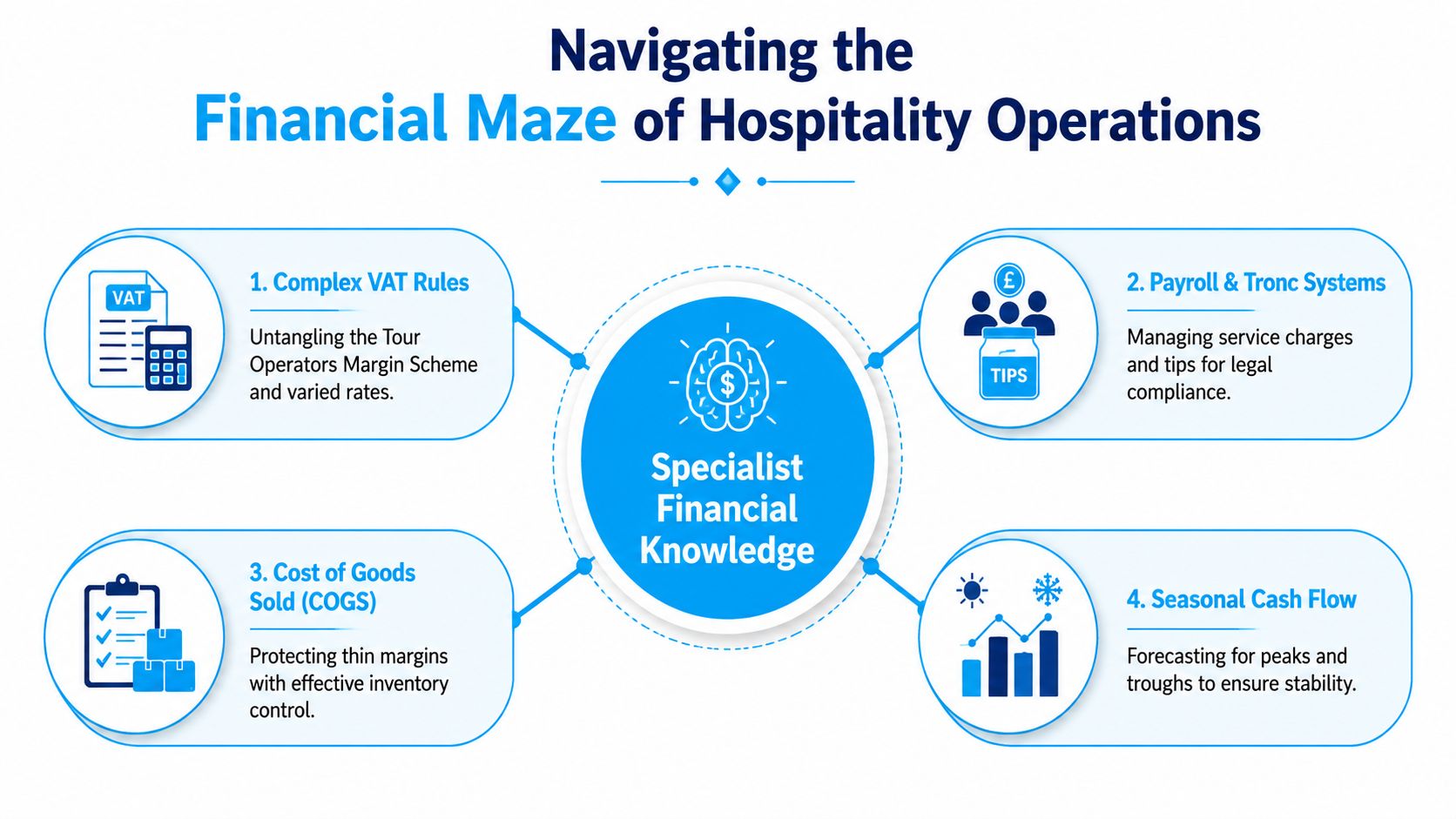
As you can see, navigating the complexities of VAT, payroll, COGS, and cash flow requires specific expertise to protect your margins and keep the business stable.
The shift from historical reporting to a live dashboard is fundamental. It empowers agile decisions on pricing, staffing levels, and marketing spend, directly impacting your bottom line and turning your finance function into a proactive driver of growth.
Ultimately, this integrated approach moves your financial oversight from a reactive, box-ticking task to a core strategic function. It gives you the clear, up-to-the-minute intelligence needed to steer your business with confidence.
To get a better handle on the specific metrics that drive this process, check out our guide on KPI tracking and reporting for your business.
How to Choose the Right Hospitality Accounting Partner
Picking an accountant for your hospitality business is a serious decision. This isn’t about finding the cheapest bookkeeper to file your taxes once a year. It’s about finding a financial partner who understands the fast-paced, high-pressure world of hospitality and can help you drive your business forward.
You need someone who provides proactive advice, not just a set of year-end accounts that tell you what happened six months ago. To find that partner, you need to look past the glossy brochures and ask tougher questions.
Look for Verifiable Sector Experience
Any firm can say they have hospitality clients. A true specialist can prove it. Ask for anonymised case studies showing how they’ve helped businesses just like yours solve real-world problems.
Look for testimonials that talk about specific results, not just vague praise. A quote explaining how an accountant helped a client fix their menu costing or sort out a complicated tronc system is worth far more than one that just says they’re “great to work with.”
A genuine specialist will speak your language. If you’re talking to a potential firm and they don’t bring up metrics like RevPAR, GOPPAR, or food cost percentages, it’s a huge red flag. It shows they don’t truly understand the levers that drive profitability in this sector.

Evaluate Their Technology Proficiency
Your accountant has to be fluent in the technology that actually runs your business. At a minimum, this means expert-level knowledge of cloud accounting platforms like Xero or Sage.
But crucially, they must also have proven experience integrating these platforms with your core operational systems. This includes:
- EPOS (Electronic Point of Sale) systems
- Property Management Systems (PMS) for hotels
- Booking and reservation platforms
- Specialist payroll and tronc software
A smooth integration is non-negotiable. It’s the only way to get the real-time data you need to make smart, fast decisions about your business.
Compare Pricing Models and Value
When you get proposals, you need to understand exactly what you’re paying for and how the firm charges. The two most common models are fixed-fee and hourly rates.
- Fixed-Fee: This gives you cost certainty. You pay a set monthly fee for a clearly defined scope of work. It encourages you to pick up the phone and ask questions without worrying about a surprise bill, fostering a more proactive partnership. It’s perfect for businesses looking for a complete finance function, including management accounts and strategic advice.
- Hourly Rate: This can look cheaper at first, but costs are unpredictable and can quickly add up. It’s better for one-off projects, but it discourages regular communication, turning the relationship into a reactive, compliance-focused one.
For a growing hospitality business, a fixed-fee model with a proactive partner almost always delivers better value. If you’re looking to elevate your financial strategy, seeing what a virtual financial controller can reveal what a high-value partnership looks like can be a real eye-opener.
Your First 90 Days with a Specialist Accountant
Switching accountants can feel like a massive job, but with a specialist firm, it shouldn’t be. The transition should feel smooth, efficient, and focused on delivering real commercial value from the get-go.
Those first 90 days are crucial. This isn’t about just shifting data around; it’s about your new partner proving their worth long before the first set of statutory accounts are even on the horizon. This is when a proactive accountant for hospitality becomes part of your team.
The whole process starts with a clear onboarding plan, designed to get everything up and running with minimal disruption to your day-to-day operations.
The Initial Onboarding Phase
The first month is all about a seamless and secure handover. We have a structured process to get under the skin of your business quickly, which lays the groundwork for the high-value advice that follows.
-
Week 1: Discovery and Data Handover: We’ll kick things off with a proper discovery meeting. We want to hear about your goals, your biggest operational headaches, and what you’re trying to achieve commercially. We then handle the entire data migration from your old accountant, making sure every financial record is transferred securely.
-
Week 2: Getting Your Systems Talking: Our team will connect your key hospitality systems—your EPOS, booking platforms, and payroll software—to our cloud accounting platform. This is the foundation for getting you the real-time reporting you need to make smart decisions.
-
Weeks 3–4: Finding Our Rhythm: We’ll set up a regular meeting schedule to run through our initial findings and start fine-tuning your reports. The goal is to make sure you’re getting the information you actually need, in a format that makes sense to you, right from the start.
Proving Our Value, Fast
The real impact of working with a specialist should be obvious within the first three months. Compliance is a given—that’s the bare minimum. Our focus is on spotting opportunities that put money back into your business.
A new specialist partner should be finding immediate tax savings, refining your management reports, and giving you initial benchmarks within weeks. This is how they prove their value and show they’re committed to your success, not just ticking a box at year-end.
For example, we’ll immediately dig into your fixed asset register. We’ll look for unclaimed Capital Allowances on past refurbishments or equipment purchases—it’s a huge area where generalist accountants often miss out on significant tax relief for hospitality businesses.
We’ll also reshape your management reports to include the KPIs that really matter and show you how your numbers stack up against anonymised industry peers. It’s this kind of immediate, tangible value that turns an accounting service into a genuine partnership.
Building a Financial Foundation for Sustainable Growth
Partnering with a specialist hospitality accountant does more than just get your books in order. It turns your finance function from a simple cost centre into a real engine for growth.
When you get on top of the messy stuff—like VAT, seasonal cash flow, and complex payroll—you’re not just staying compliant. You’re building a rock-solid financial foundation that gives you the confidence to seek investment, expand to new locations, or even plan a successful exit.
This solid groundwork is what lets you shift your focus from day-to-day survival to long-term strategy. To get there, you first need to understand the principles of financial organisation for business. It’s this clarity that allows you to make bold, data-driven decisions instead of just guessing.
The opportunity for ambitious UK hospitality businesses is clear. With a specialist by your side, you’re not just preparing for Year End. You’re actively building the financial systems you need for sustainable growth, ensuring you’re always ready for whatever comes next.
For more on this, see how our cash flow forecasts can help you plan ahead.
Frequently Asked Questions
When you’re thinking about moving to a specialist, a few key questions always come up. Let’s tackle them head-on so you know exactly what to expect.
How much do specialist accountants for hospitality cost?
For a business with a turnover between £1 million and £15 million, a full-service package typically costs between £1,500 and £5,000+ per month. The final figure depends on your complexity—how many sites you have, the size of your team, and the level of strategic support you need. The goal isn’t to find the cheapest option, but the one that delivers a return through savings and smarter decisions that far outweighs the monthly fee.
Can you manage our complex payroll and tronc system?
Absolutely. In fact, if a firm can’t confidently handle this, they aren’t a true hospitality specialist. Managing complex payroll and operating a fully compliant tronc scheme is a fundamental part of what we do. It ensures your team’s remuneration is distributed fairly and in the most tax-efficient way possible. Getting this right keeps your people motivated and protects your business from the risk of a costly HMRC investigation.
What technology should my hospitality accountant use?
Your accountant needs to be completely fluent in modern, cloud-based accounting software like Xero or Sage. The real test is their ability to integrate these platforms with the tools you use every day – your EPOS, property management systems (PMS), and specialist payroll software. This isn’t a “nice-to-have”; it’s essential for getting the real-time financial data you need to manage your business effectively.
How quickly will we get meaningful financial reports?
After the initial setup, which usually takes a few weeks to get all your data migrated and systems connected, you should receive your detailed management accounts within 10 to 15 working days of the month-end. A specialist won’t just send you a spreadsheet; you should expect a report packed with KPIs, variance analysis, and a clear, written summary that tells you what the numbers mean and what to do next.
Ready to build a more profitable hospitality business?
The difference between surviving and thriving in the UK hospitality sector is having a financial partner who understands your world inside-out. A specialist team of accountants for hospitality doesn’t just do your books—they give you the commercial insights to drive growth, control costs, and build a more resilient business.
Book a free, 30-minute consultation today to discover how our specialist hospitality accounting services could transform your financial performance. We’ll show you exactly how we can provide the clarity and control you need to achieve your goals.
This article is for informational purposes only and does not constitute professional advice. Tax rules apply as of April 2026. Consult a qualified accountant for your specific circumstances.