

Looking for specialist construction accountants? See our construction and property accounting services.
Construction accountants do far more than file CIS returns. For UK contractors, a monthly pack should bring WIP, retentions, reverse charge VAT and margin KPIs together, so leadership can see profit and cashflow before the Year End.
The familiar month-end scene is a bank balance that looks comfortable, a few large applications for payment awaiting certification, and live jobs that appear profitable in the ledger. Then a site manager reports extra labour, a supplier invoice arrives late, and a retention release moves again. The cash position and the project position no longer tell the same story.
That's where specialist construction accountants earn their place. They connect job costing, WIP accounting, retention accounting, CIS and management reporting into one decision-making process, rather than treating each item as a separate administrative task.
Why construction businesses need specialist accounting
A contractor can report cash in the bank while a live contract is already losing margin. Work is delivered over time, costs arrive unevenly, applications for payment may differ from certified work, and retentions can postpone cash after the underlying work is complete. The accounts need to show that commercial position before the project closes.
For a business with turnover between £1 million and £15 million, a generic profit and loss account rarely gives directors enough detail. It may show total turnover and costs, yet leave unanswered which job is using contingency, which application remains uncertified, and whether forecast completion costs have moved beyond the original tender.

Why timing changes the commercial picture
Take a contractor with several active projects. Bookkeeping may record supplier invoices when they arrive, payroll when it is processed, and customer invoices when they are raised. That creates an accounting record, but it may not show the value of work completed or the cost still required to finish each contract.
WIP accounting brings those measures together by comparing completed work with amounts billed and costs incurred. It helps prevent a business from recognising too much or too little project activity in a month, then discovering the difference only when the job closes.
Retention accounting follows the same commercial logic. Retention is a contract balance, not just an unpaid invoice. It should be tracked by contract, application and expected release, because it changes both the balance sheet and the cash forecast.
Commercial rule: A monthly pack should explain why profit changed, where cash is tied up, and which live job needs management attention.
That pack becomes more useful when WIP valuation, retention movements, CIS compliance and margin KPIs appear in one visible report. The MD, FD and commercial manager can then work from the same evidence instead of reconciling separate compliance tasks. A construction and property accounting service should be judged by the quality of that monthly insight, not merely by whether the bookkeeping is current.
Four accounting pressures that separate contractors from smaller businesses
Construction accounting becomes difficult when several rules and commercial events operate at once. CIS affects deductions and subcontractor cashflow. VAT treatment affects invoice coding and the customer's VAT Return. Retentions affect when certified work turns into cash. Governance changes create another responsibility for directors.
The four pressures in practice
The Construction Industry Scheme has governed the sector for decades. It was brought into UK tax law in 1971 and still underpins how contractors account for payments to subcontractors today. Contractors generally deduct tax at source at 20% for HMRC-registered subcontractors, 30% for unregistered subcontractors and 0% for subcontractors with gross payment status, subject to the latest rate notified by HMRC (ICAEW's CIS update).
The domestic reverse charge for construction services adds a separate VAT control. Since 1 March 2021, it has applied to specified CIS supplies between UK VAT-registered businesses in qualifying circumstances. The customer accounts for the VAT on its own VAT Return rather than paying the VAT to the supplier (KashFlow's reverse charge guidance).
Retentions and project cashflow create the third pressure. A business may have earned value on site but still be waiting for certification, payment or release of retained sums. The fourth is governance. Companies House identity verification has been mandatory for directors since 18 November 2025, so directors need a process for meeting that requirement alongside tax and reporting obligations.
| Accounting pressure | What it affects | Common mistake |
|---|---|---|
| CIS deductions | Subcontractor cashflow, payment statements and HMRC reporting | Applying an old rate or omitting a subcontractor from the return |
| Reverse charge VAT | Invoice coding, VAT Returns and working capital | Charging VAT when the reverse charge applies |
| Retentions and WIP | Reported profit, receivables and cash forecasts | Treating certified value and collected cash as the same thing |
| Director verification | Governance and Companies House compliance | Leaving responsibility unclear between directors and advisers |
These pressures interact. A subcontractor deduction affects the payment value, reverse charge VAT affects the VAT coding, and the application for payment affects WIP and cash forecasting. A CIS and payroll returns service should fit into the wider monthly close, not operate as an isolated submission.
What a sector-specific construction monthly pack actually covers
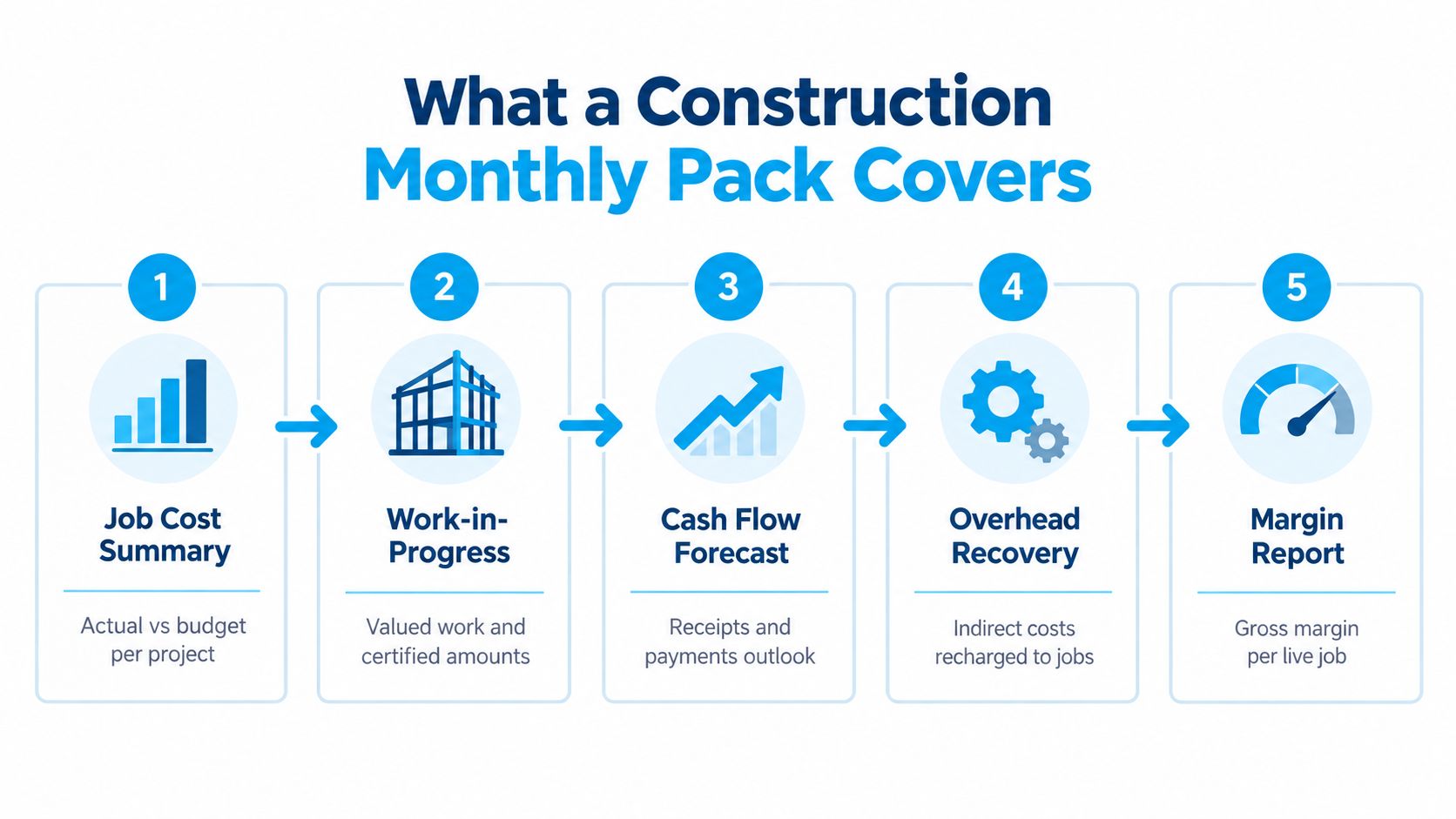
A useful monthly pack starts with project data and ends with decisions. It should show what has been completed, what has been billed, what remains to be spent and when cash is expected. The pack is not just a polished set of accounts. It's a control document for live contracts.
WIP valuation and applications for payment
The first step is a job-by-job cost summary. Direct labour, materials, subcontractor costs and other project costs should be matched to the relevant contract. The finance team then compares actual costs with the latest budget and cost-to-complete estimate.
WIP accounting brings certified amounts, applications for payment and unbilled work into the same review. It helps distinguish:
- Work completed but not yet invoiced.
- Applications submitted but not certified.
- Certified amounts awaiting payment.
- Amounts billed ahead of the underlying work.
- Costs incurred that relate to future project activity.
That distinction matters because a ledger can show an invoice while the commercial team is still disputing certification. The monthly pack should make the difference visible.
Retentions and CIS deductions
Retention accounting should maintain a contract-level schedule showing the original amount, deductions, release conditions, expected dates and outstanding balance. The cash forecast can then reflect realistic release timing instead of assuming every receivable will arrive with the next payment run.
The pack should also reconcile CIS deductions suffered against customer remittances and CIS deductions applied to subcontractor payments. That gives the FD a clear view of cash withheld from the business and cash withheld from subcontractors.
CIS administration also needs an inactivity process. From 6 April 2026, nil returns become mandatory again unless HMRC has been told that the contractor is inactive, according to the 2026 construction accounting guidance. A sound workflow records whether the business made payments, whether projects paused, and whether HMRC has been notified, while keeping project-level revenue recognition separate from the CIS submission.
Reverse charge VAT in the pack
Where the domestic reverse charge applies, the customer records the VAT rather than paying it to the supplier. The monthly review should test the supply, the customer's VAT status, the CIS connection and the accounting code before the return is finalised.
A finance team assessing systems may also find Lucentive construction software useful as a reference point for how project reporting and accounting workflows can be structured. The principle remains the same regardless of software: the pack must join operational evidence to financial reporting.
KPIs that catch margin fade on live construction jobs
Annual accounts confirm what happened. Live-job KPIs help management change what happens next. The most useful measures connect the original tender, current cost forecast, earned value, billing position and expected cash.
The measures that deserve monthly attention
Gross margin by project should be reviewed against the tender and the latest forecast. A falling margin can indicate labour inefficiency, procurement slippage, design changes not yet valued or an incomplete cost-to-complete estimate.
Cost-to-complete variance tests whether the remaining budget still reflects site reality. The commercial manager should explain material movements, rather than allowing the finance team to carry forward an outdated forecast.
Unbilled work value highlights completed work that has not yet become an invoice. It may represent normal certification timing, but it can also expose delayed applications, weak contract administration or disputed scope.
Retention release timing belongs in both the KPI review and the cash forecast. A project can be profitable on paper while retained cash remains unavailable, creating pressure on payroll, suppliers and new mobilisation costs.
Turning indicators into action
A useful monthly meeting asks for an owner and an action beside each exception. If site costs exceed the estimate, the project manager needs to explain the cause and update the forecast. If unbilled work grows, the commercial team should confirm the application status and expected certification date.
The KPI tracking and reporting service can support a reporting rhythm where directors see exceptions early. The value isn't the number of pages in the pack. It's whether the pack prompts a decision before margin fade becomes a final-account surprise.
Generic bookkeeping versus construction specialist accounting
Generic bookkeeping isn't poor. It becomes insufficient when the business needs project-level judgement that standard invoice processing doesn't provide. A bookkeeper may correctly post a supplier invoice, yet the FD still needs to know which job consumed the cost, whether the cost was recoverable and how it changes the expected margin.
| Capability | Generic bookkeeping | Construction specialist accounting |
|---|---|---|
| Transaction processing | Posts invoices and receipts | Codes transactions to jobs, cost types and reporting periods |
| WIP accounting | May be periodic or absent | Maintains project-level earned value and cost-to-complete analysis |
| Retention accounting | Records receivables | Tracks retention by contract, release condition and cash date |
| CIS | Submits information when provided | Controls verification, deductions, statements and reconciliations |
| Management reporting | Produces historic totals | Explains live-job performance and commercial exceptions |
The distinction becomes sharper as contract values, subcontractor numbers and project overlap increase. A standard month-end can close the nominal ledger, but it may not close the commercial questions.
Practical test: If the finance pack can't identify the job, cause and owner behind a margin movement, it isn't yet a construction management pack.
A finance director reviewing external support can use accounting tender services to structure a capability comparison. The assessment should focus on sector experience, month-end ownership, communication with commercial teams and the ability to explain figures to non-accountants, not only on the lowest quoted fee.
How to choose and onboard a construction accountant
The appointment should begin with the monthly decisions the leadership team needs to make. A suitable adviser should be able to explain how CIS, VAT, WIP, retentions, payroll, Statutory Accounts and cash forecasting will work together.
The selection questions that matter
Ask prospective construction accountants to describe the first month-end process in practical terms. The answer should cover data collection, job-cost coding, WIP review, retention reconciliation, management reporting, review meetings and deadlines.
Technology should support the process, not replace judgement. Useful foundations include cloud bookkeeping integration, automated bank feeds, controlled approval routes and a shared schedule for applications, certifications and retentions.
Pricing should reflect responsibility. A low fee may exclude system setup, project review, CIS corrections or director-level advice. A higher fee can be commercially sensible when it includes a disciplined close and timely interpretation, but the scope needs to be written clearly.
HMRC requires contractors to record the gross payment excluding VAT, materials cost excluding VAT where relevant and deduction amount, then retain those records for at least three years after the tax year-end (HMRC's CIS guide). The onboarding plan should assign responsibility for collecting and checking that evidence.

A practical onboarding schedule includes:
- Data mapping: Agree job codes, nominal codes, payroll feeds and VAT treatment.
- Contract review: Identify WIP, retention, application and certification requirements.
- Month-end calendar: Set deadlines for site data, supplier invoices and management review.
- Communication cadence: Define who receives exceptions and when directors meet the adviser.
- Opening reconciliation: Check CIS, VAT, retentions, debtors and project balances before relying on the first pack.
Next steps for construction businesses
Weak construction accounting rarely appears as one obvious failure. CIS sits in one system, retentions in a spreadsheet, WIP is adjusted at year end, and the cash forecast depends on uncertain certification dates. The commercial risk sits between those records, where a live job can look profitable while cash and margin are deteriorating.
A sector-specific monthly pack gives directors one operating view. It connects project costs to WIP valuation, applications for payment to receivables, retention tracking to cashflow, and CIS compliance to supporting evidence. The same report gives the commercial manager a structured basis for challenging cost-to-complete forecasts before the final account exposes a lost margin.
The compliance timetable belongs in that process. CIS returns must be filed electronically by the 19th of the month for the tax month ending on the 5th, including nil returns where no payments were made (CIS filing guidance). Add that deadline to the month-end calendar alongside VAT review, payroll processing, project reporting and director-level governance checks.
A focused review can establish the right starting point:
- Reconcile each live job to its latest cost-to-complete forecast.
- Build a retention schedule linked to applications, certification status and expected release.
- Separate CIS deductions suffered from CIS deductions applied.
- Test reverse charge VAT coding on qualifying transactions.
- Agree the margin KPIs that the FD, MD and commercial manager will review each month.
The striveX construction and property guidance provides a suitable starting point for businesses assessing their current finance function.
Frequently asked questions
How do construction accountants use WIP accounting?
They compare work completed, costs incurred, certified amounts, applications for payment and invoicing. The objective is a reliable monthly project position, rather than a view based only on cash received or invoices issued. The review should include the latest cost-to-complete estimate so directors can see whether forecast margin is holding.
What is retention accounting in construction?
Retention accounting records amounts withheld under construction contracts, together with the related application, certification status, expected release and outstanding balance. It shows why a profitable project may still be tying up cash and stops retention balances disappearing into a broad receivables figure.
What are the CIS deduction rates for subcontractors?
The standard CIS deduction rates are 20% for HMRC-registered subcontractors, 30% for unregistered subcontractors and 0% for subcontractors with gross payment status (HMRC consultation guidance). Contractors should apply the latest rate notified by HMRC.
When are CIS returns due?
CIS returns are filed electronically by the 19th of the month for the tax month ending on the 5th. Contractors must submit a return even when no payments were made, unless the relevant HMRC inactivity process applies.
What should a construction monthly pack include?
A practical pack should cover job-cost summaries, WIP valuation, applications for payment, retention accounting, cashflow forecasts, CIS deductions suffered and applied, reverse charge VAT checks and live-job margin KPIs. It should finish with clear exceptions, named owners and agreed actions.
This article is for informational purposes only and does not constitute professional advice. Tax rules apply as of April 2026. Consult a qualified accountant for your specific circumstances.
If you want help reviewing your current monthly pack, mapping WIP and retentions, or tightening CIS reporting, use the StriveX enquiry form to start the conversation.