


Meta title: Financial Due Diligence Guide for UK SMEs 2026
Meta description: Learn how financial due diligence protects valuation, exposes cash flow risk, and helps UK SMEs close stronger deals with fewer surprises.
A business can look strong on paper and still struggle the moment a buyer, investor, or lender starts asking harder questions. Turnover is growing. EBITDA looks healthy. The board pack reads well. Then the diligence request list arrives, and attention shifts to cash conversion, working capital pressure, customer concentration, tax compliance, and whether the numbers reconcile.
That's where financial due diligence earns its keep.
For UK companies turning over £1 million to £15 million, financial due diligence isn't just a deal-stage formality. It's the point where headline performance gets tested against commercial reality. A buyer wants to know what's sustainable, what's overstated, and what could hit value after completion. A seller needs to know the same thing before someone else finds it first.
What Financial Due Diligence Really Means for Your Business
Financial due diligence is best understood as a commercial stress test. It examines whether reported performance reflects the true earning capacity and cash profile of the business, and whether the balance sheet carries risks that could change price, structure, or deal appetite.
That matters because the market is active, but not forgiving. Quarter 4 of 2025 saw inward UK M&A activity reach £27.4 billion, yet 35% of UK deals still fail due to insufficient due diligence practices, according to analysis of UK deal failures and enhanced diligence. Stronger financial due diligence has been shown to reduce failure rates significantly.
It protects value on both sides
A buyer uses financial due diligence to test the deal thesis. Is the business producing maintainable earnings? Are margins stable? Is working capital normal? Will cash still be there after the handover?
A seller should use the same lens earlier. If the business can explain fluctuations clearly, support adjustments properly, and show disciplined reporting, it usually enters negotiations from a stronger position. If it can't, the buyer fills the gap with caution, wider assumptions, and price pressure.
Commercial reality: Buyers rarely pay for EBITDA in isolation. They pay for earnings they believe will convert into cash without unpleasant surprises.
It matters in more than a sale process
For a business in the £1 million to £15 million turnover bracket, financial due diligence usually shows up in three situations:
- Investment rounds where investors want confidence in reporting quality and cash use
- Acquisitions where a buyer needs to validate price and risk
- Vendor-led exits where owners want fewer delays and fewer valuation chips during exclusivity
A practical starting point is to understand how the business would stand up under external review, especially on maintainable profit and cash generation. That's closely tied to valuation logic, which is why it's worth reviewing business valuation support before a process starts.
For readers wanting a concise outside perspective on common buyer-side issues, this guide to preventing M&A financial pitfalls is a useful companion.
The Key Stages of the Due Diligence Process
Financial due diligence feels less intimidating once the sequence is clear. The work is structured. The pressure usually comes from poor preparation, inconsistent records, or slow responses.
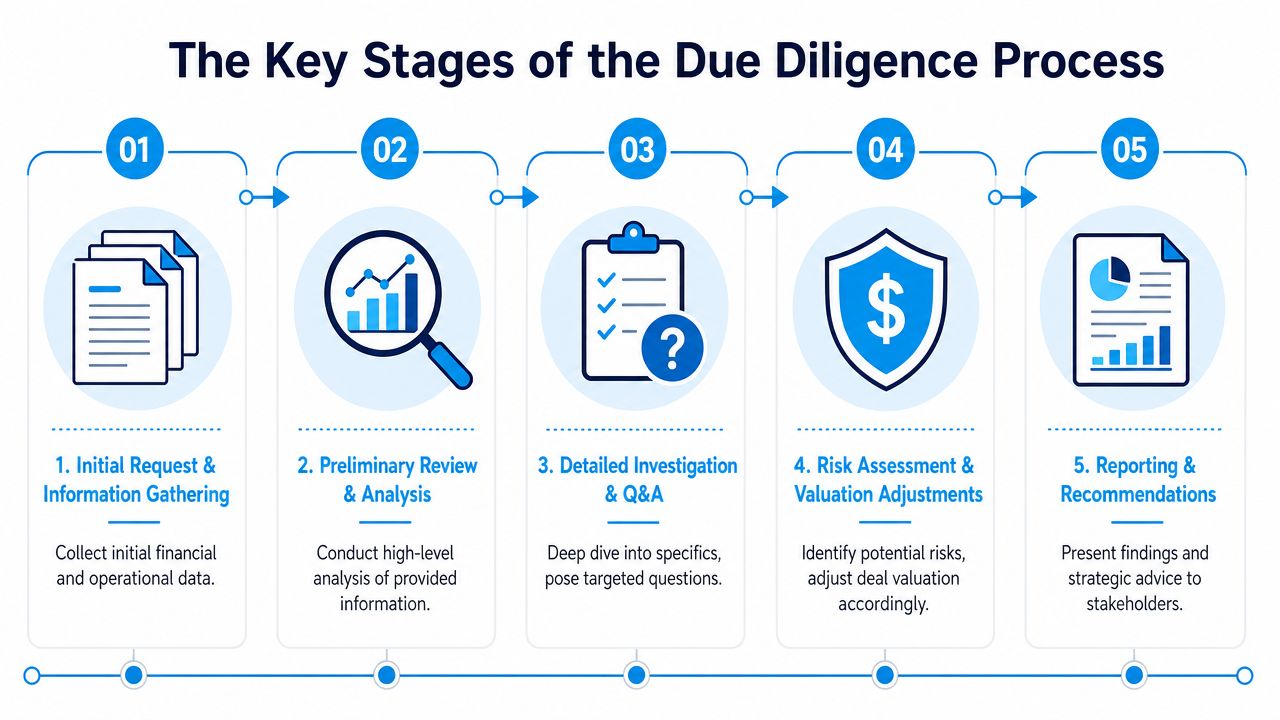
Information request and data room setup
The process usually starts with an information request list. That covers statutory accounts, management accounts, trial balances, ledgers, debtor information, tax records, and supporting schedules. Documents are uploaded into a secure data room so the buyer's advisers can review a controlled set of information.
In the UK, the baseline is well established. Financial due diligence is structured around 3 years of audited accounts plus the most recent management accounts, alongside 3–5 years of monthly management accounts in a consistent format, according to UK financial due diligence guidance.
Review, challenge, and follow-up
Once the information is in, the review moves quickly from high-level trends to detailed testing. Advisers look for consistency between statutory accounts, monthly reporting, bank activity, tax filings, and the commercial story management is telling.
The usual areas of focus include:
Turnover quality
Whether sales are recurring, concentrated, seasonal, or dependent on one-off items.Margin resilience
Whether gross margin and operating margin movements have a clear operational explanation.Working capital behaviour
Whether debtors, stock, and creditors are moving in line with growth, or masking cash strain.Balance sheet exposure
Whether debt, accruals, provisions, and tax positions have been recorded cleanly.
Q&A and report output
Most of the useful insight comes out in Q&A. That's where a buyer probes fluctuations, unusual journals, customer losses, stock build-up, overdue debtors, director adjustments, and post-year-end developments.
A fast answer isn't enough. It has to reconcile, tie back to the records, and make commercial sense.
The final output is a due diligence report. That usually highlights maintainable earnings adjustments, normalised working capital, debt-like items, cash-like items, tax or compliance concerns, and points that may affect valuation or SPA negotiations. The report doesn't just say whether the numbers add up. It shows where risk sits and what that risk is worth.
How to Prepare Your Company for Scrutiny
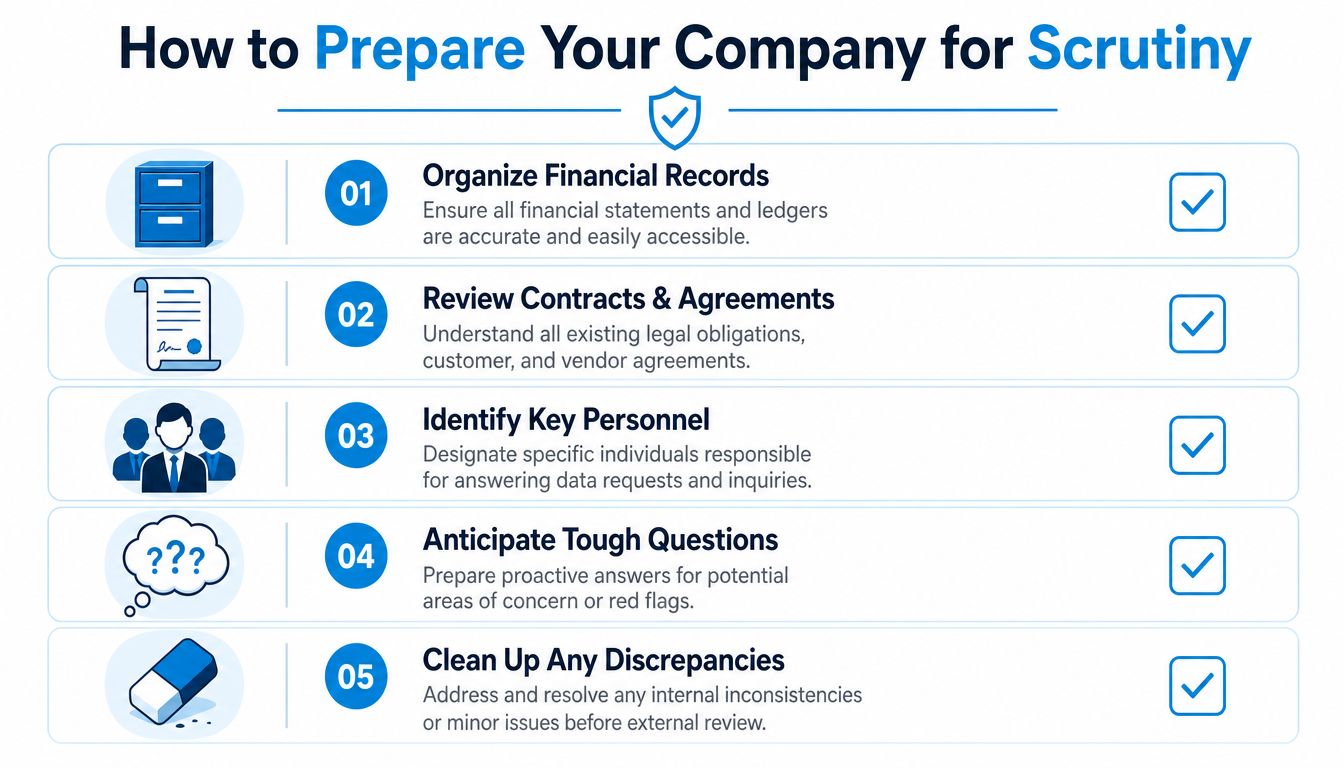
The strongest diligence processes are usually quiet. Questions still come, but they're answered quickly, with evidence, and without internal panic. That only happens when the business prepares before the process starts.
Start with reporting discipline
Management accounts need to be timely, consistent, and understandable to someone outside the business. If one month includes accruals, another doesn't, and gross margin is calculated differently by department, the buyer won't trust trend analysis.
A good preparation standard includes:
- Monthly consistency. Use the same chart structure, margin logic, and cut-off approach each month.
- Balance sheet support. Reconcile debtors, creditors, VAT, PAYE, stock, loans, and accruals.
- Clear adjustments. Separate one-off items from maintainable trading performance and document the logic.
A strong forecast matters too, especially when the business is being valued on future potential. This guide on how to build a great financial forecast is a practical place to tighten assumptions before diligence starts.
Organise tax and compliance records properly
Many deals lose momentum because tax records are scattered between email chains, old folders, and different advisers. That creates avoidable doubt.
UK founders should keep Corporation Tax filings, VAT returns, PAYE records, and HMRC correspondence with payment history and any open queries in one organised place, as outlined in this UK founder due diligence checklist.
That means pulling together:
- Corporation Tax records including returns, computations, payment confirmations, and open matters
- VAT history with filed returns, workings, correspondence, and any partial exemption or adjustment issues
- PAYE support including payroll filings, pension records, and any HMRC disputes or payment plans
- HMRC correspondence so there's a single view of what's been queried, settled, or remains open
Prepare the narrative, not just the files
Good preparation isn't only about documentation. It's also about explanation. A buyer will ask why margins dipped, why stock rose, why one customer now accounts for a larger share of turnover, and whether director remuneration has shifted trading profitability.
Practical rule: If management would struggle to explain a number in two clear sentences, that number isn't ready for diligence.
A short readiness checklist often helps leadership teams focus:
| Priority area | What needs to be ready |
|---|---|
| Earnings quality | Normalised EBITDA logic and support |
| Cash flow | Debtor days, stock movement, creditor patterns |
| Tax | Clean filing history and open-query log |
| Controls | Clear ownership for answers and document release |
Where monthly reporting needs work, formalising that process before a transaction starts often pays back quickly. Better packs lead to better answers, and better answers usually mean fewer valuation challenges.
Common Risks That Can Derail Your Deal
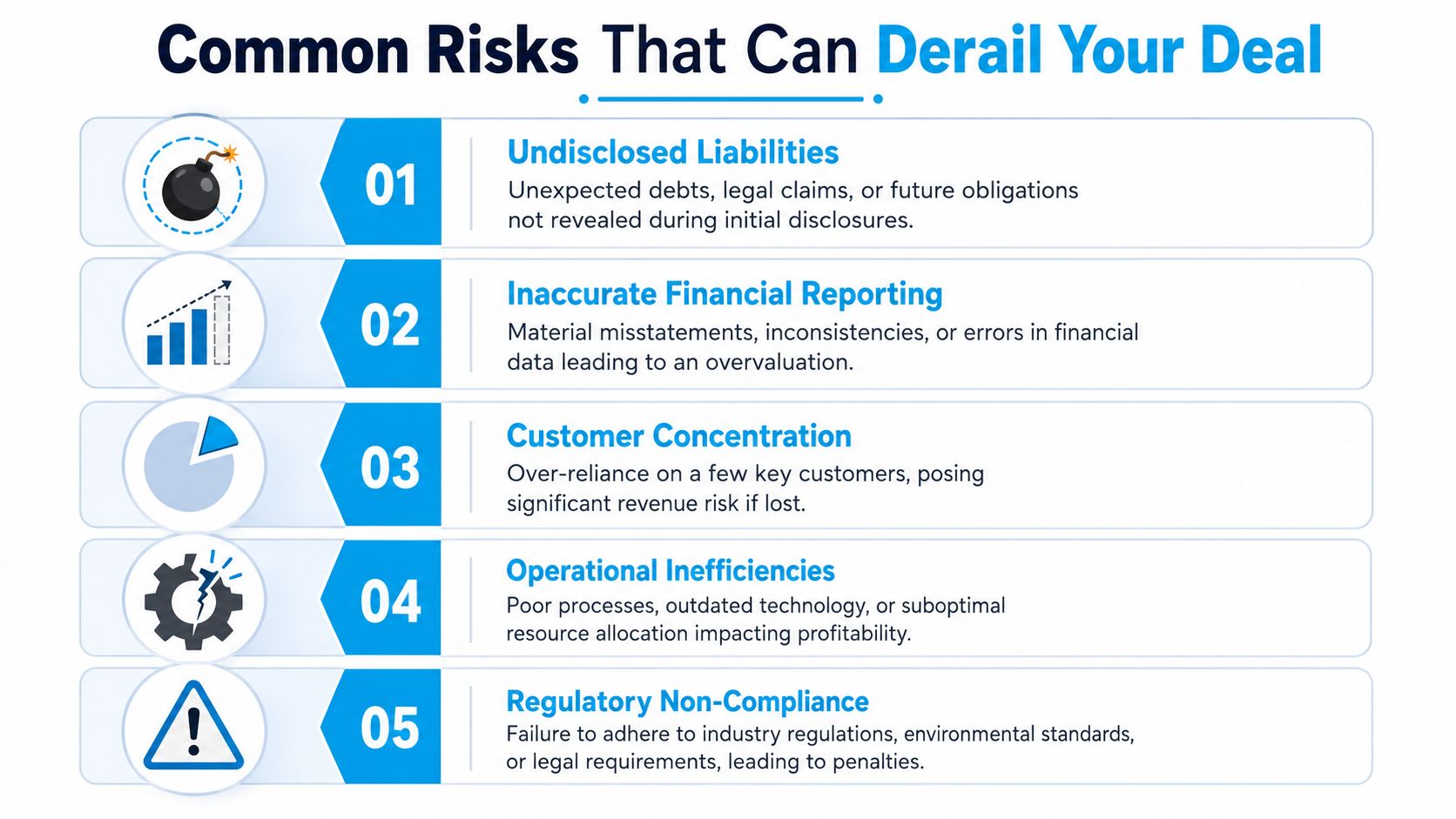
Most problem areas in financial due diligence don't come from fraud or dramatic failures. They come from ordinary weaknesses that were tolerated internally and then judged harshly externally.
Where buyers usually lose confidence
A recurring blind spot is the gap between EBITDA growth and actual cash-flow sustainability. Only 38% of deals meet investor cash conversion targets, while 62% of UK SMEs in the £1 million to £15 million range show EBITDA growth but negative free cash flow due to poor inventory turnover and receivables management, according to analysis of UK due diligence risk gaps in 2026. That's the kind of issue that changes how a buyer sees quality of earnings.
Other risks tend to cluster around a few themes:
Weak working capital control
A business may report solid profit while cash is trapped in stock or slow-moving debtors. Buyers then push for a lower price, a tougher working capital peg, or stronger protections.Customer concentration
If too much turnover sits with a small number of customers, future earnings look less secure. Even where contracts exist, renewal risk matters.Tax exposure
Incomplete filings, unresolved HMRC queries, or weak VAT treatment can move quickly from admin issue to valuation issue. When those risks aren't resolved early, they tend to land late and expensively.Unclear debt and liability positions
Director loans, finance arrangements, deferred consideration, accrual gaps, or contingent liabilities often trigger SPA negotiation points.
Cross-checking matters more than management explanation
In UK financial due diligence, cross-checking data sources is critical, and failure to resolve financial risks before diligence often results in a 10–15% reduction in transaction value due to unforeseen tax liabilities or compliance risks, based on financial due diligence guidance covering data validation and deal impact.
That's why buyers don't rely on one report. They compare sales ledgers to bank receipts, tax returns to reported balances, and management commentary to transaction data.
For businesses that want fewer reconciliation issues, stronger purchase controls help. This practical article on improving AP processes using three-way matching gives a useful overview of how to reduce mismatch risk before external review.
The deal rarely breaks at the first red flag. It weakens when management can't prove the issue is contained.
Timelines Costs and Choosing the Right Partner
Most SME owners underestimate the operational load of financial due diligence. The technical work matters, but the main drain usually comes from collecting information, answering repeat questions, and keeping the business running while scrutiny increases.

The timeline is longer than most founders expect
For smaller UK acquisitions, the complete financial due diligence process typically takes between 45 and 60 days, according to guidance on financial due diligence timing for acquirers. That period is usually needed to gather records, review trends, test balances, run Q&A, and agree what the numbers mean for value.
The cost side varies too much between deals to treat with a generic figure. Scope, reporting quality, complexity, tax issues, and transaction pressure all affect the final fee. The useful question isn't “what does diligence cost?” It's “what does weak preparation cost in price chips, delay, management distraction, and failed confidence?”
The right support changes the process
An experienced finance partner won't remove scrutiny, but it will make scrutiny easier to manage. The work usually adds value in three ways:
- Sharper preparation so the data room is cleaner and questions are answered once
- Better framing so normal commercial fluctuations aren't mistaken for structural weakness
- Stronger deal control so the owner isn't dragged into every spreadsheet issue personally
That matters most when EBITDA looks respectable but cash flow is harder to defend. A finance partner can help separate operational noise from genuine risk and make sure the buyer sees the business as it really is.
For businesses that need broader transaction and finance support before a process begins, it's worth exploring finance consultancy services.
Financial Due Diligence FAQs
Frequently asked questions
| Question | Answer |
|---|---|
| What is the difference between financial due diligence and legal due diligence? | Financial due diligence focuses on earnings quality, cash flow, working capital, debt, tax exposure, and whether the numbers support the deal price. Legal due diligence looks at contracts, ownership, disputes, compliance, and legal obligations. Both matter because a financially attractive business can still carry legal risk that changes value or deal terms. |
| Can a company do financial due diligence on itself before a sale? | Yes. That's often called vendor-side readiness or sell-side preparation. It helps management identify weak reporting, unsupported adjustments, tax issues, and working capital concerns before a buyer sees them. It won't replace buyer diligence, but it usually improves speed, credibility, and negotiation control. |
| What happens if financial due diligence finds a major issue? | A major issue doesn't always kill the deal. It may lead to a price reduction, a revised working capital target, specific indemnities, deferred consideration, or a requirement to fix the problem before completion. The outcome depends on whether the issue is isolated, explainable, and financially containable. |
| How long does financial due diligence take for a UK SME? | For smaller UK acquisitions, the process typically takes 45 to 60 days when handled thoroughly. In practice, preparation quality makes a big difference. Clean records, organised responses, and a clear internal owner shorten delays and reduce repeated questions. |
| What do buyers look at first in financial due diligence? | Buyers usually start with historical performance, monthly management accounts, margin trends, cash generation, working capital patterns, customer concentration, debt, and tax compliance. They want to know whether reported profit is maintainable and whether it converts into cash in a normal trading cycle. |
If a deal is on the horizon, or even just being considered, the smartest move is to test the numbers before someone else does. Book a confidential FDD readiness review with striveX Ltd. It takes minutes to arrange, and it can help leadership teams spot value risks early, tighten reporting, and enter negotiations better prepared.
This article is for informational purposes only and does not constitute professional advice. Tax rules apply as of April 2026. Consult a qualified accountant for your specific circumstances.
