


Meta title: UK R&D Tax Relief 2026 Guide for UK SMEs
Meta description: Understand UK R&D Tax Relief, reduce claim risk, and improve cash flow with a practical guide for finance leaders and growing firms.
A finance lead often spots the same pattern. The business has spent heavily on product development, process changes, software improvement, or production problem-solving, yet nobody is fully sure whether that work counts for R&D Tax Relief.
That uncertainty matters because this isn't just a tax compliance issue. It affects cash flow, taxable profit, and the amount the business can reinvest after the Year End. It also affects risk. A weak claim wastes management time. A well-built claim can support working capital planning and strengthen the next round of investment in innovation.
Is Your Innovation Unlocking Hidden Cash
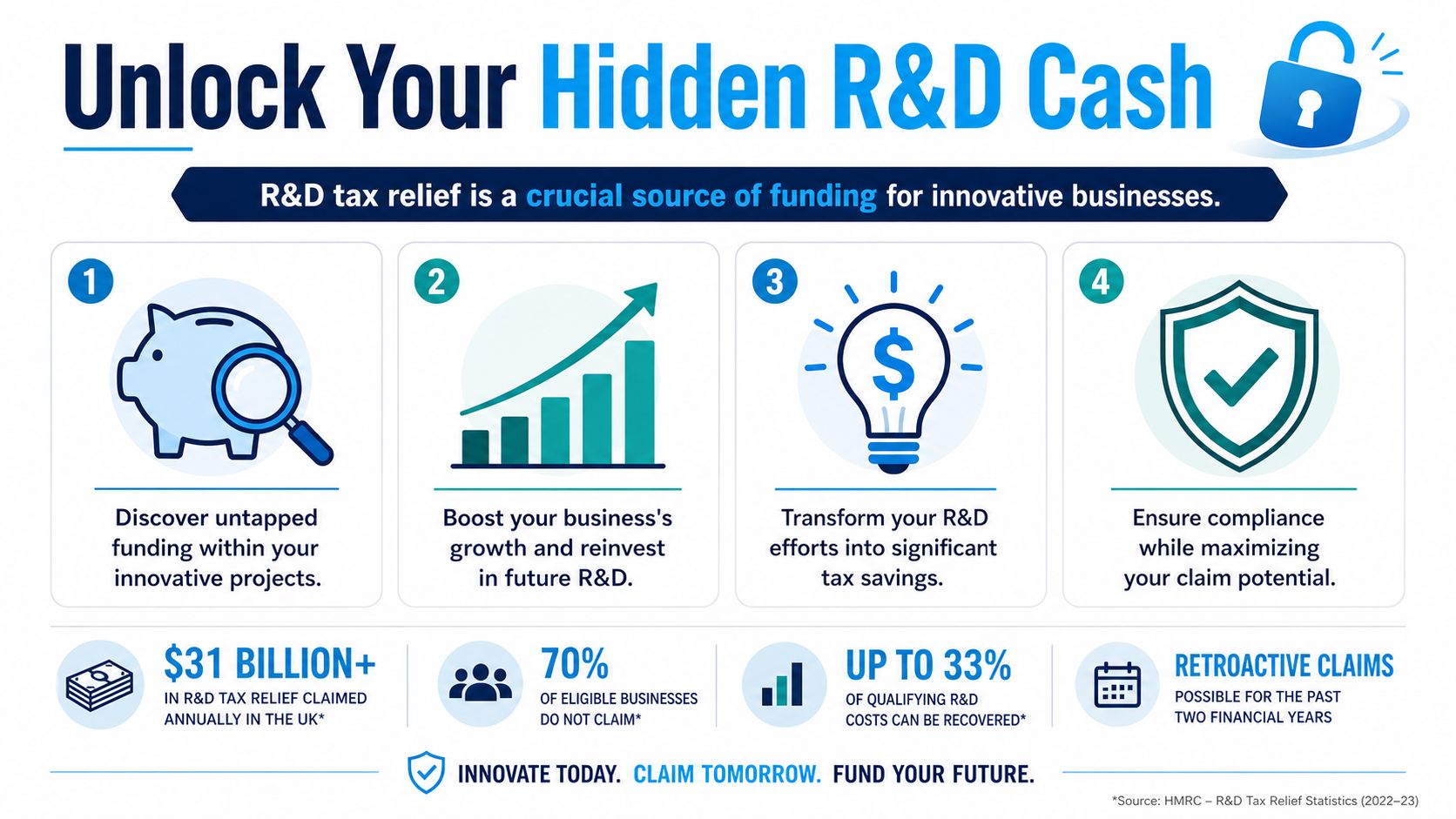
Many companies in the £1 million to £15 million turnover range are already doing qualifying work without labelling it as R&D. A manufacturer may be refining a process to solve repeatability issues. A software business may be trying to overcome technical limitations in performance or integration. A construction business may be developing a new method to deal with difficult site constraints.
The commercial problem is that these businesses often treat that effort as overhead. They absorb the cost and move on. That leaves cash on the table.
According to HMRC's September 2025 R&D tax credits statistics, in the 2023–24 tax year total claims fell by 26% to 46,950, while the average claim value rose by approximately 33% to around £162,000. The message for finance leaders is straightforward. Fewer businesses are getting claims through, and the businesses that do succeed are typically submitting larger and better-supported claims.
That shift changes the decision-making test. The question isn't just “could there be a claim?” It's “can the business evidence the claim properly and convert technical effort into a strong tax position?”
Commercial view: R&D Tax Relief works best when finance and technical teams treat it as a funding stream, not a year-end afterthought.
For businesses already reviewing how to avoid overpaying small business taxes, R&D should sit alongside broader tax planning rather than outside it. It affects the same core outcomes: retained cash, Corporation Tax exposure, and the capacity to fund growth without taking on more pressure elsewhere in the business.
There's also a strategic angle. Businesses that regularly review projects, staff time, subcontractor costs, and technical uncertainties during the year are in a stronger position than businesses that try to reconstruct everything after filing pressure begins. That's one reason many finance teams align R&D with wider corporation tax reduction planning, instead of treating it as a standalone claim.
Demystifying R&D What HMRC Actually Looks For
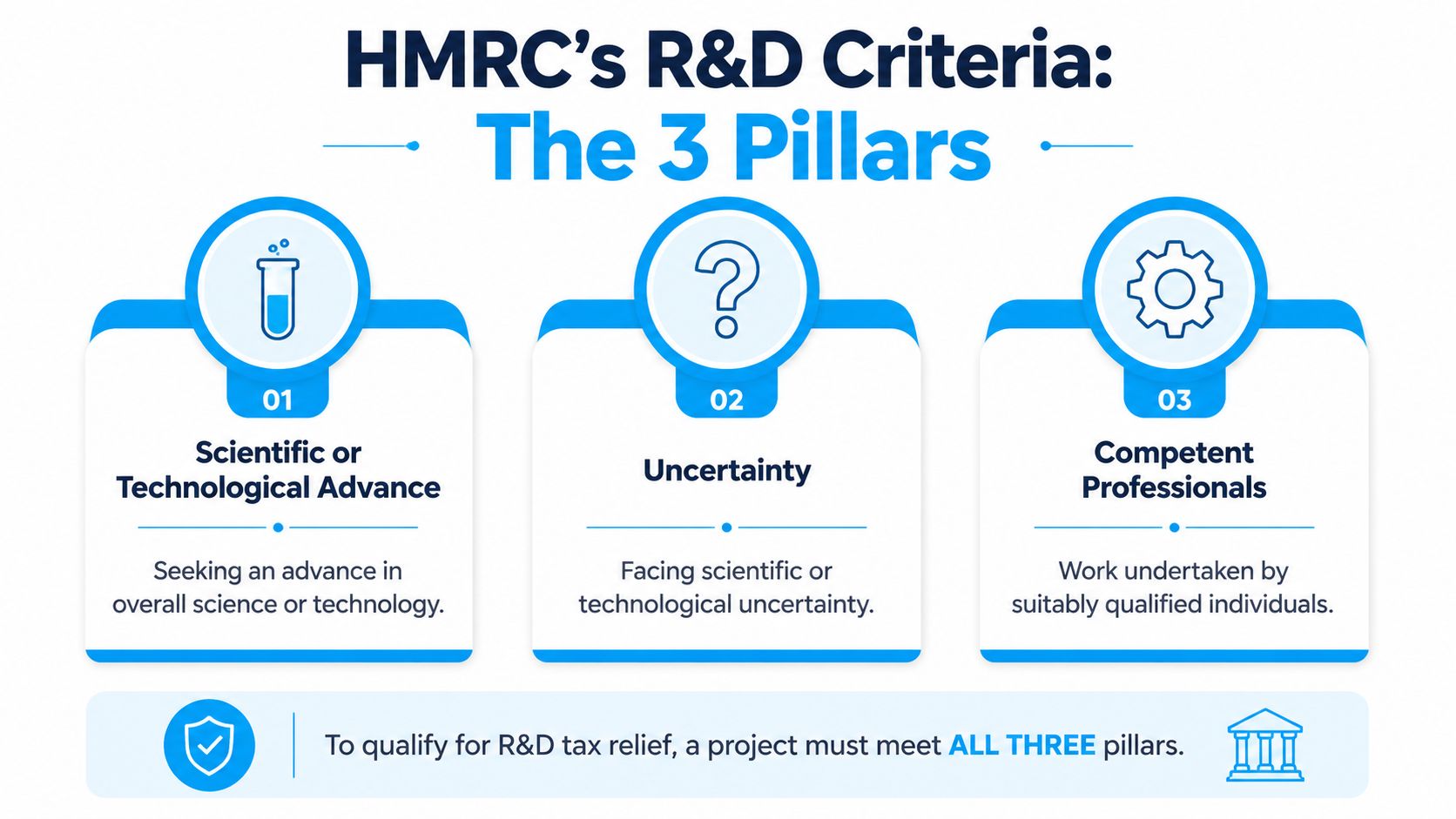
The phrase “research and development” sounds narrower than it really is. HMRC isn't asking whether a business has a laboratory or a formal innovation department. It's looking for work that tries to achieve an advance in science or technology, where the outcome wasn't readily known and competent professionals had to resolve uncertainty.
The three practical tests
A commercial reading of the rules usually comes down to three questions.
First, was the business trying to create or improve something in a way that advanced technology or science?
That could mean improving software architecture, changing a production method, or designing a technically different product.
Second, was there genuine uncertainty?
If the answer was easily available from existing knowledge, suppliers, or standard implementation, it usually won't qualify.
Third, did qualified people have to work through that uncertainty?
The claim should show that engineers, developers, technical managers, or similarly competent staff had to investigate, test, iterate, or fail before finding a workable route.
What usually qualifies and what usually doesn't
A few practical contrasts make the boundary clearer.
- Manufacturing example: Developing a new material composition or solving a tolerance problem in production can qualify. Buying a faster machine and installing it to supplier guidance usually won't.
- Software example: Building a new method to handle scale, speed, or interoperability where the technical path is uncertain can qualify. Configuring off-the-shelf software generally won't.
- Construction example: Creating a novel build solution to address difficult ground conditions or engineering constraints can qualify. Standard project management or known design adaptation usually won't.
Work counts because of the uncertainty being resolved, not because the project was commercially important.
That distinction is where many claims fall down. Businesses often submit descriptions focused on customer need, tight deadlines, or the value of the finished product. HMRC wants the technical problem, the failed routes, and the knowledge gap that the team had to close.
Why the scheme matters commercially
This is a major element of UK taxation, not a niche relief. According to the House of Lords Economic Affairs Committee report, the scheme had a cumulative cost of claims estimated at over £46.8 billion by 2021, and in 2023–24 the Information & Communication, Manufacturing, and Professional, Scientific & Technical sectors accounted for 71% of all claims and 71% of the total relief value.
That concentration tells finance directors two things:
- these sectors are heavily represented because technical uncertainty is common within them
- businesses outside those sectors need especially clear evidence if they want a claim to stand up
For teams wanting a more grounded view of what real engineering-led development can look like, Sheridan Technologies' engineering portfolio gives useful examples of the kinds of technically complex work that often sit closer to qualifying activity than routine delivery.
A broader point also matters. Plenty of eligible businesses dismiss themselves because they “don't wear a lab coat”. The actual scope is much wider, which is why this guide on claiming R&D without a lab setting is relevant for software, manufacturing, and process-led businesses alike.
SME vs RDEC The Two Paths to R&D Relief
Most confusion starts with scheme choice. Finance teams often know there is relief available, but not which route applies.
The practical distinction is simple. One route has traditionally been built around SMEs. The other has usually applied to larger companies, and in some cases to SMEs depending on the project's circumstances.
SME vs RDEC Scheme at a Glance
| Attribute | SME Scheme | RDEC Scheme |
|---|---|---|
| Typical user | Small and medium-sized companies | Larger companies |
| Main benefit style | Enhanced deduction, and in some cases payable credit for losses | Expenditure credit model |
| Best known commercial effect | Can reduce taxable profits or create a cash benefit for qualifying loss-makers | Often used where the SME route doesn't apply |
| Complexity point | Strong focus on project eligibility, intensity rules, and claim support | Strong focus on technical narrative and cost treatment |
How a finance leader should think about it
For many owner-managed companies, the first pass is whether the business falls within the SME category for tax purposes. If it does, the SME route may be available for accounting periods before the newer merged framework becomes relevant.
RDEC has historically been the route for larger businesses, and also for some companies that don't fit cleanly into the SME position for a particular claim. From a boardroom perspective, the key point isn't just the label. It's how the relief lands in the accounts, how visible the benefit is in post-tax results, and how much scrutiny the supporting narrative will attract.
Decision rule: Before modelling the value of a claim, confirm which scheme actually applies. A strong calculation built on the wrong route still fails.
The trade-off in practice
The SME route has often looked more attractive on paper for qualifying businesses, especially where losses and cash preservation matter. RDEC, by contrast, tends to be more visible as a credit-style mechanism and is familiar to larger groups with more formal claim processes.
For finance teams, the operational difference is usually this:
- SME claims need disciplined cost tracking and careful analysis of whether the project really meets the tests.
- RDEC claims still need technical rigour, but the commercial presentation often sits more naturally in management discussions around reported profitability.
The rules have changed significantly, and the direction of travel is towards tighter administration and more scrutiny. That means scheme choice shouldn't be guessed, copied from a prior year, or borrowed from another company's approach.
Calculating Your R&D Claim A Worked Example
The value of R&D Tax Relief becomes clearer when it is converted into numbers a finance team can use in planning. For accounting periods before 1 April 2024, the SME scheme allows an additional 86% deduction, creating 186% total deductible expenditure, and loss-making companies meeting the 40% R&D intensity threshold can claim a payable tax credit at 18.6% of qualifying costs, as set out in HMRC's SME R&D guidance.

What costs usually sit in scope
A claim normally starts by identifying qualifying expenditure categories. In practical terms, finance teams often look first at:
- Staff costs for employees directly involved in qualifying work
- Director remuneration where directors spend time on technical R&D activity
- Software costs used in the R&D process
- Consumables used up in testing or development
- Externally Provided Workers where the engagement and location rules allow
The discipline matters more than the headline category. A salary line isn't qualifying just because the employee works in product or engineering. The claim still needs a supportable link to qualifying R&D activity.
Example one, profit-making SME
Take a profitable SME with one qualifying development project before 1 April 2024. Assume it identifies £100,000 of qualifying R&D expenditure.
Under the SME rules, that £100,000 already sits in the accounts as a normal business deduction. The R&D relief adds an extra 86% deduction, so the company gets a further £86,000 deduction against taxable profits.
That means the commercial effect is a lower Corporation Tax bill because the taxable profit has been reduced by an additional £86,000. The exact cash saving depends on the company's tax position for that accounting period, but the planning value is clear. The business has converted technical spend that would otherwise have been treated as ordinary overhead into additional tax relief.
A finance director should read this as margin protection. The relief doesn't change the fact that the business spent the money. It improves the after-tax cost of doing that work.
Example two, loss-making R&D intensive SME
Now take a loss-making company in a genuine development phase. Assume again that qualifying costs are £100,000, and the business meets the 40% R&D intensity threshold.
The company still gets the enhanced deduction. From a cash flow perspective, the rules can allow a payable tax credit at 18.6% of qualifying costs. On £100,000 of qualifying spend, that means a potential cash credit of £18,600.
That outcome matters most where the business is prioritising runway, hiring, or product completion. The claim turns part of sunk technical cost into cash that can support operations.
A good R&D claim can improve cash timing, not just reduce a tax charge that may not be due for months.
What works and what doesn't
Claims are usually strongest where the company can show:
- Project boundaries: A clear start point, technical challenge, and end point
- People evidence: Which staff did the work
- Cost mapping: Why a proportion of wages, software, or subcontractor spend belongs in the claim
- Technical narrative: What uncertainty existed and how the team tried to solve it
Claims weaken when:
- Everything is included: Broad cost sweeps invite challenge
- The narrative is commercial: Customer need isn't the same as technical uncertainty
- Records are reconstructed badly: Memory-based apportionments are difficult to defend
A worked example is helpful, but the model only holds if the evidence behind it does.
Navigating New Rules and Common Pitfalls
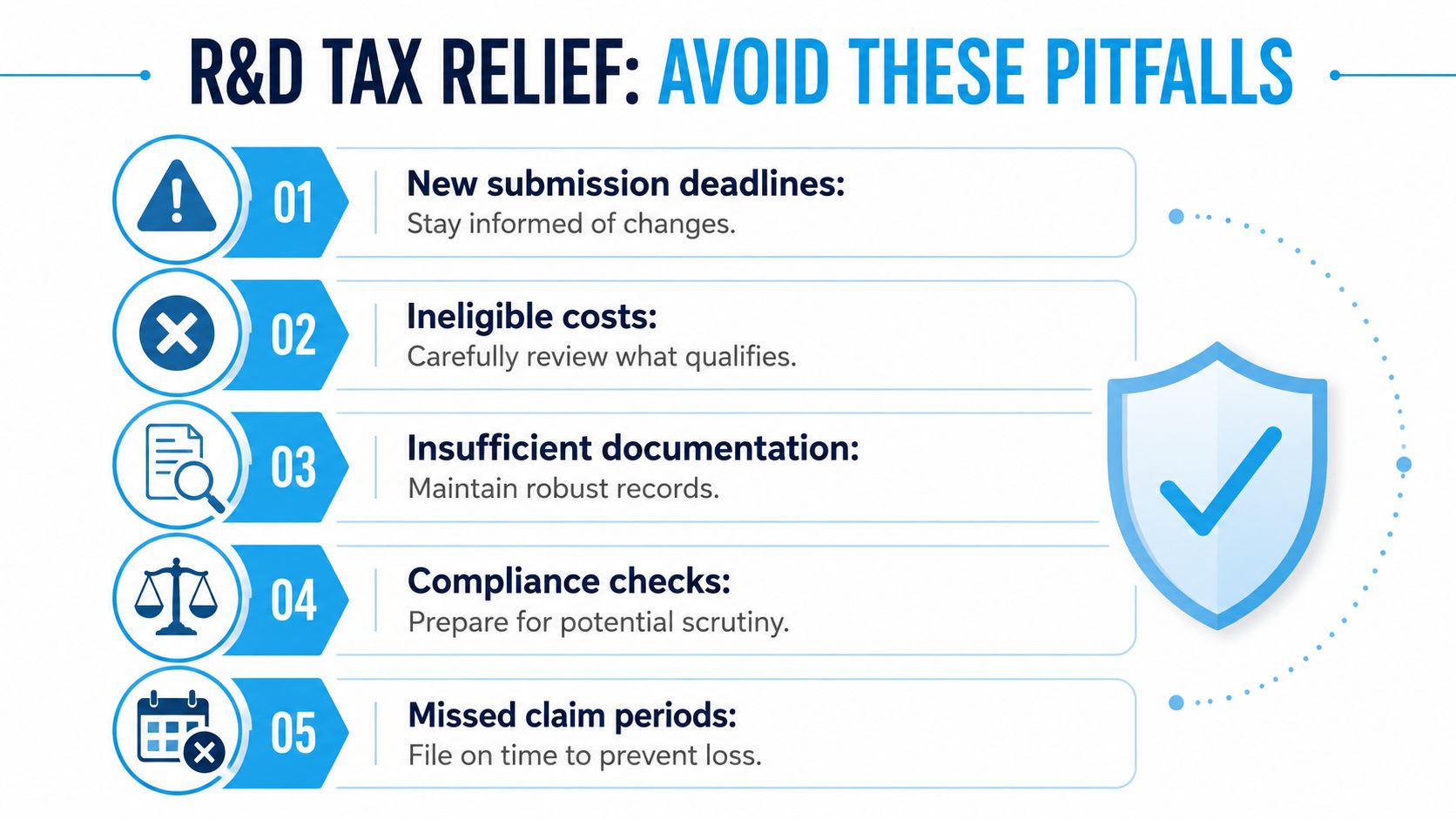
The old assumption was that a sensible technical project plus a rough cost schedule would usually get a claim over the line. That assumption no longer holds.
The current environment is far less forgiving. The technical case has to be sharper, the submission has to be cleaner, and overseas activity now creates a bigger risk than many growing companies realise.
Overseas expenditure is now a major pressure point
From 1 April 2024, the default rule is that only UK-based R&D costs qualify, and overseas expenditure, including payments for Externally Provided Workers not on UK PAYE, is now largely ineligible unless strict conditions show the work could not have been undertaken in the UK, according to the government's updated guidance on contracting-out rules and overseas restrictions.
That has immediate implications for software businesses using offshore developers, engineering firms drawing on overseas contractors, and groups that split technical delivery across jurisdictions. The risk isn't theoretical. Costs that would once have been assumed eligible may now fall out of the claim altogether.
The claims process is more document-heavy
Recent claims require more than a figure in the tax computation. HMRC now expects a more developed technical narrative through the Additional Information Form.
That means the business should be ready to explain:
- What the project was trying to achieve
- Where the scientific or technological uncertainty sat
- What methods were attempted
- What happened as a result
A short paragraph copied from a proposal document usually won't do the job. Technical staff often need input from finance to keep the narrative precise, commercially accurate, and consistent with the numbers in the claim.
Three mistakes that create avoidable risk
Warning: A claim can be valid in principle and still fail in practice if the records, narrative, or cost treatment don't line up.
- Weak evidence trails: Time spent, staff roles, subcontract arrangements, and project notes need to reconcile.
- Ignoring the payable credit cap: Cash claims for SMEs can be limited by the PAYE and NIC cap, so payroll structure matters.
- Treating every development project as qualifying: Plenty of commercially valuable work still falls outside HMRC's R&D definition.
For many companies, the fix is process rather than paperwork. Project leads need prompts during the year. Finance needs a framework for cost capture. Directors need to review risky areas early, especially where overseas teams or contractor-heavy delivery are involved.
Businesses that need support with this kind of technical and tax alignment often look at specialist help such as R&D tax relief and Patent Box support, particularly where claims are material or the internal team is stretched.
Your R&D Claim Timeline and Next Steps
An R&D claim usually runs more smoothly when it follows the accounting cycle instead of fighting it. The practical sequence matters.
The normal claim flow
- The business carries out the qualifying work during the accounting period.
- The finance team identifies candidate projects and gathers supporting technical evidence.
- Qualifying costs are analysed alongside the Year End process and tax computation.
- The claim is prepared and submitted with the Corporation Tax return, supported by the required additional information.
The key commercial point is timing. If the team leaves the review until long after the Year End, records degrade, staff forget details, and technical leads move on. The claim becomes slower, riskier, and more expensive to prepare.
What should happen now
A finance leader reading this should turn the topic into a short action list.
- Review the last two financial years: Identify projects that involved real technical uncertainty.
- Speak to technical managers: Ask what the team tried that wasn't straightforward or standard.
- Map the cost base: Pull staff, software, consumables, and worker costs that may relate to those projects.
- Flag overseas involvement early: These costs need especially careful review.
- Check filing discipline: Make sure the claim process is tied into Statutory Accounts and Corporation Tax preparation.
The strongest claims are rarely built from memory. They're built from project evidence gathered before the year-end rush takes over.
Conclusion When to Partner with an R&D Specialist
R&D Tax Relief can be a meaningful source of cash preservation and tax efficiency. It can reduce the after-tax cost of innovation, support working capital, and improve the return on development spend.
It can also become a risk area very quickly. The rules are more demanding, the evidence burden is higher, and the wrong treatment of overseas costs, staffing structures, or project narratives can undermine a claim that looked sound internally.
A business should seriously consider specialist input when any of the following applies:
- It's the first claim: The team hasn't yet built a reliable process for identifying and evidencing projects.
- Projects run across more than one year: Costs and technical narratives need tighter coordination.
- Overseas workers or offshore development are involved: Eligibility is much harder than many assume.
- The claim is material to cash flow: The downside of getting it wrong is too large to leave to guesswork.
- Internal capacity is thin: Finance and technical teams may know the business, but still lack time to prepare a well-supported submission.
One option is a specialist adviser that can work with the finance team, technical staff, and Corporation Tax process without treating the claim as a box-ticking exercise. Used properly, that support isn't just about maximising value. It's about reducing rework, protecting the filing position, and keeping management attention focused on growth rather than dispute resolution.
Frequently Asked Questions about R&D Tax Relief
What counts as R&D for tax relief in the UK?
Work can qualify if it seeks an advance in science or technology, involves genuine uncertainty, and requires competent professionals to resolve that uncertainty. Commercial importance alone isn't enough. The project needs a technical challenge that couldn't be solved easily using existing knowledge.
Can a loss-making company claim R&D Tax Relief?
Yes, in some cases. For accounting periods before 1 April 2024, qualifying SMEs meeting the R&D intensity requirement may be able to claim a payable credit rather than only using the relief against taxable profits.
Do overseas developers qualify for R&D Tax Relief?
Often not under the newer rules. From 1 April 2024, the default position is that UK-based R&D costs qualify, while overseas costs are largely excluded unless strict conditions are met.
Is software development eligible for R&D Tax Relief?
Sometimes. Software work can qualify where the team is trying to resolve genuine technological uncertainty, such as performance, scalability, or integration challenges. Routine configuration, implementation, or cosmetic changes usually won't qualify.
When should a company prepare its R&D claim?
Ideally during the accounting cycle, not months later. Claims are stronger when project evidence, staff involvement, and cost data are captured close to the work itself and then aligned with the Corporation Tax return.
Book a focused R&D Tax Relief review with striveX Ltd if the business needs a clearer view of qualifying projects, risky cost areas, or claim readiness before filing. A short initial conversation can help finance leaders decide whether there's a credible claim, what evidence is missing, and where the main risks sit.
This article is for informational purposes only and does not constitute professional advice. Tax rules apply as of April 2026. Consult a qualified accountant for your specific circumstances.
