

Manufacturing and engineering confidence fell to -13.7 in Q2 2026, down from +1.7 in Q1, making project-level cost, utilisation and margin visibility commercially urgent. Engineering firms rarely fail because of poor workmanship. More often, management accounts don't show which projects are consuming cash, which teams are productive, or where margin is disappearing.
An operations director can see a full order book and rising turnover while the FD sees tighter cash, delayed applications for payment and work in progress that isn't converting into profit. The monthly pack may confirm what happened last month, but it may not explain why a fabrication project is late, why machine capacity is idle or why a fixed-price contract is absorbing more labour than planned.
Engineering accountants add value when they connect the ledger to the workflow. That means job costing, labour and machine utilisation, overhead absorption and margin-by-project reporting, supported by disciplined forecasting and commercial review.
When Turnover Hides a Margin Problem
A growing engineering business can look healthy at board level while individual projects weaken underneath. Statutory Accounts and a conventional profit and loss account might show turnover, gross profit and overheads, but they won't necessarily reveal whether design, fabrication, assembly, testing or commissioning is responsible for the variance.
The problem usually starts with classification. Labour is posted to a broad department, materials are recorded against a supplier account and machine costs sit in an overhead line. Finance can reconcile the numbers, but management can't trace them back to the project decisions that created them.
That gap matters in a volatile market. ICAEW's Manufacturing and Engineering Business Confidence Monitor data reported confidence of -13.7 in Q2 2026, compared with +1.7 in Q1 and a historical average of +4.5. The same report recorded annual exports growth of 1.1%, employment growth of 0.1%, profit growth of 2.0% and capital investment growth of 1.1%. These conditions increase pressure on pricing, payroll planning, cash flow and investment decisions.

What the monthly pack should expose
A useful management pack should allow the board to answer:
Which projects are profitable? Show budget, committed cost, actual cost, forecast cost to complete and expected margin.
Where is capacity being lost? Separate productive hours from paid hours, and machine operating time from available time.
Who is funding the work? Connect invoicing, applications for payment, retention and work in progress to the cash forecast.
What changed this month? Explain scope changes, supplier movements, rework, downtime and delayed approvals.
Engineering accountants produce cleaner reports. They build a bridge between operational activity and financial decisions. That bridge helps leaders intervene while a project can still be recovered, rather than explaining the loss after Year End.
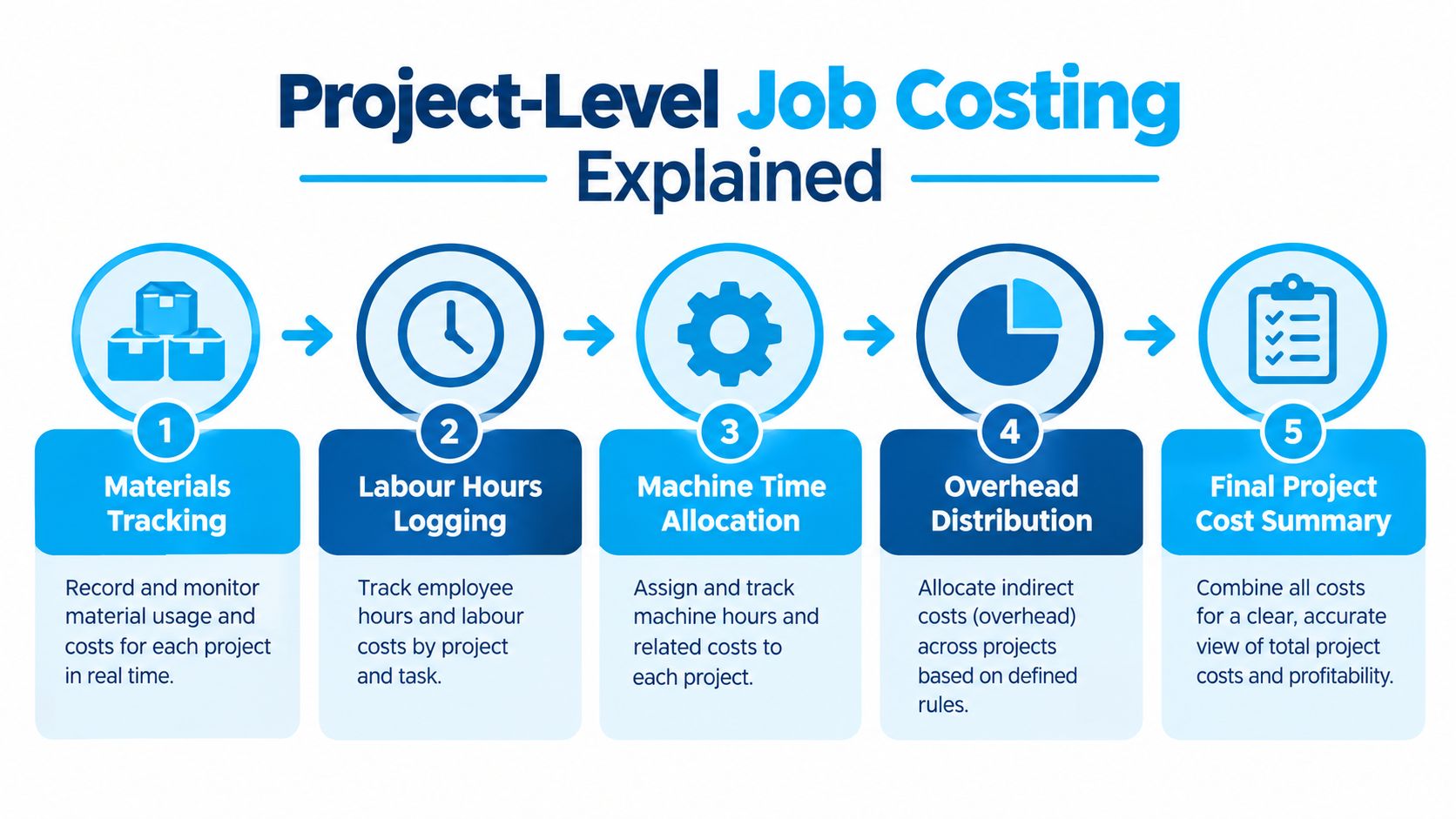
Project-Level Job Costing Explained
Job costing assigns direct expenditure to a specific project, phase or work order. For an engineering firm, that normally means more than putting an invoice against a customer name. The structure needs to follow how the business delivers work.
A typical workflow may include design, procurement, fabrication, assembly, testing and commissioning. Each phase should capture the resources it consumes, including materials, direct labour, machine time, subcontractors and site expenses.
A workable costing structure
A practical project code can follow this pattern:
Project: The customer order or contract.
Phase: Design, fabrication, assembly, testing or commissioning.
Resource: Labour grade, material category, machine or subcontractor.
Cost status: Actual, committed, accrued or forecast.
Commercial status: Billed, uninvoiced, work in progress or disputed.
manufacturing cost analysis for managers
Consider a fabricated skid. The design team logs hours to the design phase, procurement records steel and bought-in components against the project, production records machine time, and the site team captures commissioning hours and travel. If a supplier invoice arrives late, an accrual keeps the project margin realistic in the current month.
The monthly reconciliation then compares the original budget with actual cost and the latest estimate to complete. A project may be under budget on materials but already over budget on design hours. Without phase-level detail, those movements cancel each other out in a single total and the warning arrives too late.
The difference between a useful report and a spreadsheet dump is consistent ownership. Project managers need to approve hours, procurement needs to record commitments and finance needs to challenge missing or unusual entries.
Labour and Machine Utilisation Metrics
Utilisation connects capacity to financial performance. Labour utilisation is calculated by dividing productive or billable hours by available paid hours. Machine utilisation uses effective operating time divided by available operating time.
The calculation is simple. Interpretation isn't.
A design engineer may have strong productive utilisation while fabrication equipment remains idle because drawings aren't approved. Conversely, a machine may run continuously while rework, poor sequencing or low recovery rates erode the project margin. Gross profit alone won't show that operational relationship.
Read utilisation alongside margin
track operational and financial performance
Engineering firms should report utilisation by role, project type and work stage, rather than relying on one company-wide figure. The monthly pack might include:
Labour capacity: Available hours, productive hours, absence, training and non-chargeable administration.
Machine capacity: Available hours, operating hours, planned downtime, unplanned downtime and changeover time.
Recovery: Productive hours multiplied by the applicable charge-out or recovery rate.
Commercial result: Forecast project margin after labour, machine and absorbed overhead costs.
The right response depends on the cause. Low labour utilisation caused by weak scheduling may require a resource-planning change. Low machine utilisation caused by delayed materials needs procurement action. Low recovery caused by outdated pricing requires a commercial review, not pressure on the workshop.
A high utilisation figure can also mislead. If the team is busy on underpriced work, higher activity may accelerate losses. The operations director therefore needs utilisation beside margin by project, backlog quality and cash conversion.
Overhead Absorption Methods for Engineering Firms
Overhead absorption allocates indirect costs to the work that uses shared resources. Those costs might include rent, utilities, production supervision, administration, maintenance and equipment depreciation.
Direct tracing is appropriate where the cost clearly belongs to one project. A dedicated site supervisor, project-specific travel or a specialist test can usually be assigned directly. Shared costs need a rational driver.
Choosing the right driver
A labour-intensive consultancy may absorb overhead using direct labour hours. A fabrication business may find machine hours more representative. A mixed engineering firm might use separate rates for design, production and site work, because one blended rate can distort project performance.
| Cost type | Suitable treatment | Reason |
|---|---|---|
| Dedicated site travel | Direct trace | The project creates the cost |
| Shared production supervision | Machine or labour hours | The driver reflects resource use |
| Workshop utilities | Machine hours or machine capacity | Equipment consumes the resource |
| General administration | Agreed overhead pool | The cost supports multiple activities |
Over-absorption makes reported project margins look stronger than the economic reality. Under-absorption does the opposite, leaving the business with a cash shortfall when actual overheads exceed the amount recovered through work.
Rates should be reviewed when the cost base, capacity or mix of work changes. A rate built on full machine availability becomes unreliable after significant downtime. Similarly, a labour rate becomes misleading if the business moves from standard fabrication to complex one-off work.
The aim isn't perfect precision. It is a consistent method that reflects how resources are consumed, highlights unusual variances and supports better pricing. Engineering accountants should document the drivers, reconcile absorbed overhead to actual overhead and explain the difference in the monthly pack.
Worked Examples From Costing to Margin Reporting
A typical engineering workflow shows why these measures belong together. Consider a Midlands-based manufacturing client with £8 million turnover. The management pack reports each project by design, fabrication, assembly and commissioning, with labour and machine utilisation alongside forecast cost to complete.
On one project, design utilisation is high but machine utilisation is weak. The project manager initially sees a busy team and assumes progress is satisfactory. The project report tells a different story. Approved drawings are arriving late, the fabrication schedule is fragmented and fixed workshop costs are being spread across fewer productive machine hours.
The finance team records the unabsorbed overhead separately rather than hiding it inside a general variance. That makes the commercial decision visible. Operations can resequence work, procurement can address material timing and the project manager can identify whether a client-driven delay supports a variation claim.
A simple margin walk
Suppose a project budget contains:
Design: Planned hours and engineering salaries.
Fabrication: Direct labour, material and machine time.
Assembly and testing: Labour, bought-in services and specialist inspection.
Commissioning: Site labour, travel and project-specific costs.
Shared overhead: Absorbed using the agreed machine or labour driver.
The monthly report then shows original budget, actual cost, committed cost and forecast cost to complete. If fabrication materials are favourable but commissioning hours are rising, the project manager sees the margin effect before the final invoice.
A second project may show strong labour utilisation but under-absorbed overhead because unplanned downtime reduced machine hours. The business can then distinguish a delivery problem from a pricing problem. Supplier terms, scheduling, maintenance and client negotiations become specific actions rather than general concerns.
This approach doesn't turn every project into a success. It gives leadership enough information to decide whether to recover cost, change sequence, revise the forecast or stop repeating an unprofitable job type.

The Commercial Value of Specialist Engineering Accounting
Compliance keeps the records in order. Commercial finance explains why a profitable-looking order is consuming cash, which jobs are under-recovering overhead, and whether additional capacity will improve returns. For an engineering business, that means connecting job costing, utilisation, overhead absorption and project margin in the monthly management pack.
A monthly pack should show more than revenue and gross profit. It should reconcile booked hours, productive utilisation, machine time, absorbed overhead, work in progress, forecast cost to complete and expected cash receipts. That link lets directors trace a margin movement back to shop-floor activity. For example, lower machine hours can leave fixed costs under-absorbed, while delayed milestones can hold profit in work in progress and postpone collection.
The profession is large enough to support specialist finance expertise. CCAB's accountancy profession report reported 432,200 accountants across the UK economy in 2017, but that figure is dated and a more recent measure should be used where available. The point is not the size of the profession. It is whether the finance support understands engineering work orders, labour grades, machines, subcontracting and contractual recovery.
improve project margin with ERP
From compliance to financial leadership
For a business scaling between £1 million and £15 million turnover, specialist support can strengthen the finance function before a full-time senior team is justified. It should provide:
engineering and industrial businesses
Forecasting: Connect order intake, resource plans, milestones, cost to complete and payment timing.
Contract review: Expose fixed-price risk, provisions, retentions and weak change control.
Tax planning: Consider Corporation Tax, VAT, remuneration and eligible R&D activity.
Investment decisions: Test equipment purchases against funding needs, capacity and utilisation.
Board reporting: Present margin, cash, risk and operational drivers in a form directors can act on.
Tax relief does not correct weak costing. Full expensing capital allowances and the merged R&D scheme may apply to qualifying expenditure, but an eligible claim cannot compensate for poor utilisation or inadequate overhead recovery.
How to Choose a Specialist Accountancy Partner
The right accountancy partner should understand how an engineering business earns and spends money. A firm that only produces Statutory Accounts may be technically competent but still unable to explain why a project is losing margin or why cash is tied up in work in progress.
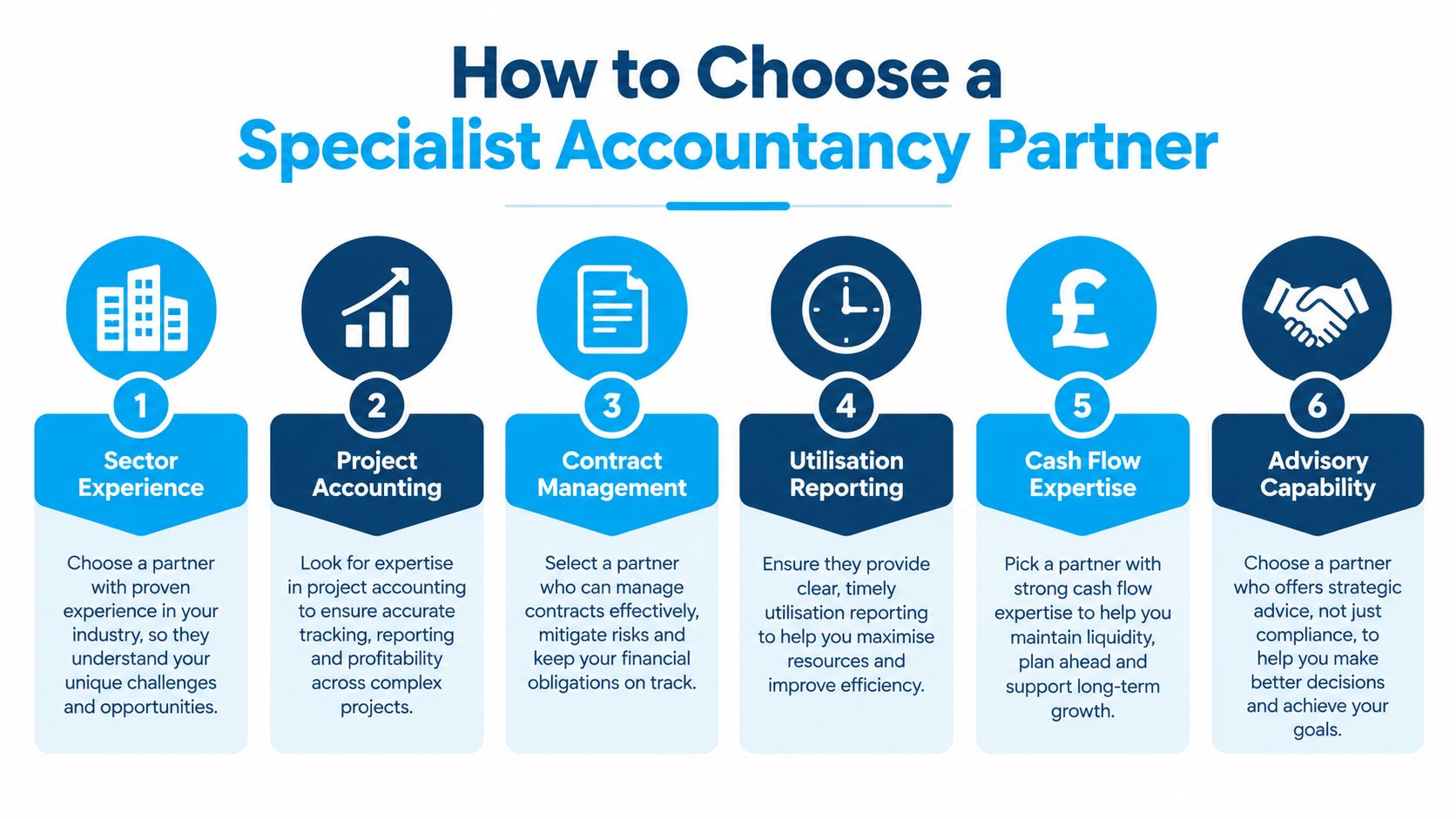
The assessment should cover six areas:
Sector experience: Ask for evidence of work with project-based engineering, manufacturing or technical consultancies.
Project accounting: Check whether reporting follows phases, work orders, labour grades, machines and subcontractors.
Contract management: Establish how the partner handles variations, provisions, retentions and revenue recognition.
Utilisation reporting: Confirm that labour and machine capacity can be shown beside project margin.
Cash flow expertise: Test whether forecasts incorporate billing milestones, supplier terms, payroll and capital spending.
Advisory capability: Explore support for pricing, funding, tax planning, full expensing and R&D Tax Credits.
Compare the working relationship, not just the fee
A fixed-fee package offers predictability for recurring management accounts, VAT, payroll and Year End work. Hourly advisory can suit irregular transactions or a complex contract review, but it makes budgeting harder. A blended arrangement can combine a defined monthly pack with separately scoped FD or project support.
accounting and outsourcing service
Software integration matters, but process ownership matters more. The partner should explain who approves timesheets, who codes materials, how committed costs are captured and when forecasts are refreshed. Cloud accounting and document capture can reduce manual handling, but the monthly review still needs commercial judgement.
At striveX Ltd, the service model includes management reporting, VAT compliance, tax planning, R&D claims and outsourced finance support for growing businesses.
Before signing, request a sample anonymised management pack, confirm reporting frequency and ask how quickly issues are escalated. A partner should be able to describe the first reporting cycle in operational terms, not just list qualifications.
Common Misconceptions About Engineering Accounting
The first misconception is that engineering accountants mainly reduce tax. Tax planning matters, but a Corporation Tax saving can't correct an underpriced contract, recover an unbilled variation or explain why a machine is idle. The more valuable service is often the regular link between project activity, margin and cash.
The second is that specialist accounting only suits large groups. A growing SME can face the same costing weaknesses as a much larger business, especially when projects become longer, work in progress grows and the owner can no longer review every job personally. Early management reporting gives directors a basis for deciding whether they need a finance manager, outsourced FD support or better operational discipline.
A third misconception is that an in-house bookkeeper provides the same capability as an external specialist. Bookkeeping records transactions. It doesn't automatically create a costing hierarchy, challenge an optimistic estimate to complete or compare machine utilisation with absorbed overhead. Internal teams remain essential, but external engineering accountants can add sector perspective, structured review and support during periods of change.
Tax incentives don't replace commercial control
Full expensing capital allowances can be relevant when a company invests in qualifying plant and machinery. The merged R&D scheme may also be relevant where qualifying development work meets the rules. However, the benefit depends on accurate records and eligibility, and neither incentive improves the economics of a project that has been priced badly.
The same principle applies to R&D Tax Credits. Engineering firms need to identify qualifying activity, retain suitable records and separate technical uncertainty from routine engineering work. A claim should sit alongside reliable project accounting, not distract from it.
A practical starting review should ask:
Are labour hours recorded against the correct project phase?
Are material commitments visible before supplier invoices arrive?
Can the monthly pack show forecast margin by project?
Are machine hours and downtime measured consistently?
Does the overhead rate reflect current capacity and resource use?
Can cash flow be traced to billing milestones and work in progress?
If the answers are unclear, the next step is a short diagnostic rather than a wholesale system purchase. Review the chart of accounts, project codes, timesheet discipline, purchase order process and month-end timetable. Then define the minimum monthly pack that the MD, FD and operations director will use together.
The legal position also needs clarity. In the UK, Chartered Accountant status and Chartered Engineer status come from distinct royal-charter traditions. UK legislation recognises Chartered Accountant titles for ICAEW, ICAS and CA Ireland, while Chartered Engineer is separately designated for the Engineering Council. The 1991 regulations list the traditions separately, which helps explain why “engineering accountant” describes a specialist service niche rather than one standalone regulated profession.
The practical test is simple. If management accounts only report turnover and total gross profit, they aren't yet giving leadership enough control over project economics. A specialist partner should help build reporting that connects work performed, resources consumed, margin earned and cash collected.
This article is for informational purposes only and does not constitute professional advice. Tax rules apply as of April 2026. Consult a qualified accountant for your specific circumstances.
striveX Ltd supports UK engineering and industrial businesses with management accounts, project accounting, tax planning, R&D Tax Credits, VAT and outsourced finance support. Become a client to discuss your current job-costing structure and the reporting changes needed for clearer project margin and cash visibility.