


A business can reach £1 million in turnover and still feel financially blind.
Sales are coming in, the team is growing, and the founder is making bigger decisions on hiring, stock, software, pricing and tax. Yet the numbers often still live in scattered spreadsheets, last month’s management accounts arrive too late to be useful, and cash feels tighter than the turnover figure suggests. That’s usually the point where gut feel stops being enough.
That’s the practical answer to what is financial strategy. It isn’t a corporate buzzword. It’s the commercial system that connects cash, profit, tax, funding and reporting to the decisions that shape growth.
For a scaling UK SME, that matters because growth creates pressure before it creates comfort. More staff mean more PAYE exposure. More customers mean more working capital strain. More product development or process improvement can create tax opportunities, but only if finance is organised early enough to capture them.
From Growing Pains to Strategic Growth
Many businesses don’t fail because demand disappears. They struggle because the finance function never caught up with the pace of growth.
The usual pattern is familiar. Turnover rises, but so do payroll, supplier commitments and VAT pressure. A director knows the business is “doing well”, but can’t answer basic board-level questions quickly: Can the business afford another senior hire? Should it lease or buy equipment? Is there enough headroom for a slower quarter? Are margins holding up by customer or product line?
That’s where a proper financial strategy changes the conversation. Instead of treating finance as record-keeping, the business starts using it as a decision framework.
What financial strategy actually means in practice
At SME level, financial strategy is the plan for how the business will:
- Generate cash reliably enough to fund operations and growth
- Protect margin so extra turnover doesn’t just create extra strain
- Structure tax sensibly, rather than reacting near Year End
- Fund investment without weakening the business
- Report performance in a way directors can act on
A generic definition misses a key issue. A growing UK company needs a strategy that reflects UK tax rules, UK financing realities and UK compliance pressure.
That includes opportunities many broad guides ignore. According to HMRC data cited in this analysis of hidden financial strategies for SMEs, UK SMEs claimed £5.8 billion in R&D tax credits in 2023/24, yet 25% of eligible firms miss out because the relief isn’t built into financial planning.
Financial strategy matters when it turns finance from hindsight into choice.
A business without strategy usually reacts. A business with strategy decides earlier, with better information and fewer surprises.
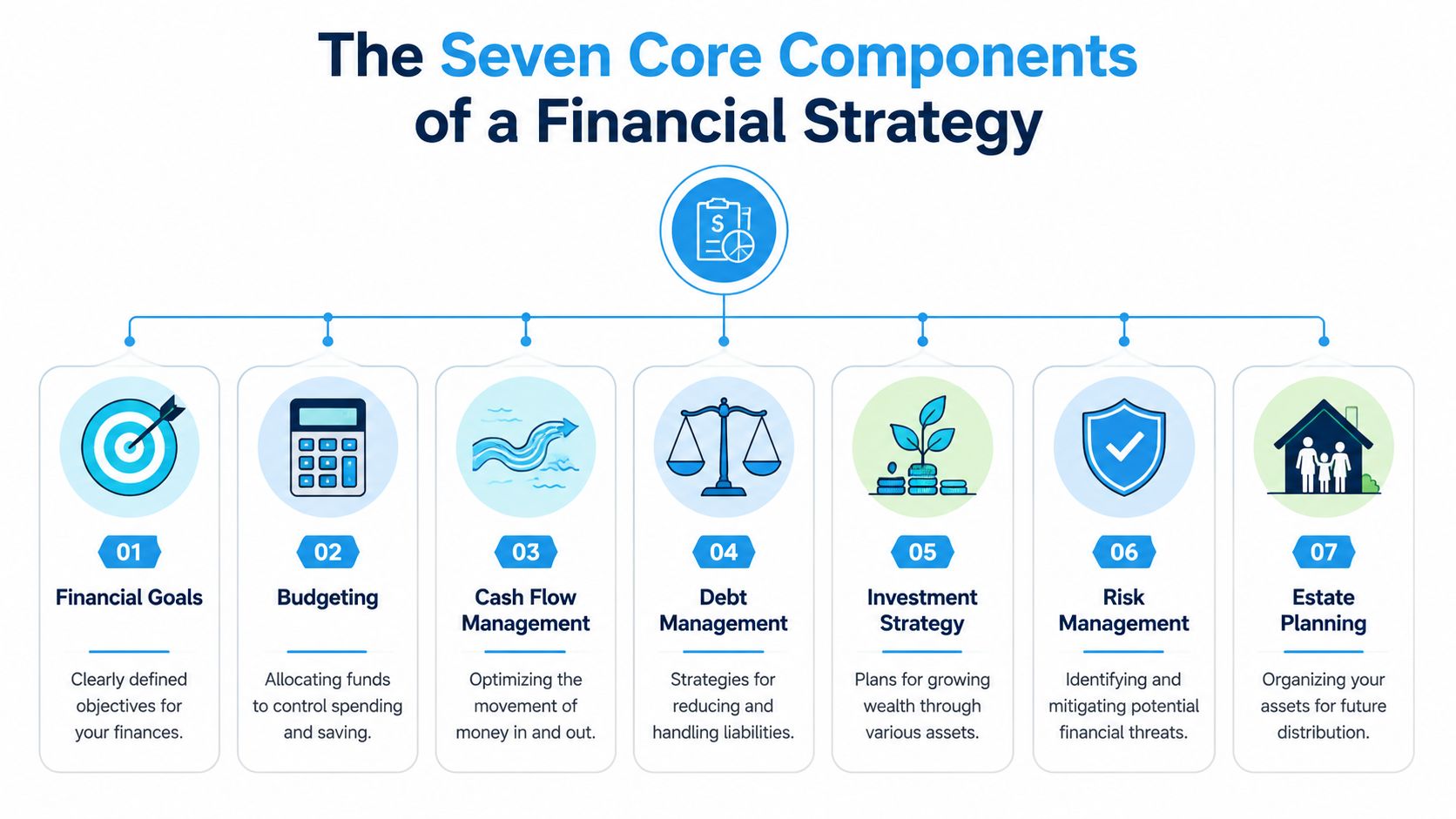
The Seven Core Components of a Financial Strategy
A useful financial strategy isn’t one document. It’s a set of connected controls. For a £5 million manufacturing business, these are the seven dials that need active management.
Cash flow management
Cash flow is the first discipline, because profitable businesses can still run into trouble when cash arrives too slowly or leaves too quickly.
For UK SMEs, maintaining positive net cash flow above 5% of turnover is linked with 22% higher year-on-year turnover growth than peers with negative flows, according to the British Chambers of Commerce survey summarised in the verified data. For a £10 million turnover business, a rolling 13-week cash flow forecast is a practical requirement, especially where VAT timing under Making Tax Digital can create pressure.
For a manufacturer, that usually means tighter debtor control, realistic stock purchasing and clear weekly visibility on payroll, VAT and supplier runs. Businesses that want a deeper grounding in this area should understand working capital management before they chase further growth.
Capital structure
Capital structure is the mix of retained profit, debt and other funding used to support the business.
Too much borrowing creates fragility. Too little funding can leave a strong business underpowered. In practice, a £5 million manufacturer needs to match funding to the asset base and trading cycle. Long-term investments shouldn’t be funded by cash that’s needed for wages next month.
Budgeting and forecasting
A budget gives direction. Forecasting keeps it useful.
A static annual budget often becomes irrelevant within a quarter. What works better is a live forecast that updates assumptions around sales mix, input costs, gross margin and overhead timing. Variance review is central here. This short Numeric guide to budget variance is a useful reference because it shows how directors can compare plan against actual performance without turning the process into accounting theatre.
For a manufacturing company, this might mean spotting that turnover is ahead of plan while margin is behind it because input costs moved faster than selling prices.
Tax planning
Tax planning isn’t about playing games with HMRC. It’s about making commercial decisions with the tax effect understood in advance.
For a scaling SME, that often covers:
- Corporation Tax timing around profit recognition and planned expenditure
- VAT management so payment dates don’t surprise the business
- R&D Tax Credits where development activity, process innovation or technical work qualifies
- Director remuneration structured sensibly for the company and the individual
When tax is left until Year End, options narrow. When it’s built into the operating plan, directors usually keep more control over cash.
Investment and growth financing
Growth needs capital. The question is whether the proposed spend will produce enough return, quickly enough, with an acceptable level of risk.
A £5 million manufacturer might face choices around machinery, premises, recruitment or process automation. Financial strategy forces those decisions through a filter: what’s the payback period, what’s the cash effect, and what gets delayed if this goes ahead?
Risk management
Risk management in finance means identifying what could damage cash, margin or continuity, then deciding what protection is worth paying for.
That includes customer concentration, foreign exchange exposure, debt burden, covenant pressure, supply disruption and compliance failure. It also includes planning for a weaker trading period, not just the best case.
Practical rule: If a downside scenario would force rushed decisions, the business needs to model it before it happens.
Reporting and KPIs
Reporting is where strategy becomes governable.
Good reporting doesn’t drown directors in numbers. It highlights the handful of metrics that show whether the business is moving towards its goals. For a manufacturing company, that could include gross margin, debtor days, stock position, operating cash movement, forecast headroom and product line profitability.
Without this, leadership meetings turn into opinion contests. With it, they become decision meetings.
Aligning Your Financial Engine with Your Business Goals
A financial strategy that isn’t tied to the business plan is mostly paperwork.
The finance function is the engine. Business strategy is the steering. If those two aren’t connected, the company may still move fast, but it won’t move deliberately.
Different goals need different financial choices
Consider two businesses with similar turnover.
One is a software company trying to win market share quickly. It may accept lower short-term profit while investing heavily in product development, sales capacity and customer acquisition. Its financial strategy should support that ambition with tighter forecasting, careful cash runway planning, disciplined investment review and full attention to tax reliefs linked to qualifying development work.
The other is an established engineering firm owned by a family that wants steady profit, controlled risk and reliable dividend extraction. Its strategy should look different. More emphasis goes on margin protection, debt reduction, cash resilience and measured capital expenditure.
Both can be well run. Both can be financially sound. But they shouldn’t use the same model.
What misalignment looks like
A business usually has a strategy mismatch when it says one thing and funds another.
Examples include:
- Growth language, defensive finance: The board talks about expansion but won’t invest in sales capacity, systems or stock.
- Stability language, aggressive commitments: Directors say cash discipline matters but keep taking on fixed costs based on optimistic assumptions.
- Innovation goals, weak tax integration: The company invests in technical development but doesn’t organise records to support relief claims.
When finance and strategy pull in different directions, cash usually takes the strain first.
The right question isn’t “What should a good financial strategy look like?” It’s “What financial strategy supports this specific business goal without creating avoidable risk?”

A High-Level Roadmap to Build Your Financial Strategy
Most businesses don’t need a thicker spreadsheet. They need a clearer process for deciding what the numbers are meant to achieve.
Phase one: diagnosis and goal setting
Start with reality, not aspiration.
Review historical performance and ask direct questions. Which customers, products or contracts produce cash? Where does margin leak away? What has driven working capital pressure over the last year? Then set one-year, three-year and five-year goals that are financially specific.
Those goals usually cover profit quality, cash generation, tax efficiency, debt capacity and investment priorities.
Phase two: three-way forecasting
A financial strategy becomes credible when the profit and loss, balance sheet and cash flow are linked.
That’s where many SME models fall down. A sales forecast on its own isn’t enough. If turnover rises, stock, debtors, VAT and staffing may rise with it. The board needs an integrated view of what growth does to cash.
A useful starting point is this guide on how to build a great financial forecast, because it focuses on turning assumptions into a model leadership teams can use.
Phase three: scenario planning
The main job here is not prediction. It’s preparedness.
A leadership team should model at least three versions of the future:
- Expected case based on current trading assumptions
- Downside case where sales slip, costs rise or receipts slow
- Upside case where demand arrives faster than the business can comfortably fund
That exercise changes behaviour. Hiring plans become more disciplined. Stock decisions improve. Directors see where funding pressure would emerge before it becomes urgent.
Phase four: structuring and financing
This phase tests whether the business is funded in a way that suits its strategy.
Questions worth asking include:
- Is debt being used for the right purpose?
- Would a different legal or group structure improve tax efficiency?
- Are directors drawing money in a way that weakens working capital?
- Does the business have enough headroom for planned investment?
The point isn’t complexity. It’s fit.
Phase five: reporting and review cadence
A strategy only works if someone checks whether it’s still working.
That means monthly reporting that arrives quickly enough to matter, plus a quarterly board rhythm focused on action rather than explanation. The review pack should show the movement in key KPIs, current forecast position, tax exposure, cash outlook and decisions required.
Good financial strategy is reviewed regularly. It isn’t written once and filed away.
Common Financial Strategy Pitfalls for UK SMEs
The most expensive financial mistakes often look sensible in the moment. They only become obvious when cash tightens, tax lands, or margin disappears.
The turnover trap
Some businesses chase sales too hard and stop asking whether the extra work is worth doing.
The symptoms are familiar: headline turnover grows, operations feel busier, but cash remains strained and the bottom line disappoints. Directors then assume the answer is even more sales. Usually it isn’t. The better correction is to examine gross margin by customer, service line or product category and cut or reprice work that consumes effort without adequate return.
The reactive tax problem
Many SMEs still treat Corporation Tax and VAT as Year End issues. That approach costs money and removes options.
A reactive tax position leads to rushed decisions, poor timing on expenditure, weak remuneration planning and missed relief claims. A stronger approach brings tax into quarterly planning so directors can assess commercial decisions with the tax effect already visible.
The static budget fallacy
An annual budget has value, but only if it stays alive.
Businesses get into trouble when they approve a budget, circulate it in January and barely revisit it until the next planning cycle. Markets move. Input costs change. Debtor behaviour shifts. A live forecast is the strategic correction because it lets directors respond while there’s still time to influence the outcome.
How an Outsourced Finance Function Implements Your Strategy
Understanding what financial strategy is doesn’t mean the business has the capacity to run it well.
Execution takes regular forecasting, management accounts, board reporting, tax planning discipline and someone willing to challenge assumptions before they become problems. That’s why many scaling SMEs use an outsourced finance model rather than waiting until they can justify a full in-house senior hire.
In sectors with volatility, that matters. Verified data shows that a 2025 ICAEW survey found 62% of UK SMEs in logistics and distribution report income volatility above 20% quarterly, yet only 15% use advanced analytics for forecasting. The same verified dataset notes that cash forecasting issues contribute to an 18% failure rate for scaling SMEs, according to ONS data.
An outsourced FD can put those controls in place, including rolling forecasts, KPI packs, cash planning and board-level decision support. For businesses comparing options, this overview of a fractional CFO for startups gives a useful picture of how part-time strategic finance support works in practice.
One example in the UK market is outsourced finance function support for fast-growth UK businesses, where the service sits between compliance work and full-time finance leadership. That model is often a better fit for companies that need sharper decisions now, not a larger fixed overhead.
Frequently Asked Questions About Financial Strategy
What is financial strategy in a small business?
It’s the plan for how a business manages cash, profit, tax, funding and reporting to support its commercial goals. In a scaling SME, it should help directors decide when to hire, invest, borrow, claim reliefs and protect working capital.
When should a UK SME create a financial strategy?
Usually once growth starts creating complexity. Common triggers include rising turnover, tighter cash despite stronger sales, more staff, larger VAT bills, investment plans, or the need for better board reporting and forecasting.
What are the most important metrics in a financial strategy?
That depends on the business model, but cash generation, gross margin, working capital movement and return on capital usually matter. For £1 million to £15 million turnover SMEs, target ROCE is typically above 15% for construction and manufacturing and above 25% for SaaS and tech. Firms exceeding those UK averages sustain an 18% lower cost of capital, according to the Bank of England SME Finance Monitor in the verified data.
Is financial strategy different from budgeting?
Yes. Budgeting is one component. Financial strategy is broader. It sets the commercial direction for funding, tax, reporting, investment and risk, then uses budgets and forecasts to keep the business on track.
A clear financial strategy helps a growing business make better decisions before cash gets tight, tax gets messy or investment goes off course. striveX Ltd supports UK companies turning over £1 million to £15 million with accounting, tax planning and finance strategy that connects reporting to action. A conversation through the contact page or book consultation page can help leadership teams assess what their current finance setup is missing and where stronger forecasting, tax planning or FD-level support could improve control.
This article is for informational purposes only and does not constitute professional advice. Tax rules apply as of April 2026. Consult a qualified accountant for your specific circumstances.
