


Meta title: What Is a Management Buyout? 2026 UK Guide
Meta description: Learn what a management buyout is, how MBOs work, and what to do next if you're planning an exit or succession for a stronger outcome.
A founder has built a solid company, the management team is capable, and stepping back is starting to feel realistic. The problem is that an external sale may feel disruptive, uncertain, or misaligned with what the owner wants for the business.
That's usually when the question lands on the table. What is a management buyout? For many UK SMEs, it's one of the most practical routes to succession because it keeps control with the people already running the company day to day.
For owners, MDs, and CFOs, the attraction is obvious. The buyer already understands the customers, staff, margins, weak spots, and operational rhythm. But familiarity doesn't make the deal easy. An MBO can be commercially strong or badly structured. The difference usually comes down to valuation discipline, funding design, tax planning, and whether the team is prepared to fully own the business rather than just manage it.
An Introduction to Management Buyouts
A management buyout, usually shortened to MBO, is a transaction where the existing management team buys the business from its current owner or shareholders. Instead of selling to a trade buyer or outside investor, the owner sells to the people already inside the company.
That sounds straightforward. In practice, it sits at the intersection of succession planning, finance, tax, and negotiation.
For an owner, an MBO can solve a very real problem. The business needs a future, but the owner wants continuity, discretion, and a buyer who won't spend months trying to understand how the company works. For the management team, it's a route from employment into ownership. That can be attractive, but it also means taking on risk, debt, and accountability at a different level.
An MBO often works best when the business is already operationally stable and the leadership bench is stronger than one individual. It tends to work less well when the owner still holds all the customer relationships, signs off every important decision, or effectively is the business.
Practical rule: If the company can't trade confidently without the owner for a sustained period, it isn't ready for a clean management buyout yet.
The commercial appeal is continuity. Customers, suppliers, and staff usually see less disruption because the leadership team is already known. The commercial risk is that both sides can assume too much. Buyers may overestimate what they can fund. Sellers may assume loyalty will bridge a valuation gap.
Owners considering succession should usually assess an MBO alongside other exit plans for businesses. When the legal framework starts taking shape, it also helps to understand the basics of managing buyout agreements, especially around deal terms, obligations, and what happens if the transaction doesn't complete as first expected.
The Anatomy of a Management Buyout
An MBO involves three moving parts. The seller wants a fair exit. The management team wants ownership on workable terms. Funders want confidence that the business can support the deal.
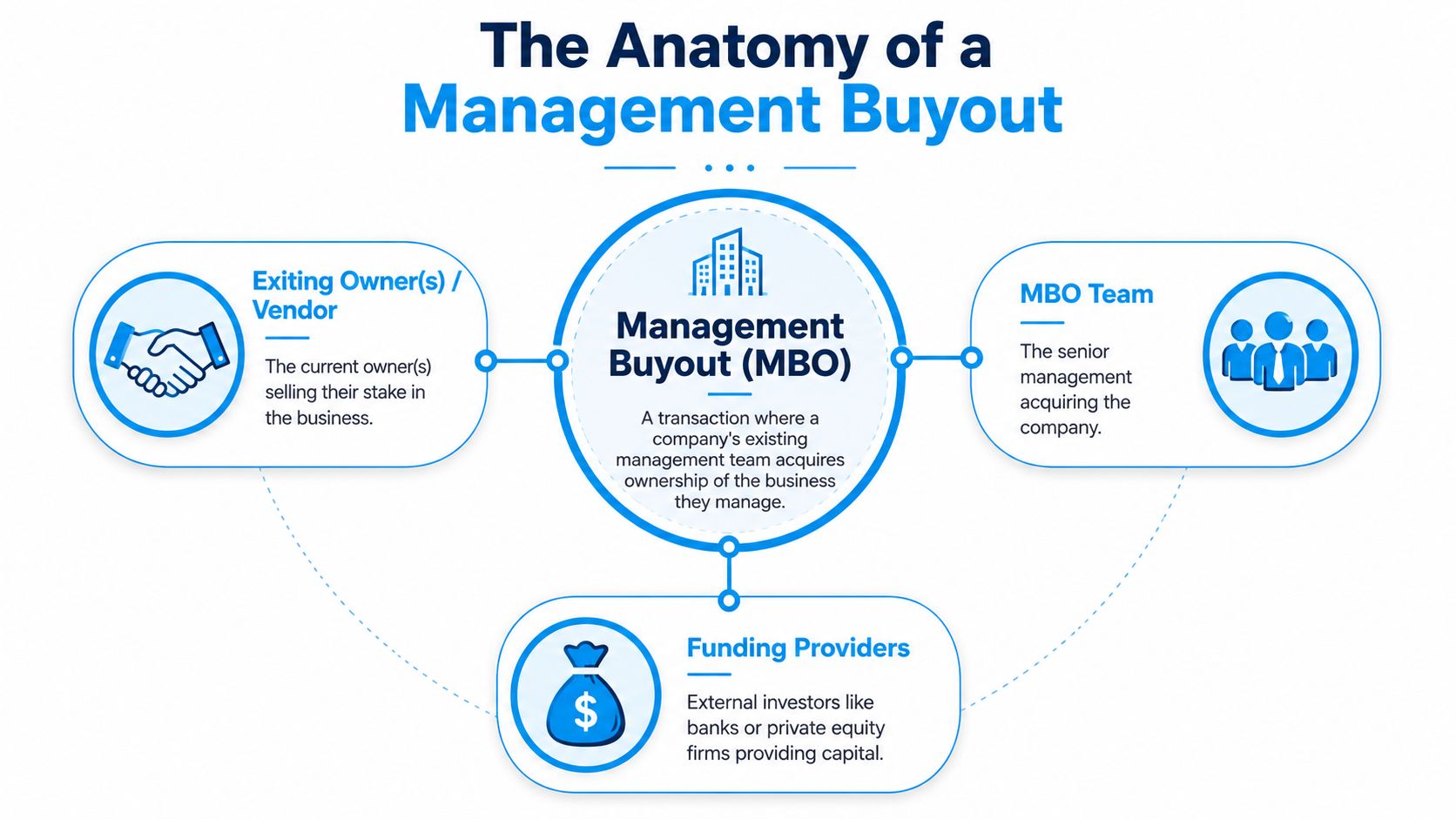
The key parties
A useful way to think about it is a well-run shop whose owner is ready to retire. The people who already run purchasing, staffing, and sales decide to buy the shop rather than let it go to an outsider. They know what works, where the cash is made, and what needs fixing. That insider knowledge is one reason MBOs can be attractive.
The usual participants are:
- The vendor. This is the current owner or shareholder group selling the company.
- The management team. These are the senior people leading the acquisition, often with different roles across finance, operations, sales, or delivery.
- Funding providers. These may include lenders, investors, or the seller if part of the price is deferred.
In many deals, the management team doesn't buy the trading company personally. A new holding company is often set up to make the acquisition. That helps organise ownership, funding, and governance more cleanly.
What makes an MBO different
An MBO is often confused with other deal types, so the distinction matters.
| Structure | Who buys the company | Main commercial implication |
|---|---|---|
| MBO | Existing management team | Continuity is stronger because the leadership already knows the business |
| MBI | External management team | Fresh leadership can help, but integration risk is usually higher |
| BIMBO | Mix of internal and external managers | Useful when the internal team is strong but has a capability gap |
The important point isn't the label. It's whether the buying group has enough depth to lead after completion.
A title on the org chart doesn't make someone a credible buyer. Funders and sellers look for decision-makers who can run strategy, cash, people, and execution without leaning on the outgoing owner.
Why structure matters early
A lot of problems begin when parties treat an MBO as a friendly internal handover. It isn't. It's a transaction with competing interests.
The seller wants value and certainty. The management team wants a price and structure that the company can carry. Funders want downside protection. If those interests aren't balanced early, the deal drifts into false optimism, then stalls when the numbers are tested.
Key Stages of a Typical MBO Transaction
A typical MBO does not fail because the documents were in the wrong order. It fails because one of the commercial assumptions was weak and nobody tested it early enough.
For an SME owner or management team, the process is usually less about learning a textbook sequence and more about making the right calls at the right time. The stages below are the usual route from first conversation to completion, but each one has a practical job. Keep the deal credible, protect trading performance, and avoid agreeing terms the business cannot support.
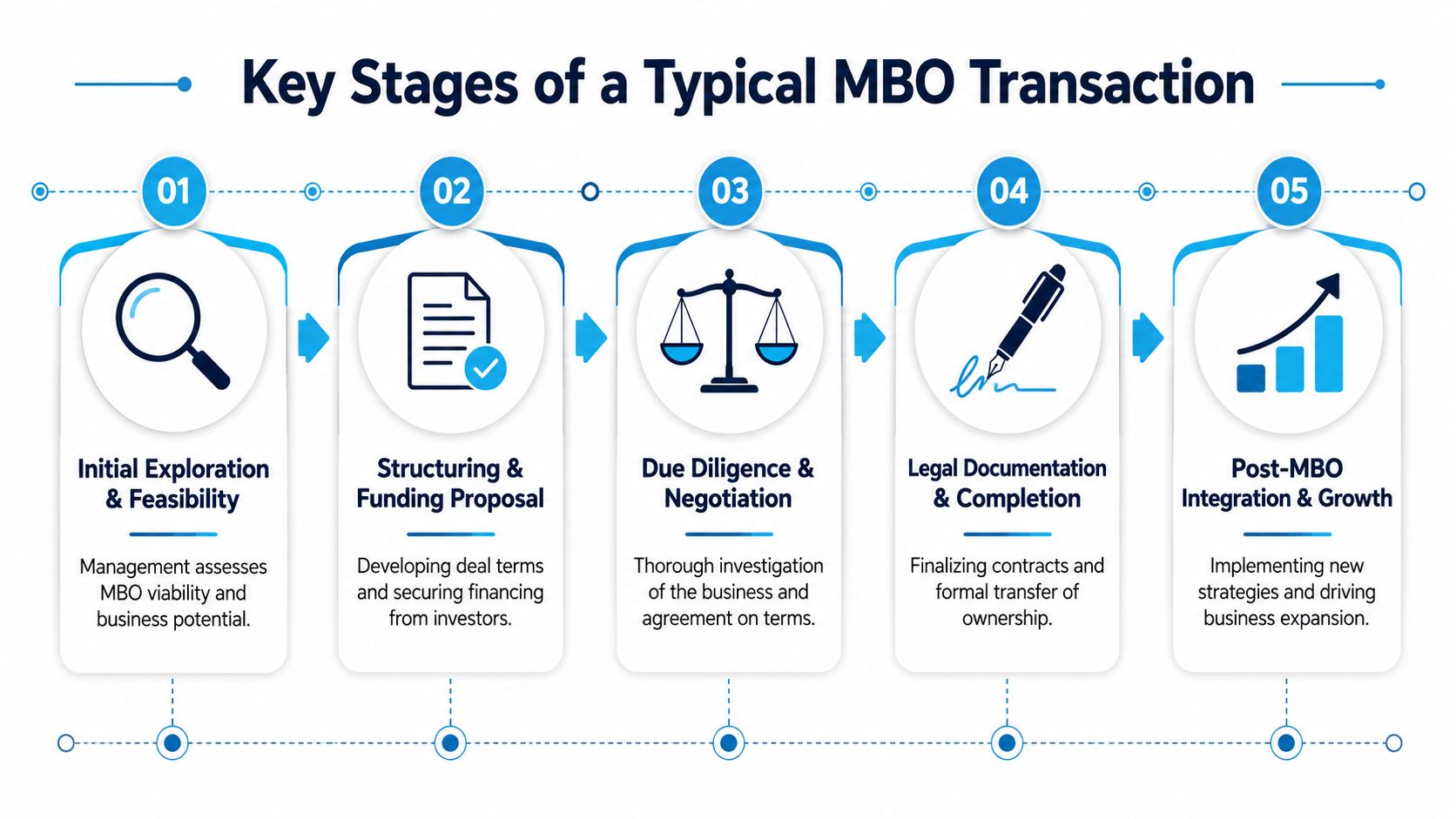
Initial exploration and feasibility
A common starting point is simple. The owner wants a succession route that protects the business, and the management team wants to know whether a buyout is realistic.
At this stage, the right question is whether the deal stands up commercially. Legal paperwork comes later.
A sensible first review covers four areas:
- Management credibility. Which individuals will lead after completion, and where are the gaps?
- Debt capacity. How much acquisition funding can the business carry without choking day-to-day cash flow?
- Seller reliance. Are customer relationships, pricing decisions, or operational know-how still sitting with the outgoing owner?
- Internal alignment. Do the proposed buyers agree on equity split, decision-making, and personal financial commitment?
This is also the point to deal with awkward issues directly. If one manager wants control and another expects parity, sort that out now. If the seller still approves every key commercial decision, build a handover plan before talking about price.
Deal structure and buyer readiness
Once the broad idea looks workable, attention shifts to building a structure the seller, the funders, and the management team can all live with.
That usually means deciding who is buying, how the acquisition vehicle will be set up, what the ownership split looks like, how board control will work, and whether part of the price needs to be deferred. For smaller UK businesses, this stage often exposes key pressure points. The management team may be operationally strong but thin on personal capital. The seller may want a clean exit, while the numbers only support a phased payment structure.
Preparation matters here. Weak monthly accounts, vague forecasts, and unclear roles make the proposal harder to support. The same applies when the team presents ambition without explaining how the business will manage debt, working capital, and leadership after the owner steps back. If you are preparing the buyer case, it helps to review what funders typically expect in business acquisition financing discussions.
Management teams pitching for lender or investor support also benefit from clear presentation discipline. Even where the capital source is not venture funding, the same communication principles behind VC pitch deck best practices can improve how the case is presented.
Heads of terms and exclusivity
Once the parties are serious, they usually record the main commercial points in heads of terms.
This stage matters more than many SME buyers expect. If the headline terms are loose, the deal often becomes harder and more expensive later.
Heads of terms should cover the proposed price, how and when it will be paid, what is subject to diligence, whether there will be an exclusivity period, and what role the seller will play after completion if any transition support is expected. Clarity on deferred consideration is especially important. A seller may see it as low-risk future payment. A buyer may be relying on performance conditions or a longer timetable.
Short and precise beats detailed and fuzzy.
If a point is unresolved, leave it marked as unresolved. Papering over open issues at this stage usually leads to dispute once advisers and funders test the detail.
Due diligence and negotiation
Due diligence is where the transaction stops being a plan and starts being evidence-based.
For management teams buying the company they already work in, this stage can feel frustrating. They know the business well, but internal familiarity is not a substitute for proper review. Funders and legal advisers will still want to test earnings quality, contracts, tax exposure, working capital patterns, employee matters, and any liabilities that sit below the surface.
The practical objective is simple. Confirm what is being bought and decide what should happen if the facts differ from the original assumptions.
Typical outcomes include:
- a price reduction
- revised debt levels
- tighter warranty protection
- more deferred consideration
- a different handover arrangement with the seller
Good diligence does not slow a good deal for the sake of it. It gives the buyer a chance to correct the structure before those risks become their problem.
Legal completion and the first 100 days
Completion transfers ownership, puts the funding in place, and makes the legal documents binding.
Commercially, the harder work often starts the next morning.
In the first phase after completion, management has to run the business under a new set of pressures. Staff want reassurance. Customers want continuity. Lenders want reporting on time. Suppliers may test the new leadership. If the deal included deferred payments or performance conditions, every trading decision now sits in a more exposed environment.
For owner-managed SMEs, the first 100 days usually come down to discipline. Set authority levels early. Tighten cash reporting. Confirm who owns key customer relationships. Keep communication simple and consistent. A buyout should create stability, not uncertainty.
The best MBO processes keep one commercial principle in view from start to finish. The structure has to work after completion, not just on signing day.
Funding the Buyout Your Main Options
A typical SME management team gets to this stage with a workable deal in principle, then hits a critical constraint. The seller wants a clean price, the bank wants comfort on cash flow, and management wants to keep enough ownership for the effort to be worthwhile. Funding decides whether those aims can sit together.
For most UK businesses in the £1m to £15m turnover range, the answer is not one pot of money. It is a structure made up of debt, management cash, deferred consideration, and sometimes outside equity. The right mix is the one the business can carry after completion without starving working capital or forcing short-term decisions that damage performance.
Debt financing
Senior debt is often the starting point because it is usually cheaper than equity and it lets management keep more of the upside if the business performs well. In the right company, that is sensible.
It also creates a fixed burden from day one.
Lenders are not funding the story alone. They are funding cash generation, asset cover, and the management team's ability to report reliably. A business with recurring revenue, stable gross margins, and predictable working capital is far easier to fund with debt than one that has lumpy projects, customer concentration, or seasonal cash dips.
The practical questions are straightforward:
- Can the business service repayments from normal trading? Base this on realistic numbers, not the best year in the accounts.
- How much headroom is left after debt service? If the answer is "not much", the structure is too tight.
- What security and reporting will the lender require? Charges over assets, covenant testing, and monthly information packs all affect how the business is run.
- What happens if profit slips or stock builds? A good structure survives a difficult quarter.
Many owner-managed companies underestimate the working capital squeeze that follows an MBO. Fees, refinancing costs, and a more formal reporting cycle all consume cash. If the debt package only works in a steady month, it is the wrong package. Businesses weighing these issues can review acquisition funding structures for management buyouts and wider deal scenarios.
Private equity or other external equity
External equity fills the gap when debt and management funds do not cover the full purchase price. It can also help where the plan is bigger than a straightforward ownership change. Expansion, follow-on acquisitions, stronger governance, and a clearer route to a future exit are all reasons to bring in an investor.
The cost is dilution, and often a different decision-making dynamic.
That trade-off is not theoretical. It affects board control, reporting discipline, dividend policy, and the pace at which the business is expected to grow. For some management teams, that is a fair exchange if it gets the transaction done on sensible terms. For others, it creates pressure that does not fit the business.
Preparation matters here. Equity backers will test whether management can explain the market, the growth plan, the funding ask, and the risks with discipline. Many of the same presentation principles used in VC pitch deck best practices are relevant, especially around use of funds, credibility of forecasts, and why this team is the right buyer.
Seller financing and deferred consideration
Seller finance is common in SME buyouts because it solves a practical problem. The price the seller wants and the price the funders will support are often not the same number.
Deferred consideration can bridge that gap, but only if the terms are realistic. Management needs enough cash left in the business to operate properly. The seller needs confidence that the unpaid element will be paid. Poorly structured deferrals create friction quickly, especially if repayments start before the business has settled under new ownership.
Key points to agree early include:
- Repayment timing
- Whether interest applies
- What happens if trading underperforms
- Whether the seller keeps any security
- How disputes over earn-out style mechanics are handled
In the right deal, seller finance aligns interests and helps both sides get to completion. In the wrong deal, it leaves the seller exposed and management boxed in.
Comparing the trade-offs
| Funding route | Main strength | Main drawback | Best fit |
|---|---|---|---|
| Debt | Keeps more equity with management | Adds fixed cash pressure and lender control | Stable, cash-generative businesses |
| External equity | Covers larger funding gaps and can support growth | Dilutes ownership and introduces investor oversight | Larger or more ambitious buyouts |
| Seller finance | Bridges pricing gaps at completion | Extends the seller's financial exposure | Deals with trust, visibility on cash flow, and clear terms |
In practice, most MBOs use a blend. Management cash shows commitment. Debt provides core funding. Seller deferral closes the gap. External equity appears where the deal is too large or the growth plan needs more capital.
The next step is usually to model three cases before speaking to funders or the seller again. Base case, downside case, and a stressed working capital case. If the structure only works in the base case, it needs adjusting. That discipline saves a lot of time and avoids agreeing a headline price the funding cannot support.
Valuation and UK Tax Considerations
Price and tax usually decide whether an MBO feels attractive or frustrating. A deal can look sensible strategically and still fail because the valuation is unrealistic or the tax position is left too late.
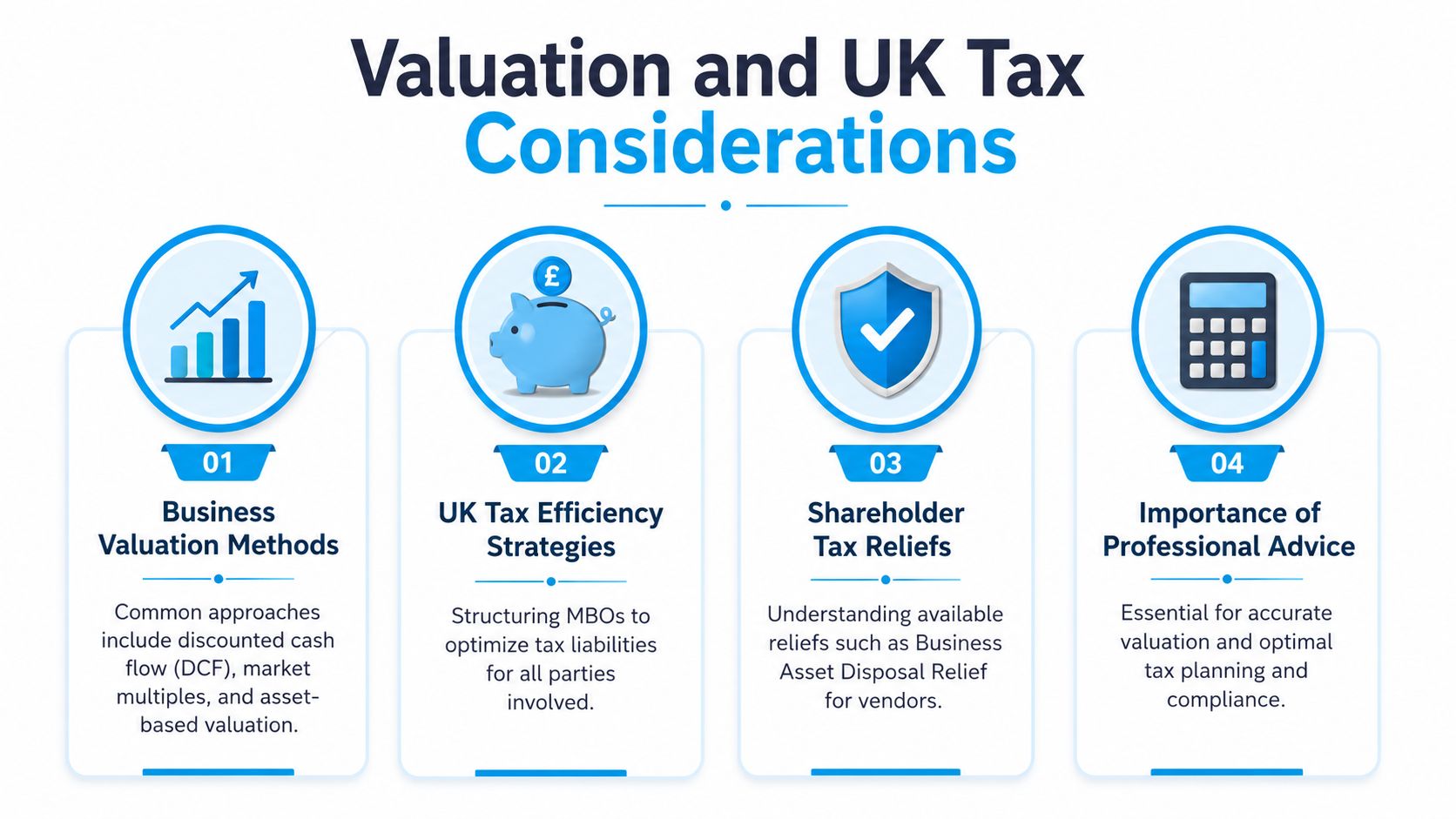
How the business is usually valued
For owner-managed businesses, valuation often starts with maintainable earnings, future cash generation, market comparables, and any business-specific strengths or weaknesses. In practical terms, buyers and sellers tend to focus on a view of earnings that reflects normal trading rather than a flattering or distressed version of the numbers.
That means testing questions like these:
- Are profits repeatable, or were they helped by one-off contracts or exceptional timing?
- Does the business rely heavily on the owner, which would reduce value after exit?
- Is working capital normal, or will extra cash be needed after completion?
- Are forecasts credible, or are they being used to justify a price the current business doesn't support?
An MBO valuation shouldn't be a loyalty discount for management, and it shouldn't be a seller's retirement target dressed up as market value. It needs to be supportable.
A deal usually becomes easier once both sides accept that value is what the business can justify commercially, not what either side hopes it might be worth.
For management teams, overpaying is the obvious danger. For sellers, pushing too hard on price can backfire if it forces a funding structure the company can't sustain. That can put deferred consideration at risk and damage the handover.
Where an independent view is needed, formal business valuation support can help anchor negotiations and reduce the chance of late-stage re-trading.
UK tax points that often matter
Tax treatment depends heavily on the structure of the transaction and the circumstances of the parties involved. That said, several issues commonly come up in UK MBOs.
For the seller, one of the first questions is whether Business Asset Disposal Relief may be available. That can affect the Capital Gains Tax outcome on a sale of shares, but eligibility depends on the facts and should be reviewed carefully before terms are fixed.
For the buying team, tax planning often turns on how the acquisition vehicle is structured, how management invests, and whether any part of the funding creates personal tax exposure or future extraction issues.
Common areas to review include:
- Share sale versus other structures and the tax consequences of each
- Use of a NewCo to acquire the target business
- Management equity design so ownership and future value are aligned sensibly
- Loan arrangements where management borrows personally or injects funds into the acquisition structure
- Post-deal remuneration and extraction, especially once debt servicing and Corporation Tax are both in play
What works and what doesn't
What usually works is early tax planning tied to the commercial design of the deal. What doesn't work is agreeing the headline terms first and expecting advisers to make the tax efficient afterwards.
That's particularly important in the 2026/27 tax year, where business owners and management teams need current advice rather than recycled assumptions from older transactions. A structure that looks neat on paper can create unnecessary friction if the tax, legal, and funding pieces weren't aligned from the start.
Common MBO Pitfalls and How to Avoid Them
Most failed MBOs don't collapse because the idea was poor. They collapse because the commercial weak spots were ignored until they became expensive.
The common mistakes
Some issues show up again and again:
- Overpaying for the business. Management wants to get the deal done and agrees to a price the company then struggles to support.
- Backing the wrong team. A good operational manager isn't always ready to become an owner with strategic, financial, and governance responsibility.
- Using the wrong funding mix. Too much debt can choke the business. Too much outside equity can leave management feeling like minority operators.
- Weak due diligence. Historic issues in contracts, tax, systems, or working capital don't disappear because the buyers already know the business.
- No plan for day one after completion. The deal closes, but reporting lines, customer messaging, authority limits, and cash monitoring are still unclear.
The practical fixes
Each pitfall has a straightforward countermeasure:
- Insist on valuation discipline. A sensible deal at a fair price beats a stretched deal with constant pressure.
- Test the team rigorously. Fill gaps before completion if finance, sales leadership, or operational control is too concentrated.
- Match funding to trading reality. Structure debt around how the business converts profit into cash.
- Treat due diligence seriously. Internal knowledge helps, but independent review still matters.
- Prepare the transition. Ownership change affects behaviour from the first day, especially with staff and lenders watching closely.
The cheapest mistake to fix is the one identified before heads of terms are signed.
Preparing for an MBO Your Action Plan
A business doesn't become MBO-ready by accident. Preparation usually determines whether the transaction feels controlled or chaotic.
For owners and management teams considering the route, the practical checklist is fairly consistent.
What to get ready now
- Tidy the financial records. Statutory Accounts, management accounts, forecasts, tax filings, and core reconciliations should all be current and internally consistent.
- Strengthen monthly reporting. Buyers and funders need clear visibility on margin, cash, working capital, and trading trends.
- Build a wider leadership bench. If too much sits with one person, the deal becomes fragile.
- Create a believable medium-term plan. The story needs to show how the business will trade after the buyout, not just why the acquisition is desirable.
- Identify owner dependencies early. Customer ties, pricing authority, or supplier influence may need a handover period rather than an abrupt exit.
When to bring in advisers
The best time to get advice is before expectations harden. Once price assumptions, ownership promises, and funding hopes become emotionally fixed, it gets much harder to shape a sensible structure.
Professional support is usually most valuable when it helps answer four questions early. Is the deal fundable? Is the valuation defendable? Is the tax position workable? Is the team ready?
That input isn't an administrative cost. It's part of protecting deal value and reducing the chance of a bruising process that consumes management attention and still fails to complete.
Management Buyout FAQs
What is a management buyout in simple terms?
A management buyout is when the people already running a company buy it from the current owner. The leadership team moves from managing the business on the owner's behalf to owning and controlling it themselves.
Is a management buyout a good exit route for a founder?
It can be. An MBO often suits founders who want continuity, a more discreet process, and a buyer who already understands the company. It may be less suitable where the owner is still central to sales, delivery, or key customer relationships.
How do management teams pay for an MBO?
They usually use a combination of funding sources rather than one single pot of money. That might include bank or other debt, their own investment, outside equity, and deferred payments to the seller.
How long does a management buyout take?
It depends on funding complexity, valuation alignment, diligence issues, and how prepared the business is. A clean, well-organised company with aligned parties will usually move faster than one with disputed pricing or weak financial reporting.
Can a management buyout be tax efficient?
Potentially, yes. But tax efficiency depends on the deal structure and the circumstances of the seller and buyers. Reliefs and planning opportunities should be reviewed before the commercial terms are locked in, not as an afterthought.
If an MBO is on the table, the next step is to test whether the deal is commercially workable before time and momentum are wasted. striveX Ltd helps UK businesses with valuation thinking, tax planning, financial due diligence, and transaction-ready reporting so owners and management teams can make clear decisions early. Book a conversation through the contact page or book a consultation to discuss the options and likely pressure points.
This article is for informational purposes only and does not constitute professional advice. Tax rules apply as of April 2026. Consult a qualified accountant for your specific circumstances.
